Typha sp.
cattail
Also published as: Typha lesquereuxi Cockerell 1906 (FOBU fossil list)
This entry was compiled from research notes and has not yet been reviewed by a person. Its facts come from the sources listed below, which are the authority if anything here disagrees with them.
A cattail with a long, slim seed head
- How big
- Seed head 18 cm (7 in); plant probably door-high, about 2 m (6.5 ft)
- Where it grew
- Standing in shallow water right along the lake's edge
- Relatives today
- Living cattails of shallow water, like the broad-leaved cattail
- Fossils found
- One complete seed head and stems from shore rocks; no leaf described
Like living cattails, it probably formed a thick fringe of tall, flat, ribbon-like leaves in the shallow water at the lake's edge. Its slim seed heads stood on straight stalks, each topped by a thin, bare spike where the pollen-making flowers had already fallen off.
Fun fact Fossil Lake's best-known cattail head was found in rock that formed in the deep, quiet middle of the lake, so it must have drifted out from the shore before it sank.
The science
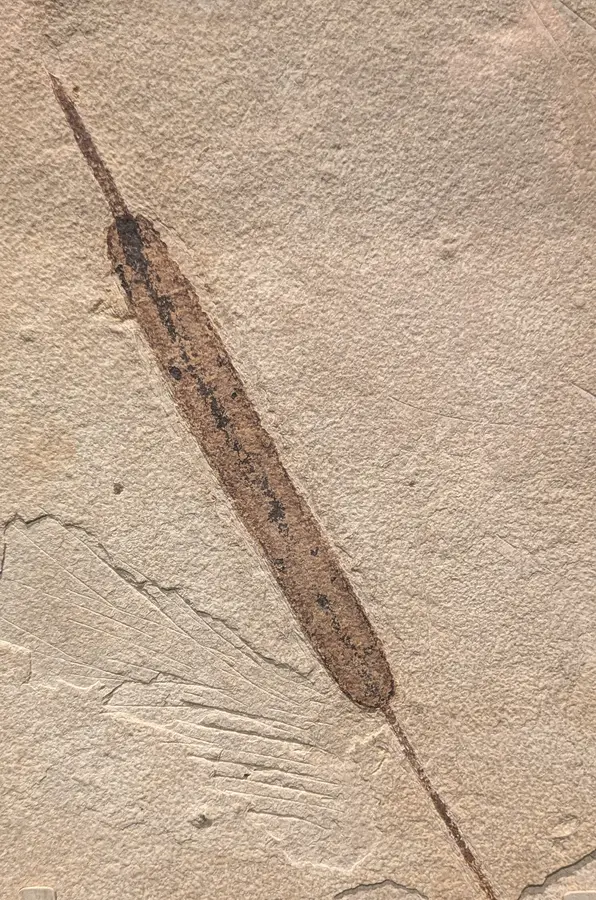
fruiting head FMNH PP 33654 from Fossil Lake (locality F-1) on exhibit at the Field Museum; the source photo's title calls it the only cattail fossil but it is not
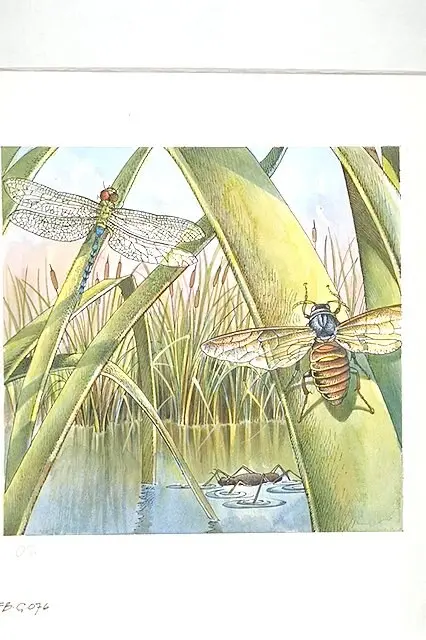
cattail leaves with March fly, dragonfly and water strider; NPGallery: "Government owns art and all reproduction rights"; 01/01/1990 - 12/30/1990; Image_Size=8" x 9-1/4"; Count:8/19; Exhibit 10/Graphic # FB-G-076(10)
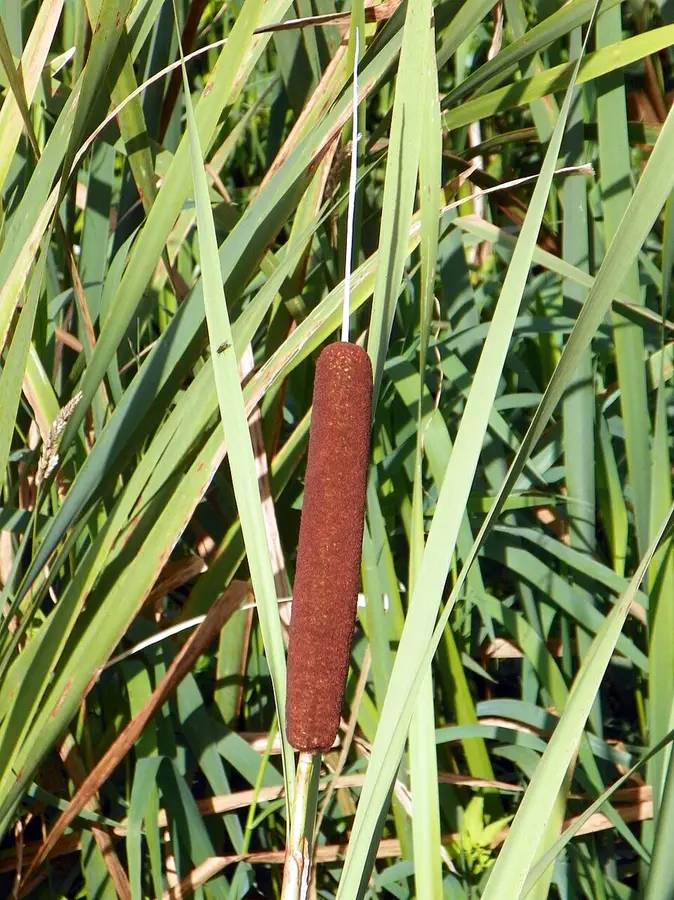
modern analog: Typha latifolia; catalog modern_analog: "Typha latifolia / Typha domingensis"
3D models
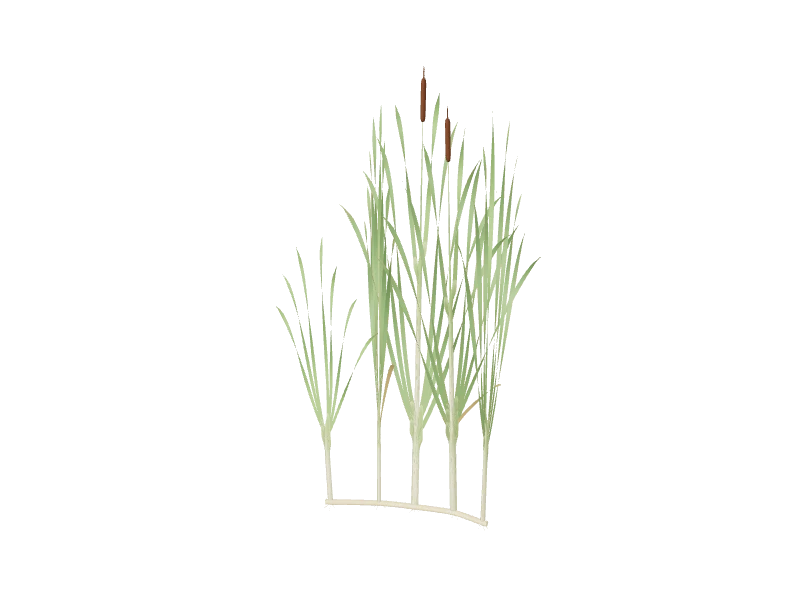
Built from a cited dossier (the Fossil Lake fruiting head FMNH PP 33654, figured by Grande 1984, and floras of the living broad-leaved cattail Typha latifolia) and chosen unanimously by blind review over a competing model (96.4 vs 94.4). Shown as one clump of five shoots on a rhizome, standing in 0.3 m of water and rising 1.7 m above it. The fruiting head is documented from the fossil: a slim brown cylinder 18 cm long and only about 2 cm thick, with a bare male spike rising directly from its top. The name T. lesquereuxi comes from the monument's fossil list; Grande and the Field Museum treat this head as an undescribed species of Typha. No Fossil Lake cattail leaf has been described, so the flat, two-ranked leaves, the height, the number of shoots, the rhizome and all colours are inferred from T. latifolia.
same genus: Cattail (Typha)
same genus: Cattail plant
same genus: Cattails
- Group
- Monocots
- Form
- cattail (emergent herb)
- Known from
- fruiting head (18 cm); stems; leaves
- Habitat
- emergent shoreline: shallow nearshore water
- Abundance
- figured from F-1 and found in lower-unit littoral carbonates; on display at FOBU
- Modern relative
- Typha latifolia / Typha domingensis
- Occurrence
- Fossil Lake: F-1 (FMNH PP33654) and lower-unit littoral facies; FOBU list; Lake Uinta (Parachute Creek Mbr)
- Notes
- Pollen of 'Typha sp. or Sparganium sp.' type also occurs in the FBM (Cushman 1983). Grande (1984) and Biaggi (1989) report the Fossil Lake cattail only as Typha sp.; the species name comes from the FOBU list (Graham 2012). Authority per Wikipedia list (unverified). The Field Museum calls the F-1 head (FMNH PP 33654) 'an undescribed species of cattail'; T. lesquereuxi was named for leaves from Florissant and has not been compared with the Fossil Lake head (models/species/typha-lesquereuxi/dossier.md).
Sources
- Grande, L. 1984. Paleontology of the Green River Formation, with a review of the fish fauna (2nd ed.). Geological Survey of Wyoming Bulletin 63, 333 p., p.262; fig. V.6 p.265 ↗
- Biaggi, R.E. 1989. Paleogeography and Paleoenvironments of the Lower Unit, Fossil Butte Member, Eocene Green River Formation, Southwestern Wyoming. MS thesis, Loma Linda University., pp.53,73 ↗
- Graham, J.P. 2012. Fossil Butte National Monument: geologic resources inventory report. Natural Resource Report NPS/NRSS/GRD/NRR—2012/587. National Park Service, Fort Collins, CO., Table 1 ↗
- National Park Service, Fossil Butte National Monument 2025. Fossil Plant Species. nps.gov/fobu, last updated September 26, 2025; accessed 2026-10-05. ↗
- Grande, L. 1984. Paleontology of the Green River Formation, with a review of the fish fauna (2nd ed.). Geological Survey of Wyoming Bulletin 63, 333 p., Table V.1 ↗