Sabalites sp.
fan palm
Also published as: Palmites sp. (NPS label for FOBU 446; Palmites Hector 1880 is a nomen nudum)
This entry was compiled from research notes and has not yet been reviewed by a person. Its facts come from the sources listed below, which are the authority if anything here disagrees with them.
Palms once grew beside this lake in Wyoming
- How big
- Leaves about 2 m (6.5 ft) long, as long as a door is tall
- Where it grew
- Probably on sandy ground close to the lake's edge
- Relatives today
- Probably fan palms, like the cabbage palm of riverbanks and dunes
- Fossils found
- Many big, complete leaves, but no trunk has been found with them
Its leaves were giant pleated fans, wider than they were long, each made of about 55 folded strips on a smooth stalk with no spines. They probably grew in a round green crown, like those of living fan palms. No trunk has been found, so the model's height of 8 m (26 ft), as tall as a two-storey house, is a careful guess, and the real palm may have been shorter.
Fun fact Palms are clues to old weather. Finding them here tells scientists that the coldest month at Fossil Lake probably averaged above about 5 °C (41 °F).
The science
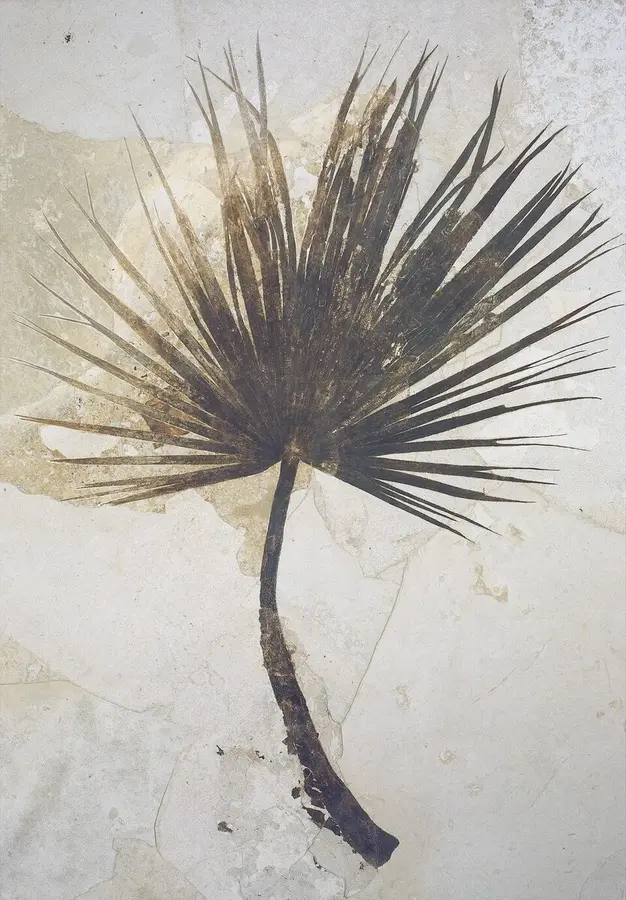
FOBU446
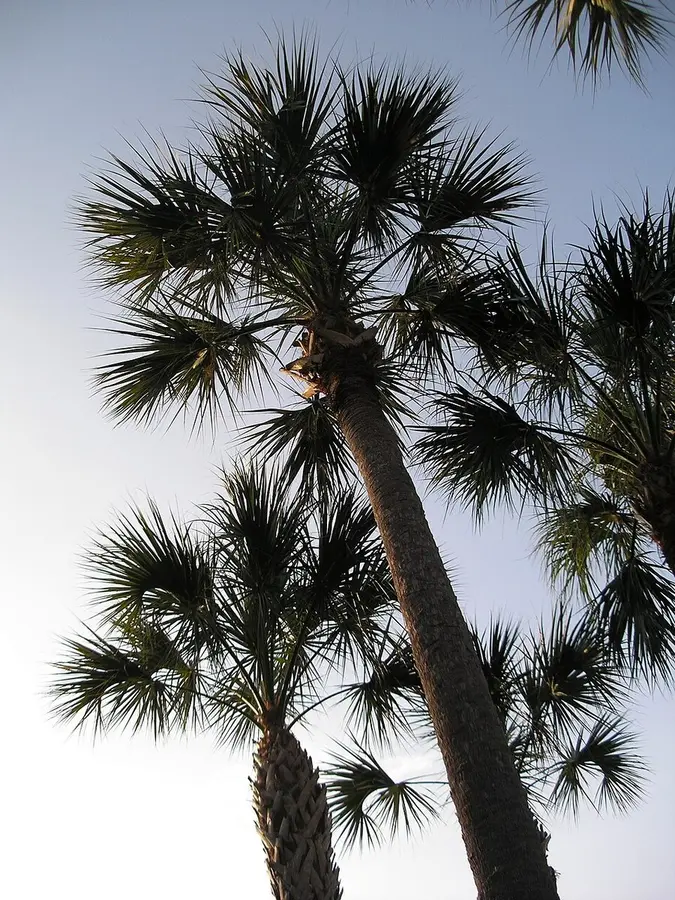
modern analog: Sabal; catalog modern_analog: "Sabal / Livistona / Washingtonia-type fan palms (use 2-3 forms)"
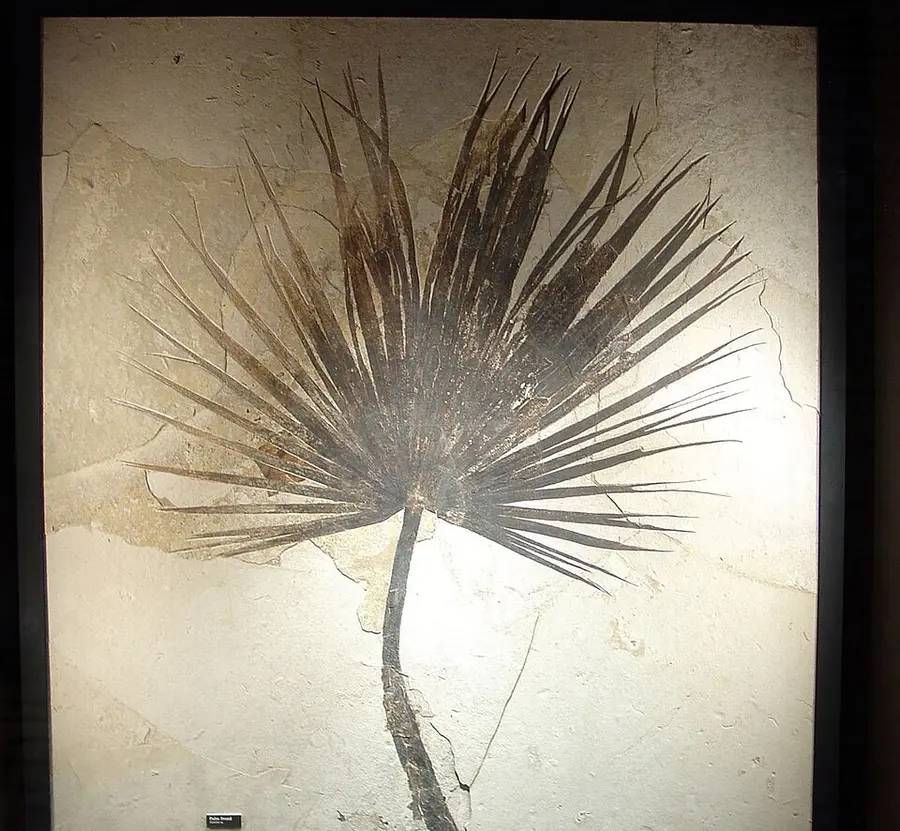
on display at Fossil Butte visitor center; Commons gives no individual photographer (source: USGS 3D Parks page / NPS photo gallery)
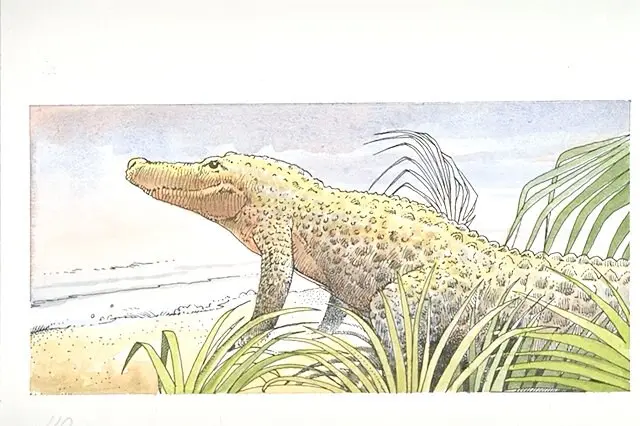
crocodilian on lake bank with Sabalites palms; NPGallery: "Government owns art and all reproduction rights"; 01/01/1990 - 12/30/1990; Image_Size=8-7/16" x 6-1/2"; Count:11/19; Exhibit 13/Graphic # FB-G-110(13)
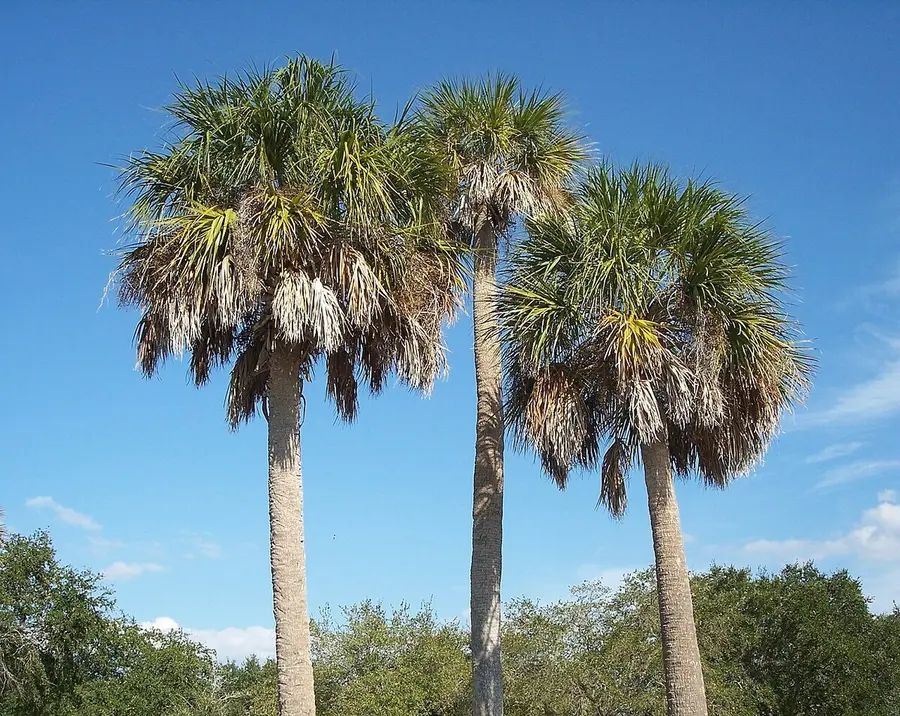
modern analog: Sabal palmetto; catalog modern_analog: "Sabal palmetto / Sabal mexicana"
PhyloPic silhouette; depicts Sabal palmetto (stand-in for Sabalites sp.)
3D models
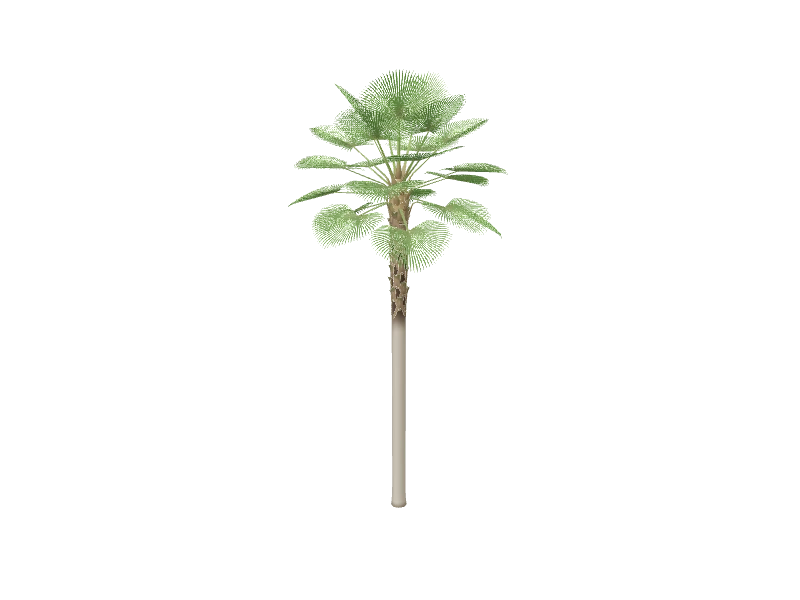
Built from a cited dossier (Fossil Lake palm fronds FOBU 446, FMNH PP 53399 and Grande 1984 fig. V.5, and Zona's 1990 monograph of Sabal) and chosen by blind review over a competing model (94.9 vs 93.1). Shown as one palm 8 m tall. The leaf is documented from Fossil Lake fossils: a fan wider than long, about 0.9 m, of some 55 folded segments with only a short costa, on a smooth, unarmed petiole about 1.1 m long that widens into a split, fibrous base. No trunk, crown or flower has been found with these leaves, so the single trunk, its height, the 22-leaf crown and the old leaf bases on the trunk are reconstructed from the living cabbage palm Sabal palmetto. The only upright Green River palm stems, from the shore of Lake Gosiute, were short, so this palm may have been smaller. No inflorescences are shown because none can be tied to it, and the green colour is inferred from living fan palms.
family (fossil): Palm leaf fossil
same subfamily (Coryphoideae): Chinese fan palm Livistona chinensis
same tribe-level analog (Sabal): Dwarf palmetto Sabal minor
Sabal: Sabal palm, photogrammetry
Sabal: Palmetto tree trunk
- Group
- Monocots
- Form
- fan palm (costapalmate leaves), tree (several species likely)
- Known from
- leaf (fronds to about 2 m)
- Habitat
- lake-margin forest on sandier soils; shoreline
- Abundance
- common (palm fronds and inflorescences are 'common fossil specimens from the FBM'); 5 palm items among 3471 research-quarry finds
- Modern relative
- Sabal palmetto / Sabal mexicana
- Occurrence
- Fossil Lake: F-1 18-inch layer (about 2 m frond); upper unit blue oil shale (Loewen & Buchheim 1998); FOBU list; FOBU 446 frond (catalogued by NPS as Palmites sp.)
- Notes
- 'No FBM palm species have been described as of yet' (NPS). McGrew & Casilliano (1975): palms grew in the sandier soils. NPS: variation in morphology suggests several palm species; large complete fronds suggest palms grew near the shore. Palm flowers and inflorescences also occur (e.g. FOBU 847, 848) but have not been linked to these leaves; Allen (2015) relates Green River palm flowers to Phoenix. The NPS 'Palmites sp.' (FOBU 446) is the same specimen as the visitor-centre 'Sabalites sp.' (models/species/sabalites-sp/dossier.md).
Sources
- Grande, L. 1984. Paleontology of the Green River Formation, with a review of the fish fauna (2nd ed.). Geological Survey of Wyoming Bulletin 63, 333 p., p.262; fig. V.5 p.264 ↗
- National Park Service, Fossil Butte National Monument 2025. Fossil Plant Species. nps.gov/fobu, last updated September 26, 2025; accessed 2026-10-05. ↗
- Loewen, M.A. & Buchheim, H.P. 1998. Paleontology and paleoecology of the culminating phase of Eocene Fossil Lake, Fossil Butte National Monument, Wyoming. Same volume (Santucci, V.L., & McClelland, L. (eds.), National Park Service Paleontological Research [v. 3], Technical Report NPS/NRGRD/GRDTR-98/01), p. 73–80. ↗
- Graham, J.P. 2012. Fossil Butte National Monument: geologic resources inventory report. Natural Resource Report NPS/NRSS/GRD/NRR—2012/587. National Park Service, Fort Collins, CO., Table 1 ↗
- McGrew, P.O. & Casilliano, M. 1975. The Geologic History of Fossil Butte National Monument and Fossil Basin. National Park Service Occasional Paper 3., p.19 ↗
- National Park Service, Fossil Butte National Monument 2023. Fossil Butte Research Quarry Data: Data 1998–2020, Missing 2018. nps.gov/fobu, specimen and abundance CSV files, page last updated October 26, 2023; accessed 2026-10-05. ↗
- Graham 2012 FOBU Geologic Resources Inventory Table 1 (as Palmites sp.)