Rhus nigricans
Also published as: Myrica nigricans
This entry was compiled from research notes and has not yet been reviewed by a person. Its facts come from the sources listed below, which are the authority if anything here disagrees with them.
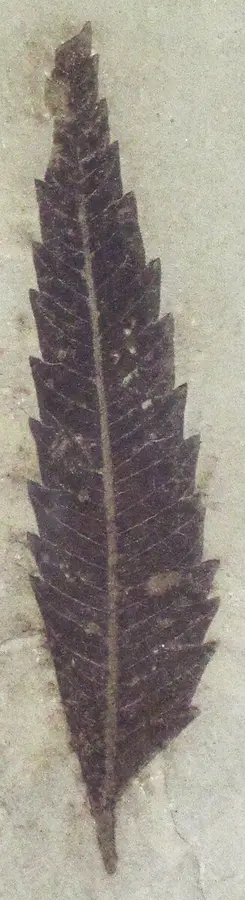
Utah (Lake Uinta), not Fossil Lake
3D models
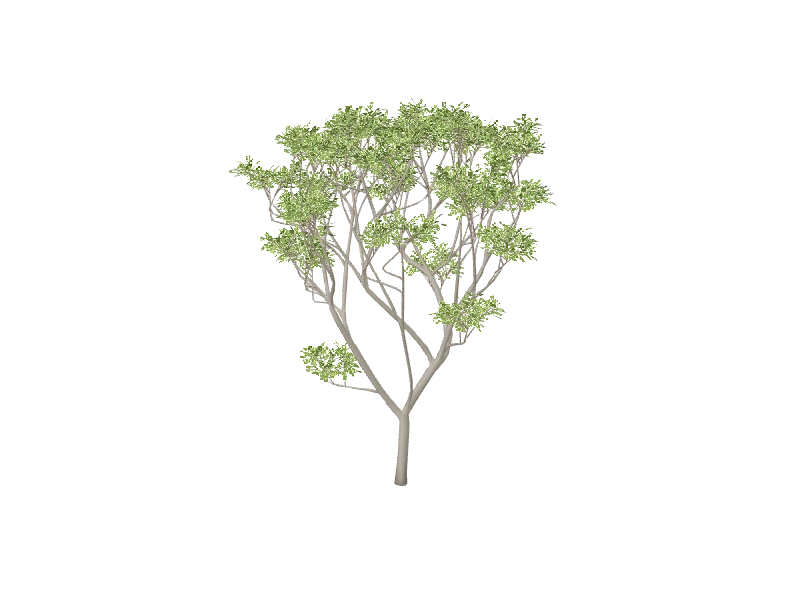
Built from a cited dossier (the complete leaf from the Roan Mountains of Colorado figured by Brown in 1934, the Fossil Lake leaf FOBU 47, leaflets from Little Mountain, Wyoming, and the living South American tree Loxopterygium) and chosen by blind review over a competing model (90.5 vs 87.4). Shown as one small tree 8 m tall in full leaf. The leaf is documented from Green River fossils: about 20 cm long, once divided into about 13 narrow, slightly sickle-shaped leaflets in opposite pairs, each with coarse, sharp, forward-pointing teeth and a short stalk formed by its narrowed base. Despite its name this plant is probably not a true sumac; its leaves place it in the cashew family, genus unknown. No wood, twig, flower or fruit is known with certainty, so the tree's size, low fork, flat-topped crown, bark and colours are reconstructed from Loxopterygium and related trees, and no fruit is shown.
- Group
- Eudicots
- Form
- sumac-like shrub or tree (Anacardiaceae)
- Known from
- leaf; fruits possibly Barkleya schinoloxus samaras (linked by co-occurrence only; Manchester & Judd 2022)
- Habitat
- lake-margin / floodplain forest
- Abundance
- third of the 8 most abundant species at Parachute Creek (Lake Uinta) localities (MacGinitie 1969 p.30, via Grande 1984 pp. 258, 261); 'a common element of the early to middle Eocene Green River flora' (Manchester & Judd 2022)
- Modern relative
- Loxopterygium (Brown 1929 p. 288; Manchester & Judd 2022); sumacs (Rhus typhina / Rhus glabra) only for leaflet comparison
- Occurrence
- Fossil Lake: FOBU 47, 18-inch layer, Grande's Locality E (Grande 1984 fig. V.16, as F-1; queried as '?Rhus nigricans' by Grande 2013, FMNH media caption, GBIF 1425197068); FOBU list; Lake Uinta (Parachute Creek Mbr); Lake Gosiute: type locality Green River, Wyoming (Knowlton 1923 p. 168) and Little Mountain, one of the three dominants (Wilf 2000 Table 3 p. 296); Laney Mbr per Wikipedia list
- Notes
- Generic placement in Rhus is doubtful (Wikipedia writes 'Rhus' nigricans). Basionym Myrica nigricans Lesquereux 1872 (Knowlton 1923 p. 168; PBDB; Wilf 2000 Table A3). Rhus copallinum is not a suitable analog: it has a winged rachis and mostly entire leaflets (Brown 1929 p. 288). No flowers are known. Manchester & Judd (2022) only 'speculate, on the basis of co-occurrence', that Barkleya samaras came from the same plant.
Sources
- Grande, L. 1984. Paleontology of the Green River Formation, with a review of the fish fauna (2nd ed.). Geological Survey of Wyoming Bulletin 63, 333 p., p.262; fig. V.16 p.268 ↗
- Graham, J.P. 2012. Fossil Butte National Monument: geologic resources inventory report. Natural Resource Report NPS/NRSS/GRD/NRR—2012/587. National Park Service, Fort Collins, CO., Table 1 ↗
- Grande, L. 1984. Paleontology of the Green River Formation, with a review of the fish fauna (2nd ed.). Geological Survey of Wyoming Bulletin 63, 333 p., Table V.1 ↗
- Manchester, S.R. & Judd, W.S. 2022. Extinct anacardiaceous samaras and sumac-like leaves from the Eocene of western North America. Int. J. Plant Sci. 183:357–366. ↗
- Knowlton, F.H. 1923. Revision of the flora of the Green River formation, with descriptions of new species. USGS Professional Paper 131-F, pp. 133–182., p.168 ↗
- Wilf, P. 2000. Late Paleocene–early Eocene climate changes in southwestern Wyoming: paleobotanical analysis. GSA Bulletin 112(2):292–307., Table 3 p.296 ↗
- Wilf, P. 2000. Late Paleocene–early Eocene climate changes in southwestern Wyoming: paleobotanical analysis. GSA Bulletin 112(2):292–307., Table A3 ↗
- Brown, R.W. 1929. Additions to the flora of the Green River formation. USGS Professional Paper 154-J., p.288 ↗
- Grande, L. 2013. The Lost World of Fossil Lake: Snapshots from Deep Time. Univ. Chicago Press, xi + 425 pp. (catalogue record; publisher says 432 pp.), 243 colour plates. ISBN 9780226922966 / ebook 9780226922980. ↗
- The Paleobiology Database. paleobiodb.org, data service v1.2; occurrences and taxonomic opinions pulled 2026-10-05., taxon 450195 ↗