Priscacara serrata
spiny perch
This entry was compiled from research notes and has not yet been reviewed by a person. Its facts come from the sources listed below, which are the authority if anything here disagrees with them.
A tall, spiny fish with a saw-edged cheek
- How big
- About 19 cm (7.5 in), as long as a pencil; up to 41 cm (16 in)
- What it ate
- Probably snails, insects and small shelled creatures; sometimes fish
- Where it lived
- Mostly mid-lake, sometimes near shore; it did not swim in schools
- Fossils found
- Common mid-lake, but a smaller look-alike outnumbers it over 3 to 1
Priscacara serrata had a tall, oval body, thick sharp spines and a cheek edged like a saw. Unlike its smaller look-alike, it did not travel in schools. Its spines may have kept bigger fish from swallowing it tail-first, though some Priscacara spines have turned up inside large hunting fish.
Fun fact Its jaw teeth were tiny, but deep in its throat it had heavy plates of flat, molar-like teeth, probably for crushing snail shells.
The science
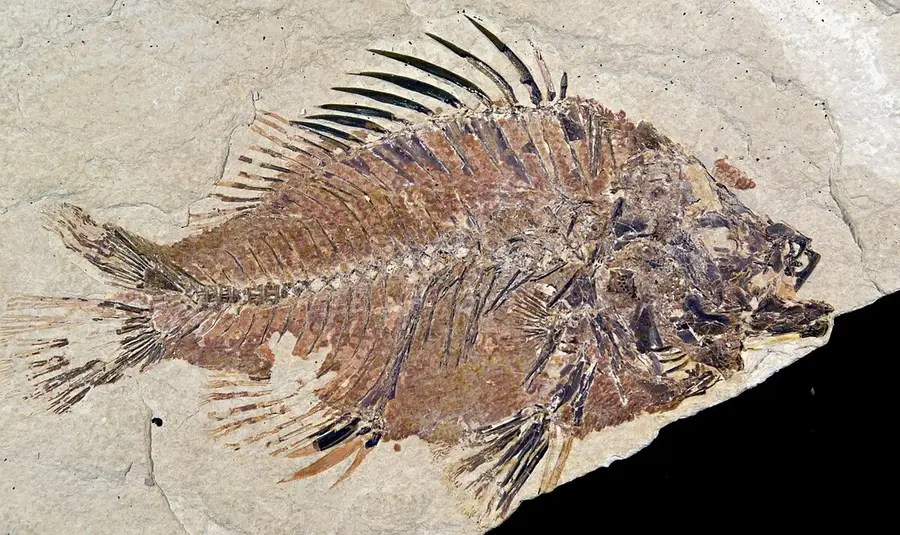
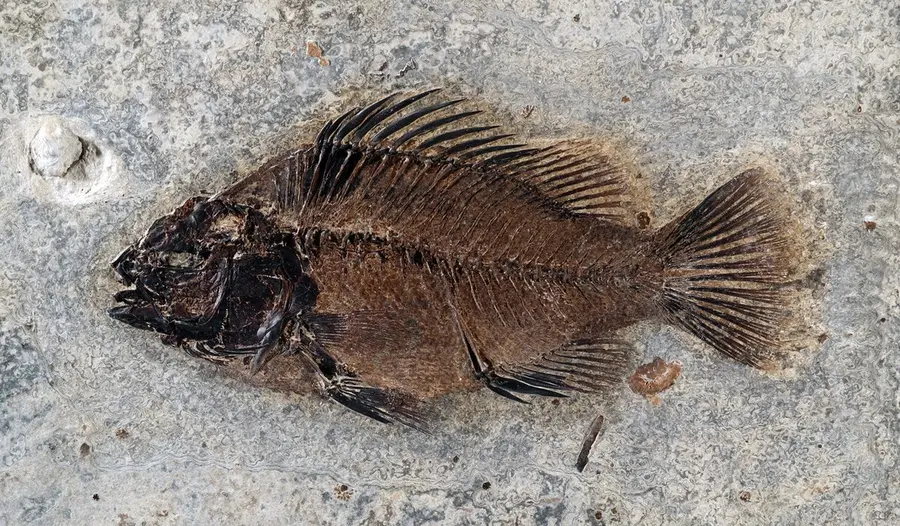
FOBU14318; alt text: A football-shaped fossil fish with prominent spines along the back and a fan-shaped tail.
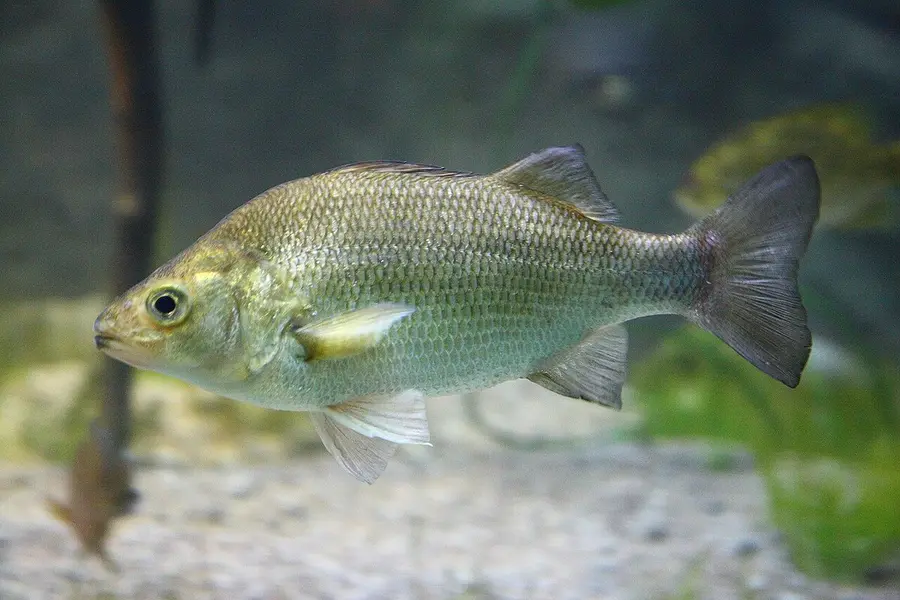
modern analog: Morone americana (White perch); catalog modern_analog: "Morone americana (white perch)"
PhyloPic silhouette; depicts Morone saxatilis (stand-in for Priscacara serrata)
3D models
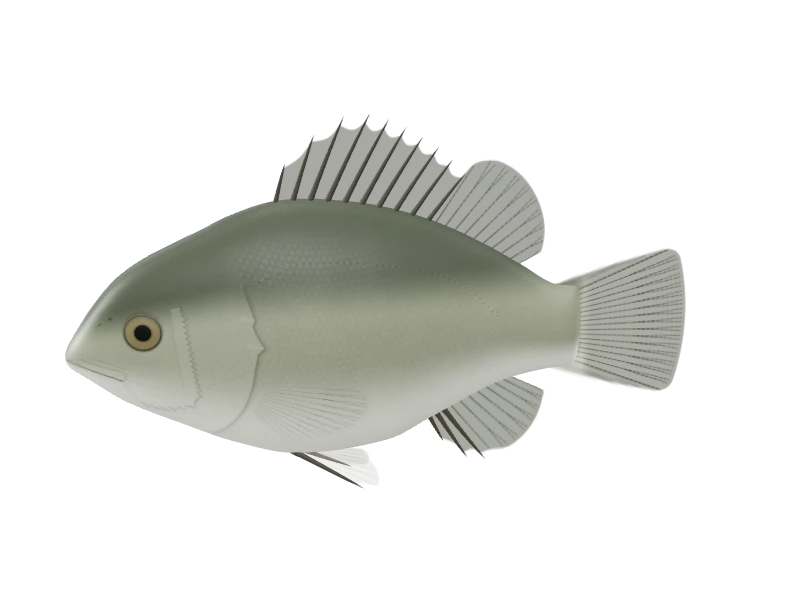
Built from a cited anatomical dossier (Cope 1884, Grande 1984 and five photographed fossils) and chosen unanimously by blind review over a competing model. Shown at 15 cm standard length. The deep body (about half as deep as long), the single dorsal fin of ten stout spines and about ten soft rays, the anal fin of three spines and about eight soft rays, the serrated preopercle, the stout pelvic spine and the nearly straight-edged tail are documented from fossils; the shorter soft fins, serrated gill cover and stouter spines distinguish it from Cockerellites liops. Eye size, body width and the course of the lateral line are inferred, and no colour is preserved, so plain countershading without stripes or bars is inferred from living temperate basses.
ecological/body-plan analog (percomorph): Bluegill Lepomis macrochirus
body-plan analog: Bluegill sunfish
body-plan analog: Black crappie Pomoxis nigromaculatus
body-plan analog: Flier Centrarchus macropterus
- Description
- Deep-bodied spiny 'sunfish' (temperate bass, Moronidae per NPS) with massive pharyngeal crushing teeth and a serrated preopercle
- Group
- Fish
- Size
- max ~38-41 cm TL
- Habitat
- mid-lake and nearshore; not a schooling fish
- Diet
- molluscs, arthropods/insects; some with fish in the stomach
- Abundance
- common (Priscacara spp. 20-30% of mid-lake samples, ~0.3-2% nearshore)
- Modern relative
- Morone americana (white perch)
- NPS quarry
- 3 specimens, 1998–2020 (Logged as "Priscacara")
- Notes
- G13 figures a 'monstrously large' 414 mm individual. Family placement varies: Priscacaridae (G84; PBDB) / Moronidae (NPS; S12).
Sources
- Grande, L. 1984. Paleontology of the Green River Formation, with a review of the fish fauna (2nd ed.). Geological Survey of Wyoming Bulletin 63, 333 p., p.150 ↗
- Grande, L. 2013. The Lost World of Fossil Lake: Snapshots from Deep Time. Univ. Chicago Press, xi + 425 pp. (catalogue record; publisher says 432 pp.), 243 colour plates. ISBN 9780226922966 / ebook 9780226922980., fig.89 ↗
- National Park Service, Fossil Butte National Monument 2025. Fossil Fish Species. nps.gov/fobu, last updated November 18, 2025; accessed 2026-10-05. ↗
- Finger, T.R. 1998. A comparison of fish community structure among several paleoenvironments of Eocene Fossil Lake, Wyoming: a preliminary report. In Santucci, V.L. & McClelland, L. (eds.) 1998, National Park Service Paleontological Research [vol. 3], NPS/NRGRD/GRDTR-98/01, p. 81ff. ↗