Presbyornis pervetus
Also published as: Nautilornis avus; Nautilornis proavitus; Presbyornis sp.
This entry was compiled from research notes and has not yet been reviewed by a person. Its facts come from the sources listed below, which are the authority if anything here disagrees with them.
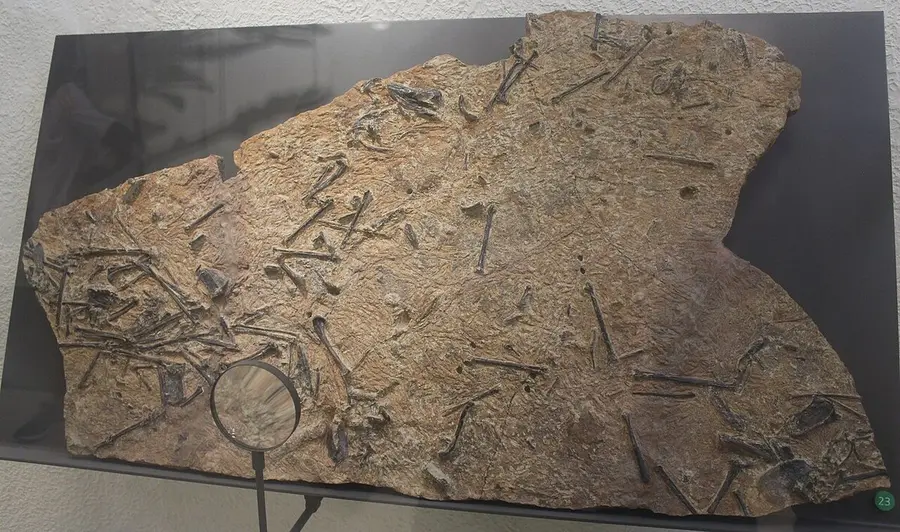
Presbyornis pervetus assemblage AMNH 28505; probably Lake Gosiute material (Canyon Creek Butte), not Fossil Lake
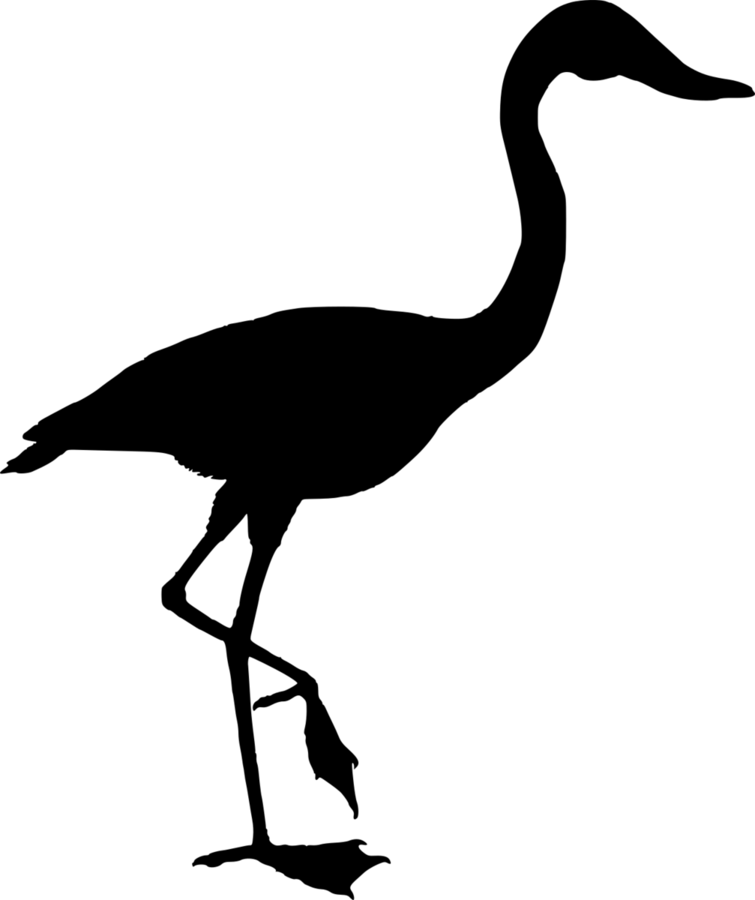
PhyloPic silhouette; depicts Presbyornis pervetus
3D models
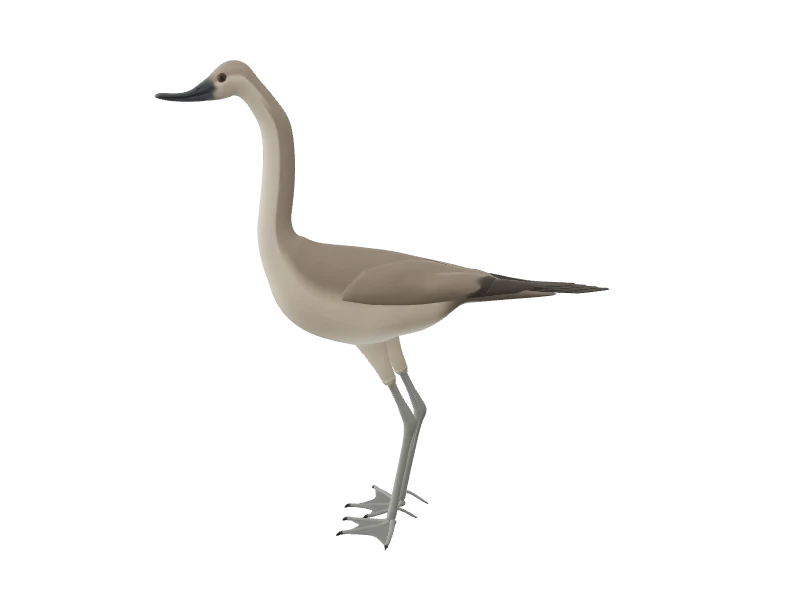
Built from a cited dossier (some 3,900 bones of at least 66 adults from a Fossil Lake shoreline bonebed, a skull from Lake Gosiute, and living waterfowl such as the magpie goose and screamers) and chosen by blind review over a competing model (94.6 vs 91.6). Shown as one adult standing on a lime-mud flat, about 0.46 m tall. The skeleton is documented from fossils: a duck-like head with a long, broad, flat bill ending in a small nail, on a long neck, a compact body, long wings and very long legs. At Fossil Lake it is known from nesting colonies with eggshell along the shore early and late in the lake's history; it has not been found in the middle-unit fish beds. No feathers or neck vertebrae are preserved, so the neck length, the webbed feet, the plumage and its plain grey-brown colours are reconstructed from living relatives.
order (Anseriformes): Common shelduck
- Description
- Duck-headed, long-legged shorebird-like waterfowl (Presbyornithidae)
- Group
- Bird
- Size
- skull 85 mm (81-91 mm, n=6) at Fossil Lake (Powerline quarry); about 90 mm at other North American sites
- Habitat
- shoreline mudflats; nesting colonies
- Diet
- filter-feeding on invertebrates (inferred)
- Abundance
- abundant in the shoreline deposits surrounding the lake (nesting and mass-death sites); unknown from the fish-bed shales
- Modern relative
- Anas head on a large thick-knee (Burhinus) body with longer wings (composite)
- Occurrence
- nesting sites near base of lower unit (Bear Divide, Warfield Creek) and top of upper unit (Powerline); not in deep-water shales
- Notes
- The Fossil Lake bones are P. pervetus: S. L. Olson identified the Powerline bones and figured casts of two of them as P. pervetus (Olson 1994 fig. 1; Leggitt 1996 p. 5), and Ericson (2000 p. 7) and Loewen & Buchheim (1998 p. 78) refer the Fossil Lake material to the species. Leggitt (1996 p. 5) uses the genus name alone 'for simplicity', and Leggitt et al. (1998) write 'Presbyornis sp.'. NC16 (p. 10) place Presbyornis second among large FBM birds, noting that it 'is abundant in the shoreline deposits surrounding the lake'; it is not known from the deep-water shales (OM05 p. 2). Size and build like the largest thick-knees (Burhinus) but with relatively longer wings (Olson 1994 p. 431; Ericson 2000 p. 3); Burhinus is a size analog, not a relative. Mass deaths possibly botulism (LB98; Leggitt 1996). T12 says Powerline may be a Wasatch Fm pond and the other two sites lie in the Road Hollow Member.
Sources
- Leggitt, V.L., Buchheim, H.P. & Biaggi, R.E. 1998. The stratigraphic setting of three Presbyornis nesting sites: Eocene Fossil Lake, Lincoln County, Wyoming. Same volume (Santucci, V.L., & McClelland, L. (eds.), National Park Service Paleontological Research [v. 3], Technical Report NPS/NRGRD/GRDTR-98/01), p. 61–67., pp.61-67 ↗
- Buchheim, H.P. 1998. A walk through time at Fossil Butte: historical geology of the Green River Formation at Fossil Butte National Monument. In Santucci, V.L., & McClelland, L. (eds.), National Park Service Paleontological Research [v. 3], Technical Report NPS/NRGRD/GRDTR-98/01, p. 56–61., p.60 ↗
- Nesbitt, S.J. & Clarke, J.A. 2016. The anatomy and taxonomy of the exquisitely preserved Green River Formation (early Eocene) lithornithids (Aves) and the relationships of Lithornithidae. Bulletin AMNH 406:1–91., p.10 ↗
- Musser, G. & Clarke, J.A. 2024. A new Paleogene fossil and a new dataset for waterfowl (Aves: Anseriformes)…. PLoS ONE 19:e0278737. ↗
- Tweet, J.S., Santucci, V.L., Connors, T. & Kenworthy, J.P. 2012. Paleontological resource inventory and monitoring: Northern Colorado Plateau Network. NPS Natural Resource Technical Report NPS/NCPN/NRTR-2012/585 (FOBU chapter pp.363–378). ↗
- National Park Service, Fossil Butte National Monument 2025. Fossil Bird Species. nps.gov/fobu, last updated September 26, 2025; accessed 2026-10-05., reference list only ↗
- Leggitt, V.L. 1996. An Avian Botulism Epizootic Affecting a Nesting Site Population of Presbyornis on a Carbonate Mudflat Shoreline of Eocene Fossil Lake. MS thesis, Loma Linda University., pp.5, 15 (Table 1) ↗
- Ericson, P.G.P. 2000. Systematic revision, skeletal anatomy, and paleoecology of the New World early Tertiary Presbyornithidae (Aves: Anseriformes). PaleoBios 20(2):1–23., pp. 3, 7; Table 2 p. 16 ↗
- Olson, S.L. 1994. A giant Presbyornis (Aves: Anseriformes) and other birds from the Paleocene Aquia Formation of Maryland and Virginia. Proceedings of the Biological Society of Washington 107(3):429–435., pp.430-431 ↗
- Loewen, M.A. & Buchheim, H.P. 1998. Paleontology and paleoecology of the culminating phase of Eocene Fossil Lake, Fossil Butte National Monument, Wyoming. Same volume (Santucci, V.L., & McClelland, L. (eds.), National Park Service Paleontological Research [v. 3], Technical Report NPS/NRGRD/GRDTR-98/01), p. 73–80., p.78 ↗
- Olson, S.L. & Matsuoka, H. 2005. New specimens of the early Eocene frigatebird Limnofregata…. Zootaxa 1046:1–15., p.2 ↗