Populus wilmattae
poplar
This entry was compiled from research notes and has not yet been reviewed by a person. Its facts come from the sources listed below, which are the authority if anything here disagrees with them.
A cottonwood cousin from the forests by the lake
- How big
- Probably about 18 m (60 ft) tall, like a 6-storey building
- Where it grew
- Damp forests along the lake shore and nearby streams
- Relatives today
- Poplars; its closest living cousin is a riverside cottonwood in Mexico
- Fossils found
- Only leaves so far, and nobody knows how common it was
On damp ground near the shore, this poplar probably spread a broad, leafy crown like a cottonwood. Its leaves hung on long, thin stalks, with small rounded teeth along the edges, and many ended in a long, narrow point. Scientists think the leaves quivered in the wind, as living cottonwood leaves do.
Fun fact Living poplars flower on bare twigs before their leaves open, but a fossil twig from Utah shows that this poplar grew its fruits while it was already in leaf.
The science
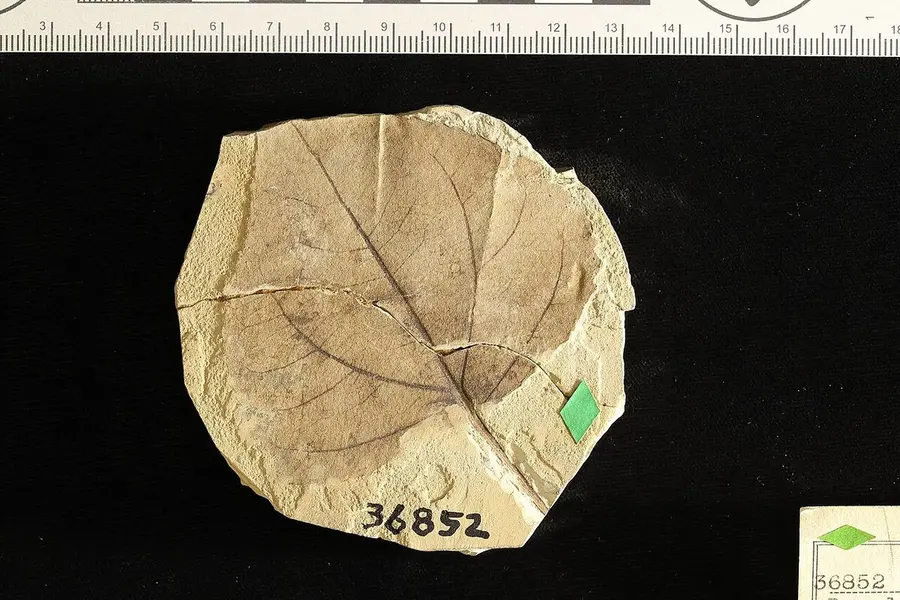
holotype USNM 36852; Lake Uinta, not Fossil Lake
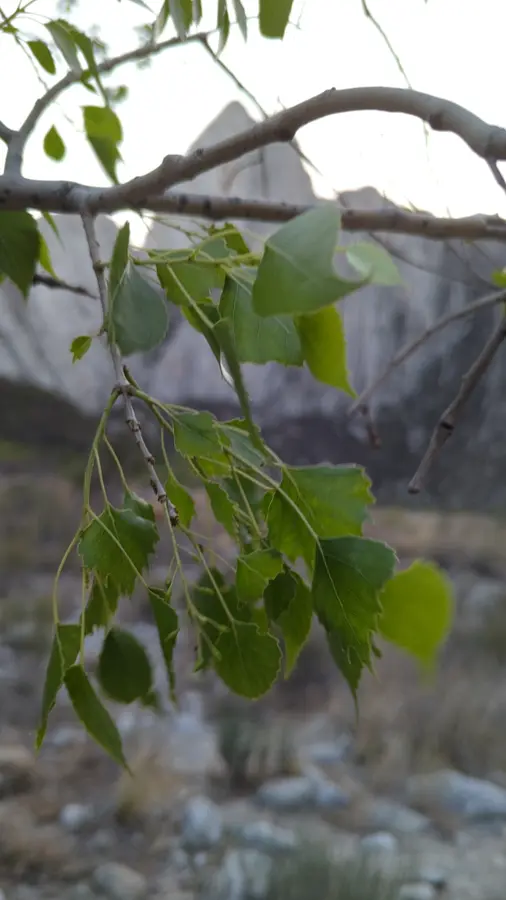
modern analog: Populus mexicana (Mexican poplar) the closest living relative; its broad leaves differ from the narrower fossil leaves
PhyloPic silhouette; depicts Populus nigra (stand-in for Populus wilmattae)
3D models
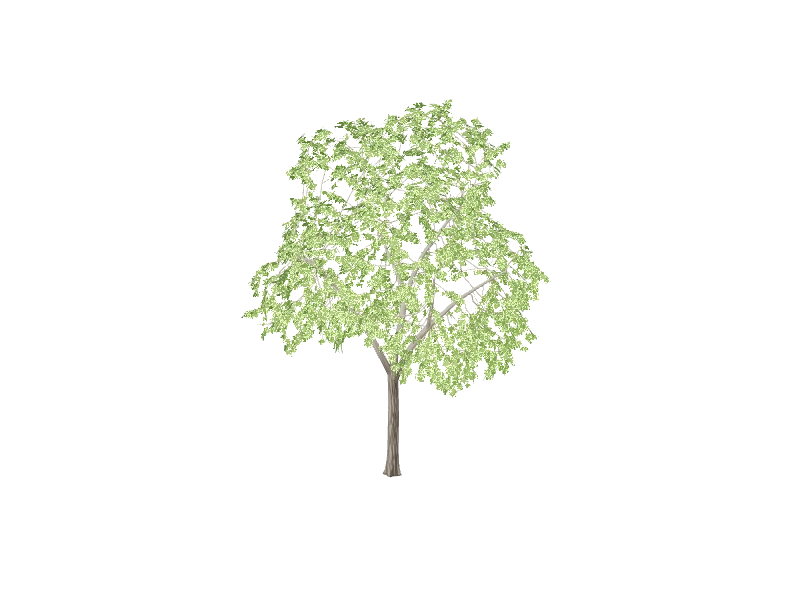
Built from a cited dossier (the Fossil Lake leaf NHMUK PB V 62003 figured by Grande 1984, the holotype USNM 36852, and a Utah twig with leaves and fruits attached, Manchester, Dilcher & Tidwell 1986) and chosen by blind review over a competing model (90.5 vs 87.0). Shown as one tree 18 m tall in summer leaf. The leaf is documented from fossils: ovate, widest near its base, with straight-sided flanks, a long drawn-out tip, small rounded glandular teeth and two strong basal vein pairs, on a long slender stalk. The Utah twig shows that this poplar, unlike living ones, fruited while in leaf. No wood or trunk is known, so the tree's height, broad cottonwood crown and furrowed bark are reconstructed from living poplars such as Populus mexicana, and its colours are inferred.
same genus: Cottonwood tree pack
same genus: Eastern cottonwood Populus deltoides, photogrammetry
- Group
- Eudicots
- Form
- poplar / cottonwood, tree
- Known from
- leaf (fruits known from Lake Uinta)
- Habitat
- riparian and lake-margin forest
- Abundance
- unknown at Fossil Lake
- Modern relative
- Populus mexicana (Mexican poplar; closest living relative per Manchester et al. 1986) / riparian cottonwoods such as Populus fremontii for size
- Occurrence
- Fossil Lake: F-1 (BMNH V.62003); FOBU list; Lake Uinta (Parachute Creek Mbr, with fruits)
- Notes
- Authority per Wikipedia list (unverified).
Sources
- Grande, L. 1984. Paleontology of the Green River Formation, with a review of the fish fauna (2nd ed.). Geological Survey of Wyoming Bulletin 63, 333 p., p.262; fig. V.21 p.270 ↗
- Graham, J.P. 2012. Fossil Butte National Monument: geologic resources inventory report. Natural Resource Report NPS/NRSS/GRD/NRR—2012/587. National Park Service, Fort Collins, CO., Table 1 ↗
- Grande, L. 1984. Paleontology of the Green River Formation, with a review of the fish fauna (2nd ed.). Geological Survey of Wyoming Bulletin 63, 333 p., Table V.1 ↗
- Manchester, S.R., Judd, W.S. & Handley, B. 2006. Foliage and fruits of early poplars (Salicaceae: Populus) from the Eocene of Utah, Colorado, and Wyoming. Int. J. Plant Sci. 167:897–908. ↗