Populus cinnamomoides
Also published as: Ceanothus cinnamomoides; Zizyphus cinnamomoides
This entry was compiled from research notes and has not yet been reviewed by a person. Its facts come from the sources listed below, which are the authority if anything here disagrees with them.
PhyloPic silhouette; depicts Populus nigra (stand-in for Populus cinnamomoides)
3D models
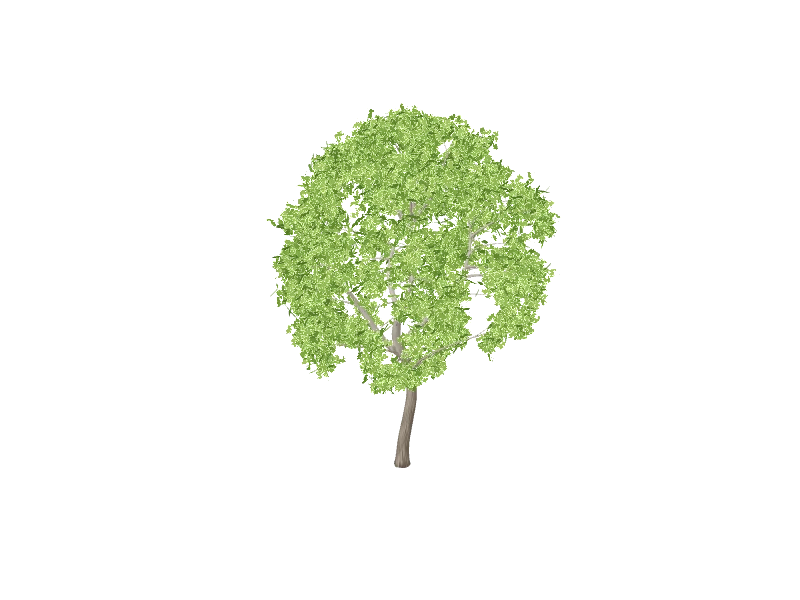
Built from a cited dossier (the Fossil Lake leaf FMNH PP 43954, identified by Steven Manchester, Lesquereux's type leaves from Green River, Wyoming, and living narrowleaf and Fremont cottonwoods) and chosen by blind review over a competing model (92.1 vs 91.1). Shown as one tree 15 m tall in summer leaf. The leaf is documented from fossils: small, oblong to narrowly elliptic and widest near the middle, with one pair of strong side veins starting at the base beside the midrib, faint ladder-like cross-veins, an untoothed or bluntly toothed margin and a rounded to pointed tip. It is told apart from the other Fossil Lake poplar, Populus wilmattae, by its single basal vein pair and narrow shape. The species is rare at Fossil Lake, and no twig, catkin, fruit or wood has been found with it, so the tree's height, sinuous trunk, furrowed grey-brown bark and rounded crown are reconstructed from living poplars, and its colours are inferred.
same genus: Cottonwood tree pack
same genus: Eastern cottonwood Populus deltoides, photogrammetry
- Group
- Eudicots
- Form
- poplar / cottonwood, tree
- Known from
- leaf
- Habitat
- riparian and lake-margin forest
- Abundance
- rare at Fossil Lake (FMNH PP 43954; cf. PP 53577); abundant at Blue Rim, Bridger Fm, where it 'predominates among the angiosperm taxa' of the lower horizon (~39%; Allen 2015 abstract)
- Modern relative
- no closest living relative established
- Occurrence
- Fossil Lake: F-1 (Grande 1984 p. 262); FMNH PP 43954 (Lewis Ranch, Locality A; det. S. R. Manchester 2011) and cf. PP 53577; FOBU list; Lake Gosiute: typified on specimens from 'Green River Station, WY'; YPM PB 038956 (Laney Mbr); Little Mountain (Wilf 2000 Table A3); Bridger Fm: Blue Rim (Stein et al. 2021)
- Notes
- Manchester et al. (2006) separated Populus tidwellii of Lake Uinta from P. cinnamomoides: the Parachute Creek leaves formerly called P. cinnamomoides, with their listing and abundance rank (Grande 1984 Table V.1, after MacGinitie 1969), belong to P. tidwellii, and the 2006 abstract names only P. tidwellii and P. wilmattae from that flora. Basionym Ceanothus cinnamomoides Lesquereux 1872 (Annual Report for 1871 p. 289); also Zizyphus cinnamomoides (Lesquereux) Lesquereux 1878 (Lesquereux 1878 p. 277; Knowlton 1923 p. 170). Populus deltoides, formerly given as the analog, has a different leaf (broad, triangular, with a truncate to cordate base; FNA).
Sources
- Grande, L. 1984. Paleontology of the Green River Formation, with a review of the fish fauna (2nd ed.). Geological Survey of Wyoming Bulletin 63, 333 p., p.262 ↗
- Graham, J.P. 2012. Fossil Butte National Monument: geologic resources inventory report. Natural Resource Report NPS/NRSS/GRD/NRR—2012/587. National Park Service, Fort Collins, CO., Table 1 ↗
- Manchester, S.R., Judd, W.S. & Handley, B. 2006. Foliage and fruits of early poplars (Salicaceae: Populus) from the Eocene of Utah, Colorado, and Wyoming. Int. J. Plant Sci. 167:897–908. ↗
- Field Museum. Field Museum on GBIF. GBIF; accessed 2026-10-05. ↗
- Wilf, P. 2000. Late Paleocene–early Eocene climate changes in southwestern Wyoming: paleobotanical analysis. GSA Bulletin 112(2):292–307., Table A3 ↗
- Stein, R.A., Sheldon, N.D., Allen, S.E., Smith, M.E., Dzombak, R.M. & Jicha, B.R. 2021. Climate and ecology in the Rocky Mountain interior after the early Eocene Climatic Optimum. Climate of the Past 17:2515–2536., p.2518 ↗
- Allen, S.E. 2015. Leaf fossils from the Blue Rim flora of the Eocene Bridger Formation, southwestern Wyoming. Botany 2015 conference, abstract 1071. ↗
- Lesquereux, L. 1872. Fossil flora. In Hayden, F.V., Preliminary report of the United States Geological Survey of Montana and portions of adjacent territories; being a fifth annual report of progress (Annual Report for 1871), pp. 283 ff., p.289 ↗
- Lesquereux 1878. Tertiary Flora. Hayden Survey Rept. vol. 7., p.277 ↗
- Knowlton, F.H. 1923. Revision of the flora of the Green River formation, with descriptions of new species. USGS Professional Paper 131-F, pp. 133–182., p.170 ↗
- Eckenwalder, J.E. 2010. Populus. In Flora of North America Editorial Committee (eds.), Flora of North America North of Mexico, vol. 7. ↗