Plastomenus thomasii
This entry was compiled from research notes and has not yet been reviewed by a person. Its facts come from the sources listed below, which are the authority if anything here disagrees with them.
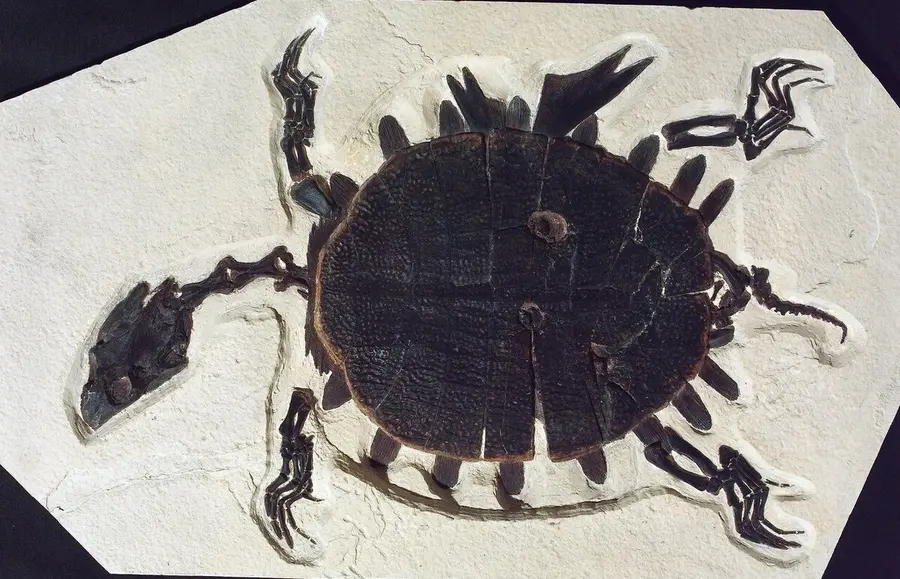
cast FOBU 442 with bite marks; identification conflicting: NPS labels it Plastomenus thomasii, but the same cast is exhibited as Hummelichelys guttata at the Houston Museum of Natural Science and at the FOBU visitor centre, a name based on a nomen dubium (Vitek & Joyce 2015, via PBDB)
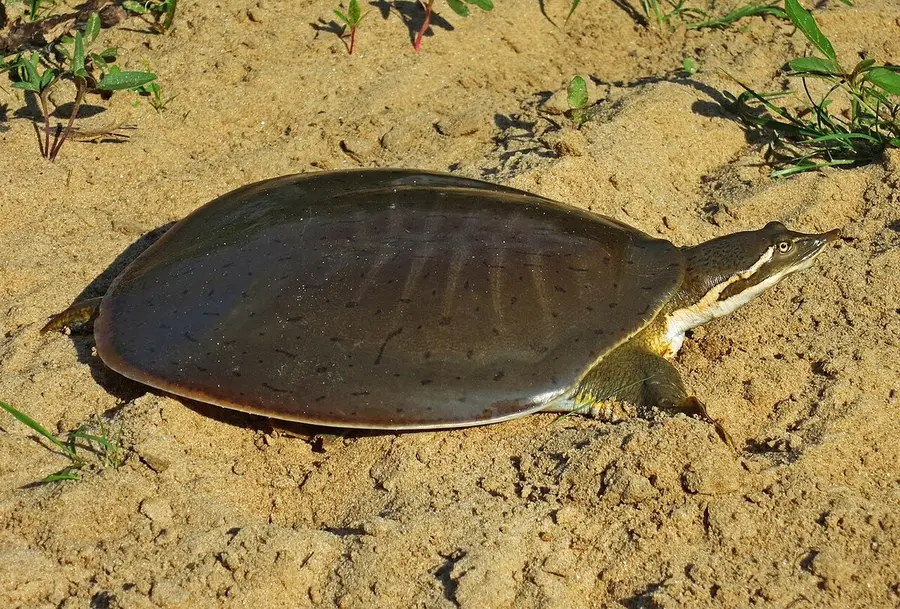
modern analog: Apalone mutica (Smooth softshell turtle); catalog modern_analog: "Apalone mutica (smooth softshell)"

PhyloPic silhouette; depicts Amyda cartilaginea (stand-in for Plastomenus thomasii)
3D models
same family (Trionychidae): Chinese softshell turtle Pelodiscus sinensis
- Description
- Softshell turtle (Trionychidae)
- Group
- Reptile
- Habitat
- lake
- Diet
- carnivore
- Abundance
- rare
- Modern relative
- Apalone mutica (smooth softshell)
- Notes
- Vitek 2012 (p. 37) treats P. thomasii as a valid Bridger Formation softshell but reports no softshell from the Green River Formation; the Fossil Lake record rests on NPS (cast FOBU 442, shell about 14.75 cm long). Identification conflicting: the same bite-marked cast is exhibited as Hummelichelys guttata at the Houston Museum of Natural Science and at the FOBU visitor centre (NPS-EX). The names Hummelichelys guttata and Apalone heteroglypta (under which FMNH PR 1900 from Fossil Lake is catalogued) rest on 'Trionyx' guttatus and 'T.' heteroglyptus, which Vitek & Joyce (2015, via PBDB) treat as nomina dubia.
Sources
- National Park Service, Fossil Butte National Monument 2025. Fossil Reptile Species. nps.gov/fobu, last updated November 20, 2025; accessed 2026-10-05. ↗
- Vitek, N.S. 2012. Giant fossil soft-shelled turtles of North America. Palaeontologia Electronica 15(1):13A., p.37 ↗
- National Park Service, Fossil Butte National Monument. Visitor Center Exhibits. nps.gov/fobu; accessed 2026-10-05. ↗
- Vitek, N.S. & Joyce, W.G. 2015. A review of the fossil record of New World turtles of the clade Pan-Trionychidae. Bulletin of the Peabody Museum of Natural History 56(2):185–244. ↗