Pinus sp.
pine
This entry was compiled from research notes and has not yet been reviewed by a person. Its facts come from the sources listed below, which are the authority if anything here disagrees with them.
A slender-needled pine from the hills around the lake
- How big
- Probably about 25 m (80 ft) tall, like an 8-storey building
- Where it grew
- Cool, damp hills around the lake, not down by the shore
- Relatives today
- Most like white pines, such as the eastern white pine of the US
- Fossils found
- Loose needles, one winged seed and lots of pollen, but no cones
On the cool hills around the lake, this pine probably stood tall among spruce and fir, its long branches spreading in layers. Its slender needles likely grew in soft bunches of five near the branch tips. Wind and streams carried its pollen, a fine dust made by its cones, down into the lake along with needles and winged seeds.
Fun fact The pine that grows at Fossil Butte today, the limber pine, has almost wingless seeds, so it is a different kind from the ancient pine, whose seed had a long wing.
The science
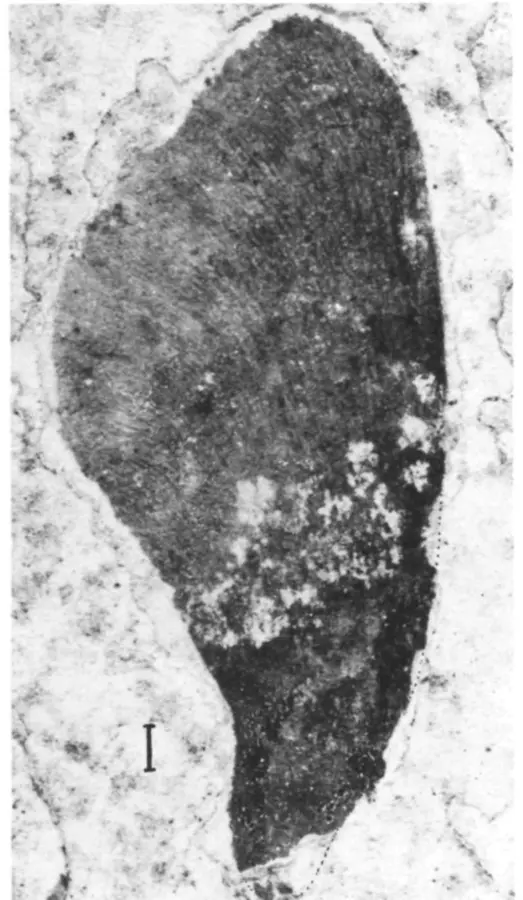
winged seed FMNH PP 33655 from Fossil Lake (locality F-1); crop of Grande 1984 fig. V.10 with a 1 mm scale bar
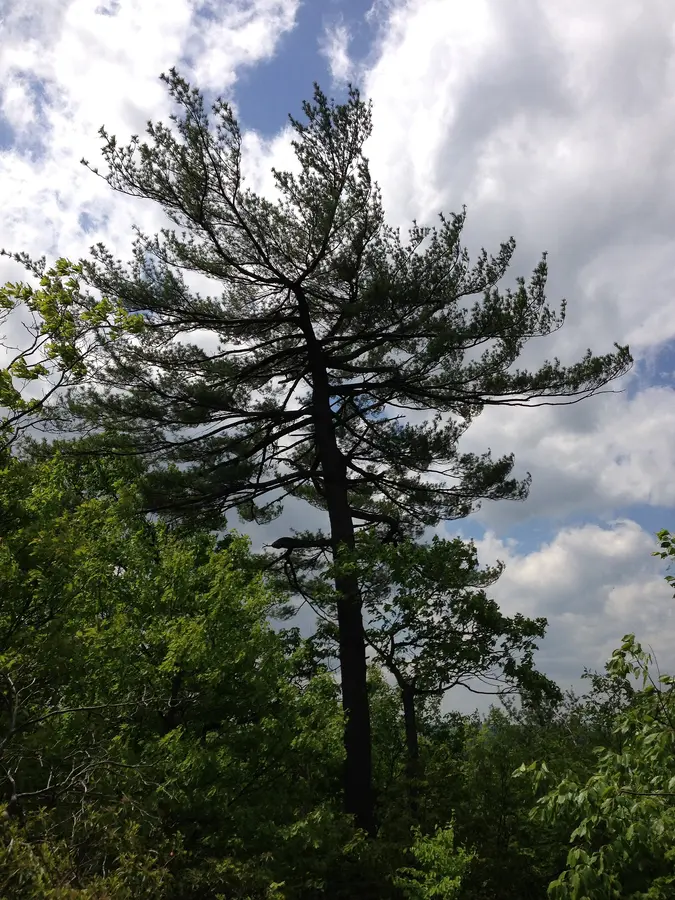
modern analog: Pinus strobus (eastern white pine) as chosen in the dossier; a mature upland tree in New Jersey
PhyloPic silhouette; depicts Pinus (stand-in for Pinus sp.)
3D models
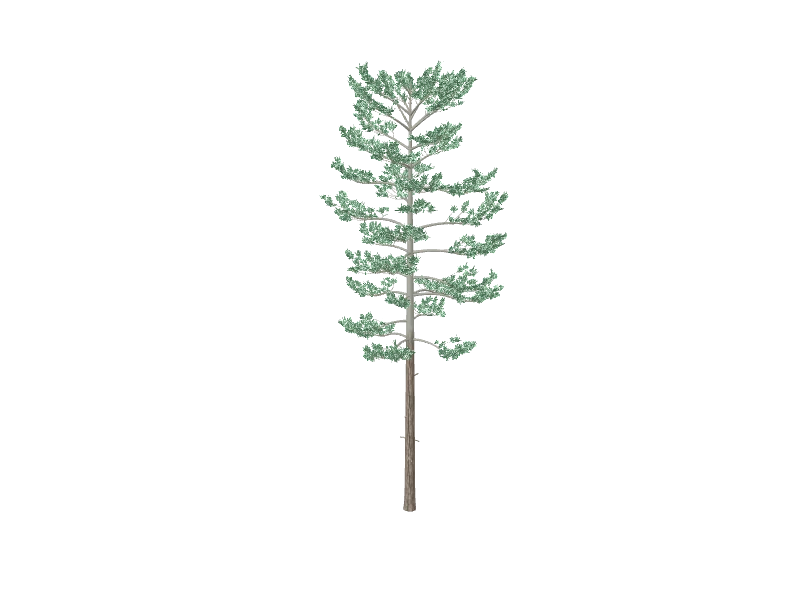
Built from a cited dossier (the Fossil Lake winged seed FMNH PP 33655 and needle mat NHMUK PB V 62000, both from the 18-inch layer and figured by Grande 1984; pine pollen, 9% of the Fossil Butte Member's pollen and spores (Cushman 1983); and the living eastern white pine Pinus strobus) and chosen unanimously by blind review over a competing model (91.2 vs 85.2). Shown as one mature upland pine 25 m tall. The fossils document slender needles and a seed with a long, asymmetric wing, which together point to a soft white pine rather than a ponderosa-type pine. The needles at Fossil Lake show no bundle base, so the five needles per bundle follow a five-needled pine from Lake Gosiute of similar age. The tiered crown, height, bark and colours are reconstructed from P. strobus, and no cones are shown because none is known from Fossil Lake. Pines grew on the uplands around the basin; their pollen, needles and seeds were carried into the lake.
- Group
- Conifers
- Form
- pine tree
- Known from
- needles; seed; pollen
- Habitat
- upland conifer forest on surrounding ranges (needles and seeds washed or blown into the lake)
- Abundance
- needles and a seed figured from the 18-inch layer; Pinus pollen = 9% of all FBM palynomorphs, the dominant gymnosperm (Cushman 1983)
- Modern relative
- Pinus strobus (eastern white pine; five-needled soft pine)
- Occurrence
- Fossil Lake: F-1 (18-inch layer) needles BMNH V.62000 and seed FMNH PP33655; pollen in all FBM units (Cushman 1983)
- Notes
- Cushman (1983) treats pine pollen as from conifers ranging from swamps to highlands; McGrew & Casilliano (1975) use spruce, fir and pine pollen to infer nearby mountains of 6000-8000 ft. Pigg & DeVore (2010) note pine macrofossils are rare in late Paleocene-early Eocene Rocky Mountain floras. Analog revised 2026-10-12: the slender Fossil Lake needles (about 0.6 mm wide), the seed's long wing (about three times the seed body) and a five-needled pine at Little Mountain, Lake Gosiute (Wilf 2000) point to a white pine (subgenus Strobus); Wodehouse (1933) notes that strobipites-type pollen does not settle the type on its own (models/species/pinus-sp/dossier.md).
Sources
- Grande, L. 1984. Paleontology of the Green River Formation, with a review of the fish fauna (2nd ed.). Geological Survey of Wyoming Bulletin 63, 333 p., p.262; figs V.10 p.266, V.11 p.267 ↗
- McGrew, P.O. & Casilliano, M. 1975. The Geologic History of Fossil Butte National Monument and Fossil Basin. National Park Service Occasional Paper 3., p.19 ↗
- Cushman, R.A., Jr. 1983. Palynology and Paleoecology of the Fossil Butte Member of the Eocene Green River Formation in Fossil Basin, Lincoln County, Wyoming. MS thesis, Loma Linda University., pp.19,23 ↗