Phareodus encaustus
bonytongue
Also published as: Dapedoglossus aequipinnis; Osteoglossum encaustum; Phareodon
This entry was compiled from research notes and has not yet been reviewed by a person. Its facts come from the sources listed below, which are the authority if anything here disagrees with them.
A sharp-toothed hunter built for bursts of speed
- How big
- About 40–50 cm (16–20 in), the length of a cat; up to 76 cm (30 in)
- What it ate
- Other fish, including spiny ones found in its stomach
- Where it lived
- Open water, both near shore and out in the middle of the lake
- Fossils found
- 8 of 4,687 fossils logged at the park's research quarry, 1998–2020
Phareodus had a tall, oval body covered in big scales, long front fins, and long jaws lined with sharp, pointed teeth. The fins on its back and underside sat far back near the tail, which scientists think helped it put on sudden bursts of speed. Grown-ups probably hunted alone, while young ones swam together in schools.
Fun fact The species was first named from just a few scales, and its namer guessed the fish was 3 or 4 feet (about 1 m) long; whole fossils later showed that was too big.
The science
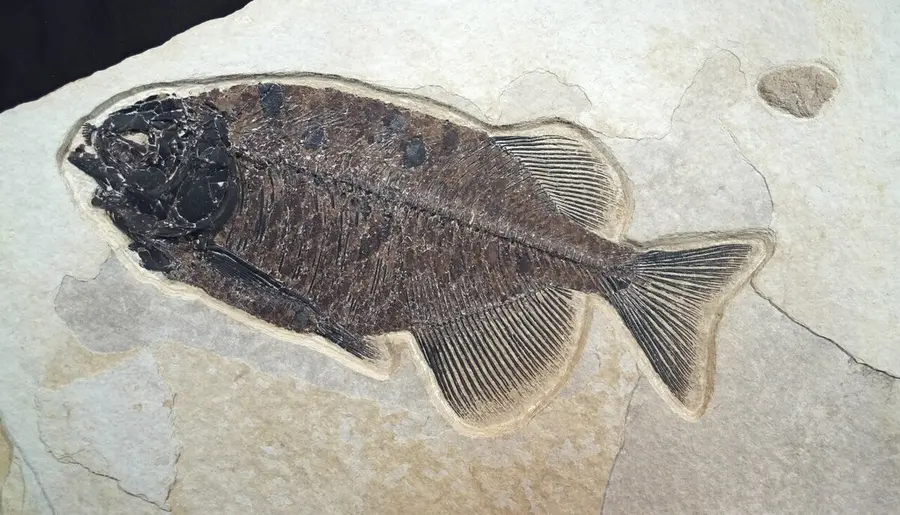
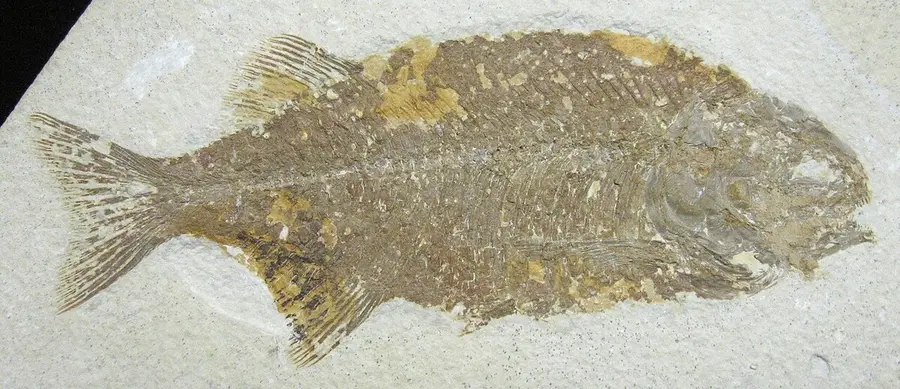
Lincoln County, Wyoming per description
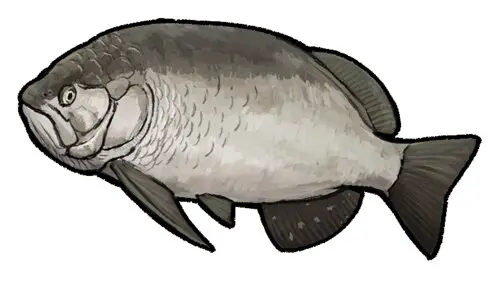
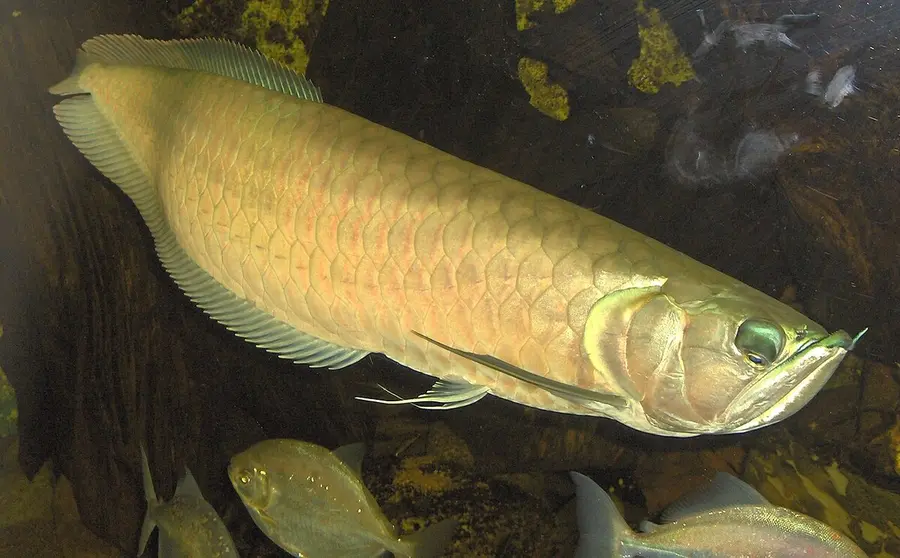
modern analog: Osteoglossum bicirrhosum (Silver arowana); catalog modern_analog: "Osteoglossum bicirrhosum (silver arowana)"
PhyloPic silhouette; depicts Phareodus encaustus
3D models
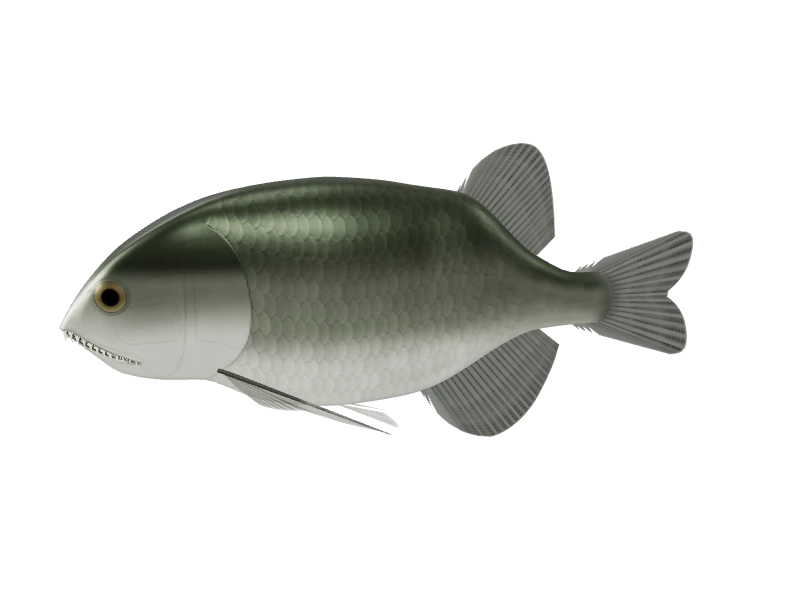
Built from a cited anatomical dossier (Grande 1984, published descriptions and three complete photographed fossils) and chosen by blind review over a competing model (93.6 vs 90.2). Shown at 40 cm standard length. The deep, compressed bonytongue body, the large mouth with enlarged conical teeth, the anal fin starting ahead of the dorsal with both set far back, the long, thick leading ray of the pectoral fin, the small pelvic fins and the very slightly forked tail are documented from fossils. Body width, eye size and the exact course of the lateral line are inferred, and no colour is preserved, so the countershaded olive-grey back and silvery flanks are inferred from living bonytongues.
same family (Osteoglossidae): Red arowana (Scleropages)
- Description
- Large bonytongue (Osteoglossidae): long flexible pectoral fins (~1/3 SL), big oval scales, many sharp teeth, dorsal and anal fins set far back
- Group
- Fish
- Size
- to ~76 cm TL (G84); NPS max 30 in
- Habitat
- open water; juveniles school, adults solitary
- Diet
- piscivore: Mioplosus, Priscacara and Cockerellites found in stomachs
- Abundance
- uncommon mid-lake (~1-2%); common nearshore F-2 (~5.5%)
- Modern relative
- Osteoglossum bicirrhosum (silver arowana)
- NPS quarry
- 8 specimens, 1998–2020 (Logged as "Phareodus")
- Notes
- Former-name list compiled from Grande 1984 nomenclature notes and PBDB (Dapedoglossus aequipinnis appears in PBDB). Living osteoglossids are mouth-brooders (NPS) - no fossil evidence.
Sources
- Grande, L. 1984. Paleontology of the Green River Formation, with a review of the fish fauna (2nd ed.). Geological Survey of Wyoming Bulletin 63, 333 p., pp.167-176 ↗
- National Park Service, Fossil Butte National Monument 2025. Fossil Fish Species. nps.gov/fobu, last updated November 18, 2025; accessed 2026-10-05. ↗
- Finger, T.R. 1998. A comparison of fish community structure among several paleoenvironments of Eocene Fossil Lake, Wyoming: a preliminary report. In Santucci, V.L. & McClelland, L. (eds.) 1998, National Park Service Paleontological Research [vol. 3], NPS/NRGRD/GRDTR-98/01, p. 81ff. ↗