Parvileguminophyllum coloradensis
Also published as: Mimosites coloradensis; Mimosites debequensis; Mimosites falcatus
This entry was compiled from research notes and has not yet been reviewed by a person. Its facts come from the sources listed below, which are the authority if anything here disagrees with them.
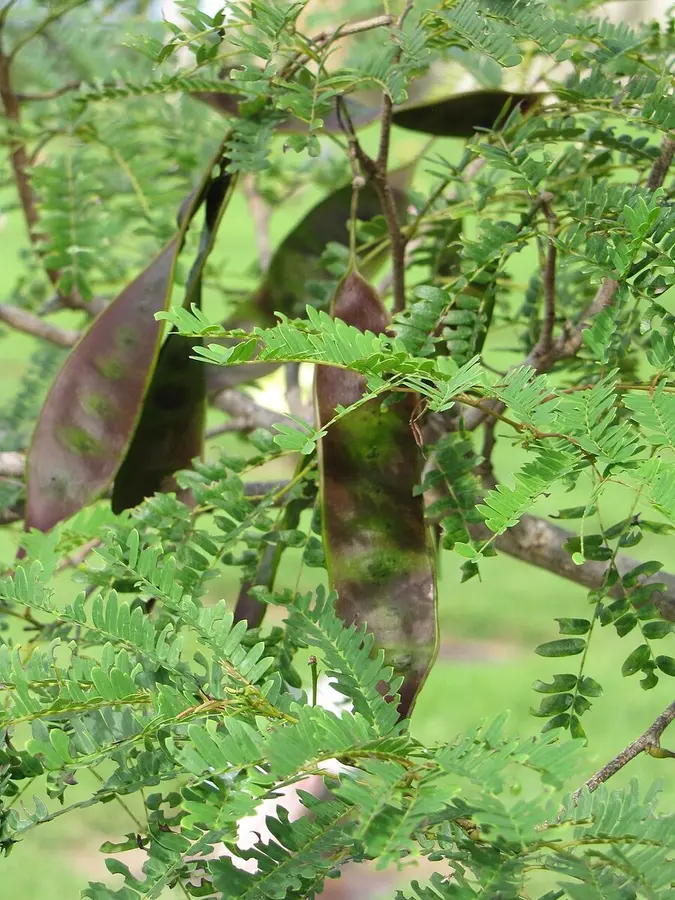
modern analog: Lysiloma; catalog modern_analog: "Lysiloma / Albizia"

PhyloPic silhouette; depicts Lysiloma divaricatum (stand-in for Parvileguminophyllum coloradensis)
- Group
- Eudicots
- Form
- legume leaflet, position in the family uncertain
- Known from
- leaflets ('small inequilateral legume leaflets', Call & Dilcher 1994)
- Habitat
- forest
- Abundance
- one of the 8 most abundant species at Parachute Creek (Lake Uinta) localities (MacGinitie 1969 p.30, via Grande 1984) (listed first, i.e. most abundant)
- Modern relative
- Lysiloma / Albizia
- Occurrence
- Lake Uinta: Parachute Creek Member (MacGinitie 1969 list); Lake Gosiute: Little Mountain, the top-ranked dominant (Wilf 2000 Table 3 p. 296)
- Notes
- Current name per Call & Dilcher 1994 (Rev. Palaeobot. Palynol. 80(3-4): 305-310, doi:10.1016/0034-6667(94)90007-8; abstract read); authority as given by Wilf 2000 Table A3 (p. 303). M. debequensis and M. falcatus Brown 1929 are synonyms (Brown 1934 p. 59). Fossil Lake has Mimosites sp. (see that record). FOBU 13377, identified as P. coloradensis in Grande 2013 p. 324, is a pinna of Arcoa lindgreni (Herendeen & Herrera 2019 p. 222).
Sources
- Grande, L. 1984. Paleontology of the Green River Formation, with a review of the fish fauna (2nd ed.). Geological Survey of Wyoming Bulletin 63, 333 p., Table V.1 ↗
- Wikipedia. Paleobiota of the Green River Formation. Wikipedia. ↗
- Call, V.B. & Dilcher, D.L. 1994. Parvileguminophyllum coloradensis, a new combination for Mimosites coloradensis Knowlton, Green River Formation of Utah and Colorado. Review of Palaeobotany and Palynology 80(3–4):305–310. ↗
- Wilf, P. 2000. Late Paleocene–early Eocene climate changes in southwestern Wyoming: paleobotanical analysis. GSA Bulletin 112(2):292–307., Table 3 p.296 ↗
- Brown, R.W. 1934. The recognizable species of the Green River flora. USGS Professional Paper 185-C, pp. 45–77., p.59 ↗
- Herendeen, P.S. & Herrera, F. 2019. Eocene fossil legume leaves referable to the extant genus Arcoa (Caesalpinioideae, Leguminosae). International Journal of Plant Sciences 180(3):220–231., p.222 ↗
- Wilf, P. 2000. Late Paleocene–early Eocene climate changes in southwestern Wyoming: paleobotanical analysis. GSA Bulletin 112(2):292–307., Table A3 ↗