Onychonycteris finneyi
This entry was compiled from research notes and has not yet been reviewed by a person. Its facts come from the sources listed below, which are the authority if anything here disagrees with them.
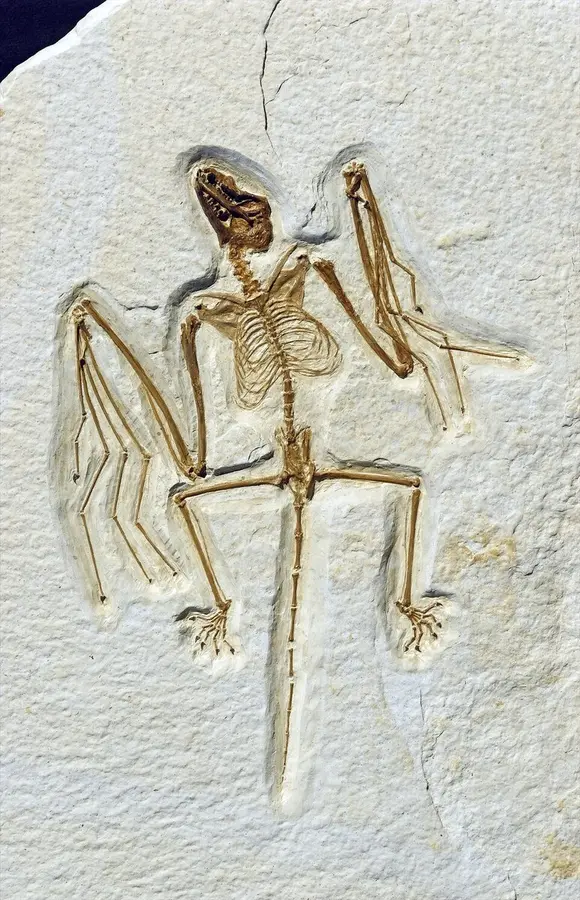
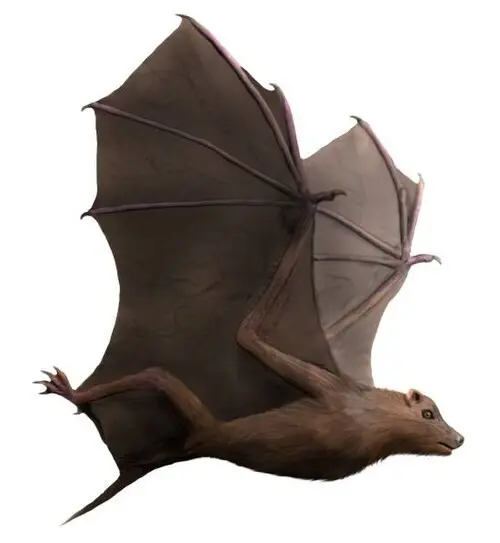
Nobu Tamura
PhyloPic silhouette; depicts Onychonycteris finneyi
3D models
same species (reconstruction): Onychonycteris finneyi life model
order (Chiroptera): Hammer-headed fruit bat (specimen scan)
- Description
- Most primitive known bat, with claws on all five fingers and a long calcar supporting a broad tail membrane
- Group
- Mammal
- Size
- 38-41 g; wingspan 0.28-0.32 m
- Habitat
- forest canopy; agile climber
- Diet
- insects (inferred)
- Abundance
- two skeletons
- Modern relative
- no close living analog; rig from a generic microbat with clawed fingers
- Notes
- Powered flight with glide-flutter capability (Gi24). Echolocation disputed (Simmons et al. 2008, 2010 vs Veselka et al. 2010). NPS suggests it may have been diurnal.
Sources
- Giannini, N.P., Cannell, A., Amador, L.I. & Simmons, N.B. 2024. Palaeoatmosphere facilitates a gliding transition to powered flight in the Eocene bat, Onychonycteris finneyi. Communications Biology 7:365. ↗
- Simmons, N.B., Seymour, K.L., Habersetzer, J. & Gunnell, G.F. 2008. Primitive Early Eocene bat from Wyoming and the evolution of flight and echolocation. Nature 451:818–821. ↗
- National Park Service, Fossil Butte National Monument 2025. Fossil Mammal Species. nps.gov/fobu, last updated September 26, 2025; accessed 2026-10-05. ↗
- Rietbergen, T.B., van den Hoek Ostende, L.W., Aase, A., Jones, M.F., Medeiros, E.D. & Simmons, N.B. 2023. The oldest known bat skeletons and their implications for Eocene chiropteran diversification. PLoS ONE 18(4):e0283505. ↗