Notogoneus osculus
beaked sandfish
This entry was compiled from research notes and has not yet been reviewed by a person. Its facts come from the sources listed below, which are the authority if anything here disagrees with them.
A pointy-nosed bottom feeder that left a fossil trail
- How big
- About 46 cm (18 in) long, the length of a cat; up to 91 cm (3 ft)
- What it ate
- Probably algae, rotting scraps or tiny animals, sucked off the mud
- Where it lived
- The deep middle of the lake, feeding along the bottom
- Fossils found
- About 1 in 100 fossil fish from the deep lake beds; most are adults
Notogoneus was a long, slim fish with a pointed, scaly snout and a small, toothless mouth tucked underneath. Scientists think it cruised along the deep lake floor, tipping its nose down to suck food off the mud. The bottom water there was probably unlivable most of the time, so it may have come to feed only at certain times of year.
Fun fact Scientists think one of these fish left a fossil trail in the lake mud: grooves from its tail and belly fins, and little oval marks where its mouth touched the bottom.
The science
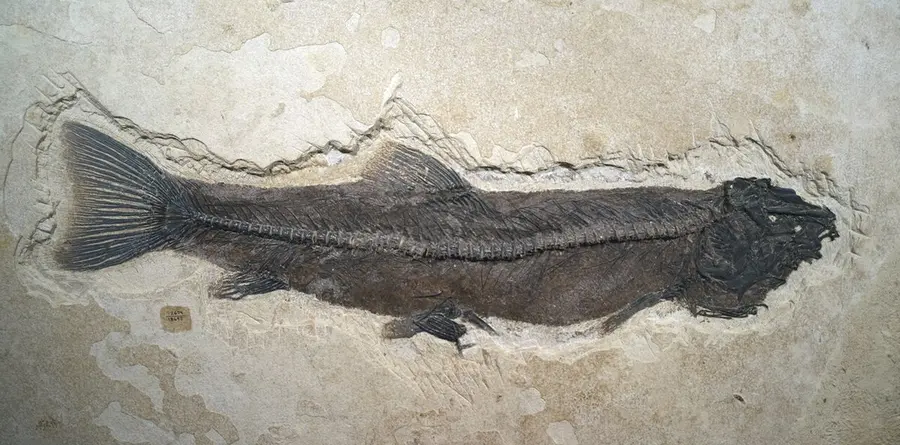
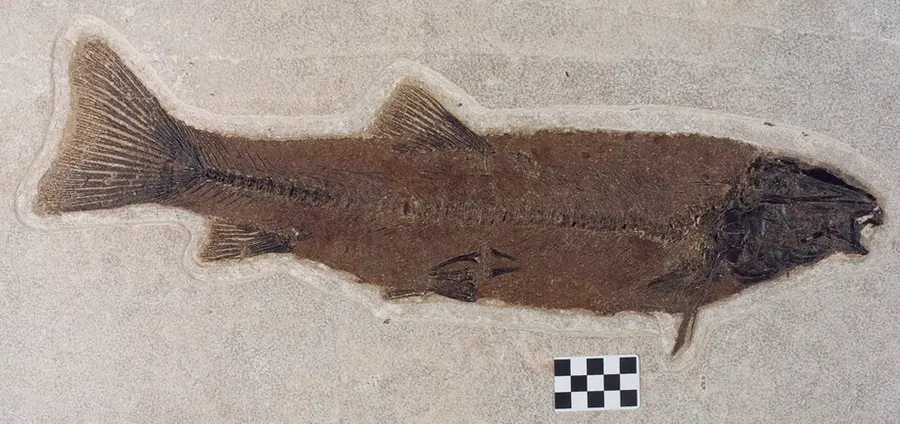
FOBU collection; photo by Arvid Aase (Martin et al. 2010)
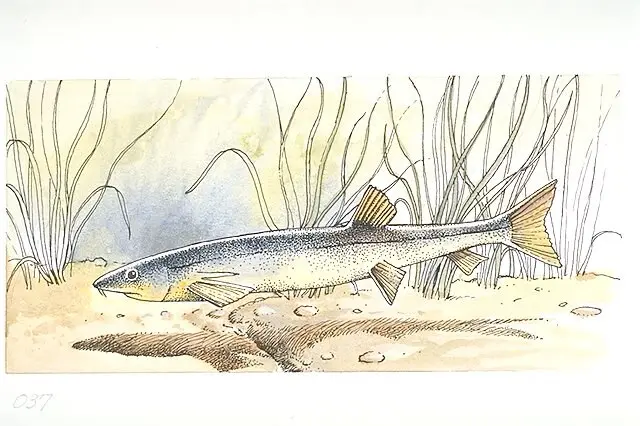
feeding along lake bottom; NPGallery: "Government owns art and all reproduction rights"; 01/01/1990 - 12/30/1990; Image_Size=8-3/4" x 6-11/16"; Count:5/19; Exhibit 6/Graphic # FB-G-037(6)
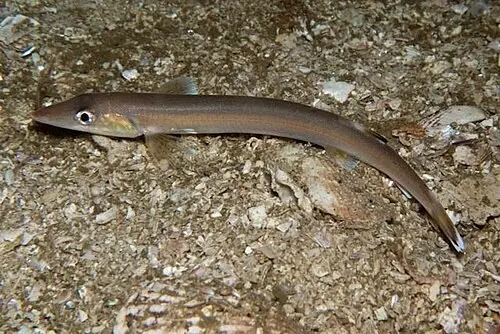
modern analog: Gonorynchus gonorynchus; catalog modern_analog: "Gonorynchus gonorynchus (beaked sandfish)"
3D models
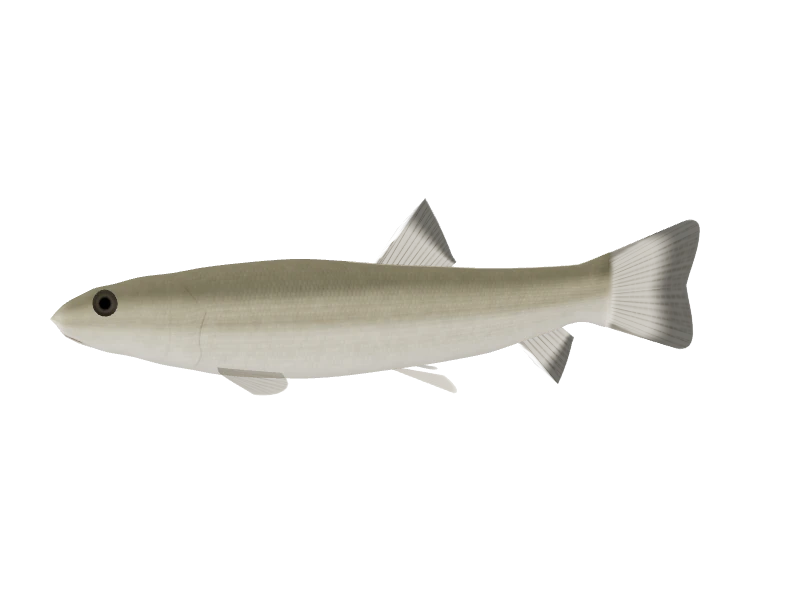
Built from a cited anatomical dossier (Grande 1984, published descriptions and photographed fossils) and chosen by blind review over a competing model, narrowly (90.5 vs 89.5). Shown at 39 cm standard length. The slender body (about 0.21 SL deep), the dorsal and pelvic fins starting opposite each other at mid-body, the small toothless underslung mouth beneath a pointed, fully scaled snout, and the slightly forked tail with rounded lobes are documented from fossils; no barbel is shown because none has been found. No colour has been reported for Notogoneus, so the sandy-olive back, pale belly and dusky fin margins are inferred from its living relatives Gonorynchus and Chanos.
- Description
- Beaked sandfish (Gonorynchidae): elongate, ventral sucker-like toothless mouth, scales fringed with long spines
- Group
- Fish
- Size
- average ~46 cm, max ~91 cm TL
- Habitat
- deep-water (F-1) deposits; bottom feeder
- Diet
- suction feeding on plant material and detritus
- Abundance
- uncommon mid-lake (~1-2%), extremely rare nearshore
- Modern relative
- Gonorynchus gonorynchus (beaked sandfish)
- Notes
- Fossil feeding/swimming trail (Undichna) made by a ~45 cm individual (M10). Possibly migratory: Grande 1984 found young absent; NPS (after Grande 2013) reports very young juveniles and adults only.
Sources
- Grande, L. 1984. Paleontology of the Green River Formation, with a review of the fish fauna (2nd ed.). Geological Survey of Wyoming Bulletin 63, 333 p. ↗
- National Park Service, Fossil Butte National Monument 2025. Fossil Fish Species. nps.gov/fobu, last updated November 18, 2025; accessed 2026-10-05. ↗
- Martin, A.J., Vazquez-Prokopec, G.M. & Page, M. 2010. First known feeding trace of the Eocene bottom-dwelling fish Notogoneus osculus and its paleontological significance. PLoS ONE 5(5):e10420. ↗
- Finger, T.R. 1998. A comparison of fish community structure among several paleoenvironments of Eocene Fossil Lake, Wyoming: a preliminary report. In Santucci, V.L. & McClelland, L. (eds.) 1998, National Park Service Paleontological Research [vol. 3], NPS/NRGRD/GRDTR-98/01, p. 81ff. ↗