Nelumbo sp.
lotus
This entry was compiled from research notes and has not yet been reviewed by a person. Its facts come from the sources listed below, which are the authority if anything here disagrees with them.
A lotus with round leaves up to half a metre wide
- How big
- Leaves 10–51 cm (4–20 in); the biggest nearly two dinner plates wide
- Where it grew
- Probably rooted in mud under calm, shallow water near the shore
- Relatives today
- The two living lotuses, from eastern North America and from Asia
- Fossils found
- Lily pads, seed pods and root tufts, maybe from more than one kind
This lotus probably grew the way the American lotus does today, from a stem creeping through the mud under calm, shallow water. Its round leaves, each joined to its stalk right in the middle, likely floated flat on the water or stood above it like shallow bowls. A flat-topped seed pod dotted with dozens of seed pockets has been found too, but no flower, so nobody knows what colour its blooms were.
Fun fact People often call its leaves lily pads, but a lotus is not a water lily. A water lily leaf has a slit running from the edge to the middle, while a lotus leaf is a full circle.
The science
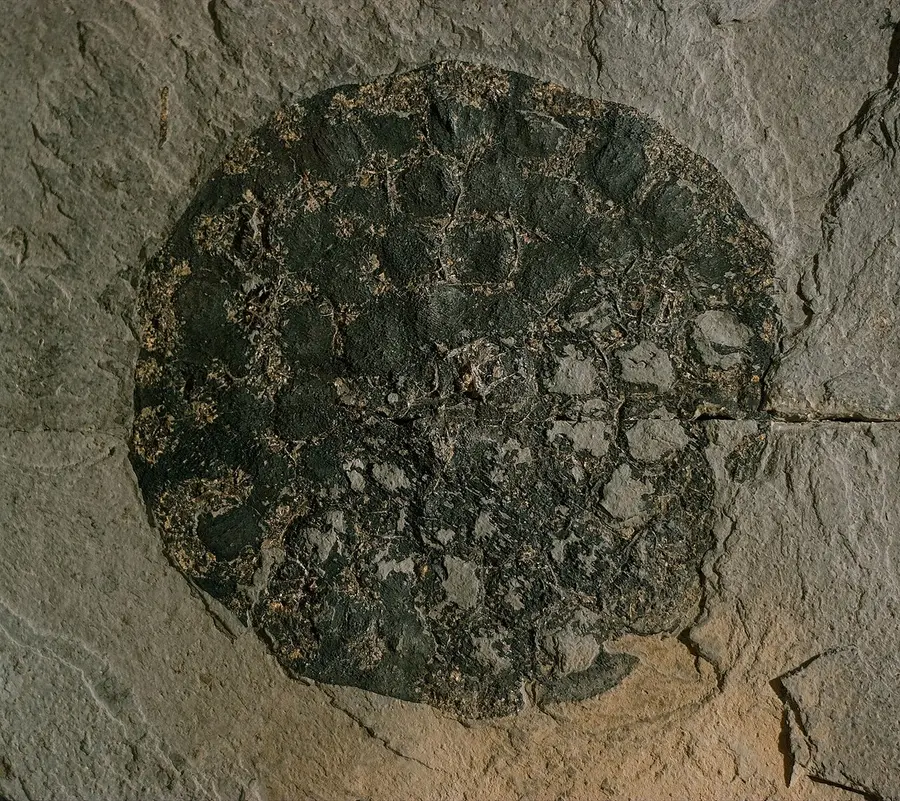
seed pod
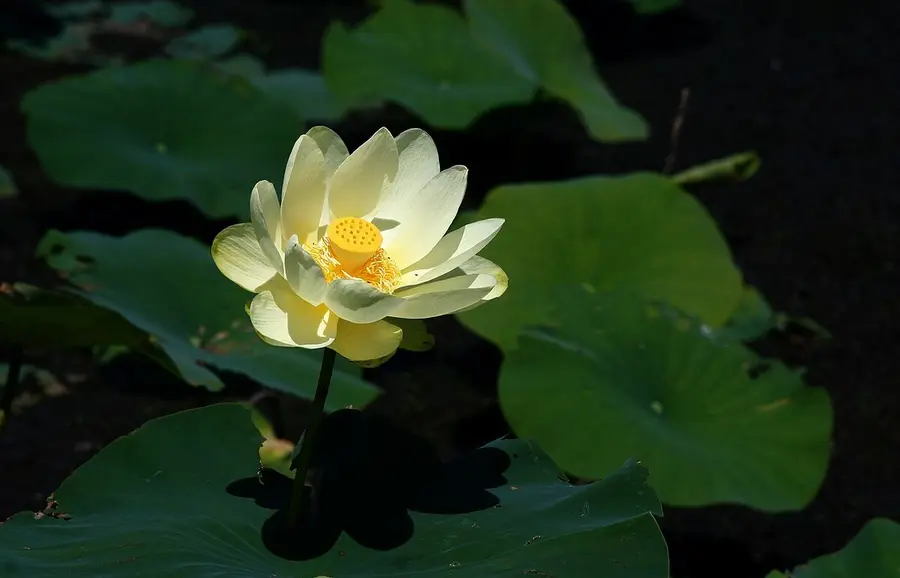
modern analog: Nelumbo lutea; catalog modern_analog: "Nelumbo lutea (American lotus) / Nelumbo nucifera"
3D models
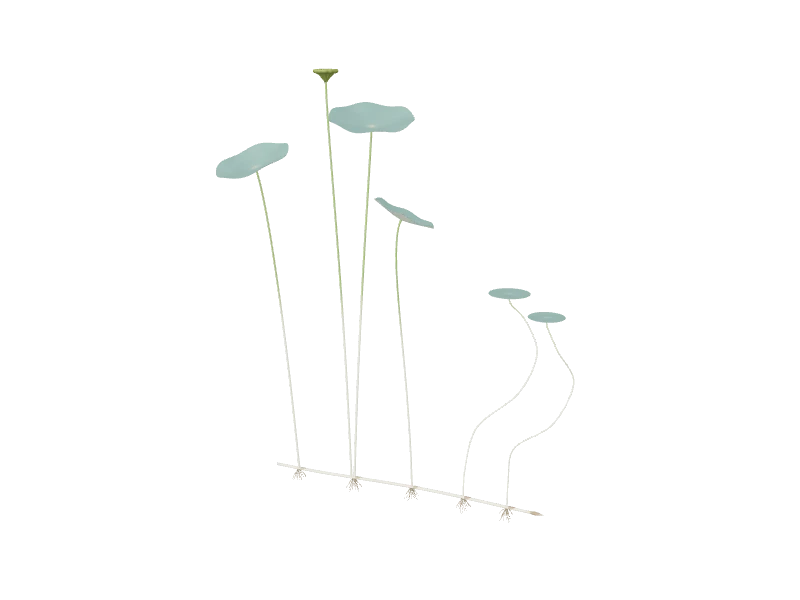
Built from a cited dossier (Fossil Lake lotus leaf FMNH PP 43979 and seed head FOBU 11744, Grande 1984 and floras of the living American lotus Nelumbo lutea) and chosen unanimously by blind review over a competing model (97.0 vs 94.5). Shown as one rhizome segment rooted under 1 m of water, reaching 1.15 m above it. The leaf is documented from Fossil Lake fossils: a full circle with the stalk at its centre, about 24 radiating veins that fork toward the margin, and one unbranched midvein; so is the flat-topped seed head with about 30 sunken pits. No Green River lotus has a formal species name. The rhizome, the water depth, the mix of floating and raised cup-shaped leaves and all colours are inferred from N. lutea, and no flower is shown because none is known from the fossils.
same genus: Indian lotus Nelumbo nucifera
same genus: Lotus flower
same genus: Lotus leaf cluster
- Group
- Aquatic eudicots
- Form
- lotus (rooted aquatic with emergent leaves and flowers)
- Known from
- leaf (lily pads 4-20 in); roots/rhizomes; seed pods (receptacles)
- Habitat
- open water to shoreline: shallow calm water
- Abundance
- several organs on display; possibly more than one species
- Modern relative
- Nelumbo lutea (American lotus) / Nelumbo nucifera
- Occurrence
- Fossil Lake (FOBU11744 and others); Lake Gosiute: Laney Member lily pad, the first from the Green River Fm (Buchheim 1978, figured in Grande 1984)
- Notes
- NPS: 'Fossil Lake may have been home to multiple species of the Nelumbo genus.'
Sources
- National Park Service, Fossil Butte National Monument 2025. Fossil Plant Species. nps.gov/fobu, last updated September 26, 2025; accessed 2026-10-05. ↗
- Graham, J.P. 2012. Fossil Butte National Monument: geologic resources inventory report. Natural Resource Report NPS/NRSS/GRD/NRR—2012/587. National Park Service, Fort Collins, CO., Table 1 ↗
- National Park Service, Fossil Butte National Monument. Visitor Center Exhibits. nps.gov/fobu; accessed 2026-10-05. ↗
- Grande, L. 1984. Paleontology of the Green River Formation, with a review of the fish fauna (2nd ed.). Geological Survey of Wyoming Bulletin 63, 333 p., p.262; fig. V.7 p.266 ↗