Mioplosus labracoides
perch
Also published as: Mioplosus abbreviatus; Mioplosus longus; Mioplosus beani; Mioplosus sauvagenus
This entry was compiled from research notes and has not yet been reviewed by a person. Its facts come from the sources listed below, which are the authority if anything here disagrees with them.
A perch-like hunter that swallowed other fish
- How big
- About 25 cm (10 in), almost a ruler long; up to 51 cm (20 in)
- What it ate
- Other fish, mostly small herrings, some half its own length
- Where it lived
- From near the shore out to the open middle of the lake
- Fossils found
- Uncommon, about 2 to 4 of every 100 fossil fish found
Mioplosus had a strong, perch-shaped body, two fins on its back and a broad, fan-shaped tail. Young ones swam in schools, but grown-ups probably hunted alone, grabbing other fish with a big mouth lined with small, sharp teeth. The teeth pointed slightly inward, so a fish that was too big could not be spat back out.
Fun fact No other Fossil Lake fish is found so often with a fish it was eating still in its mouth or stomach.
The science
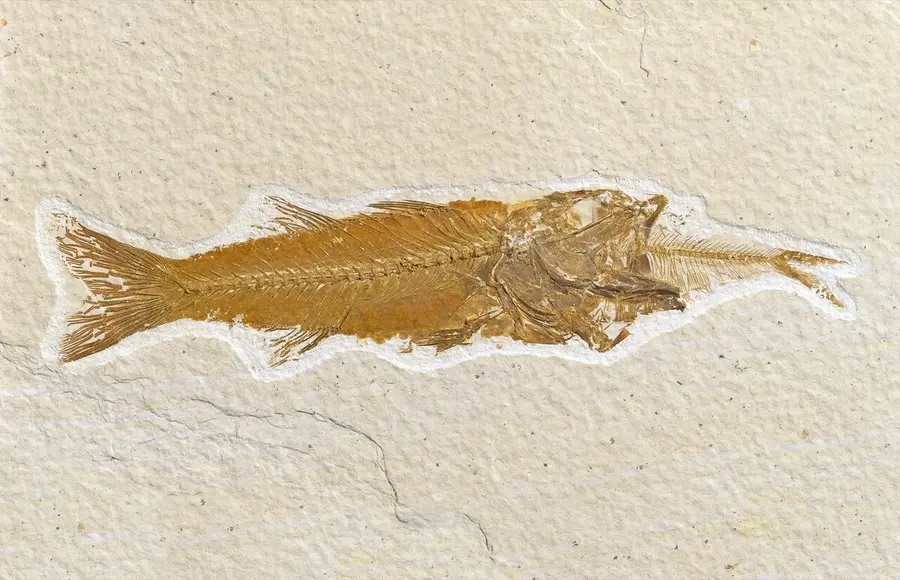
eating Diplomystus dentatus
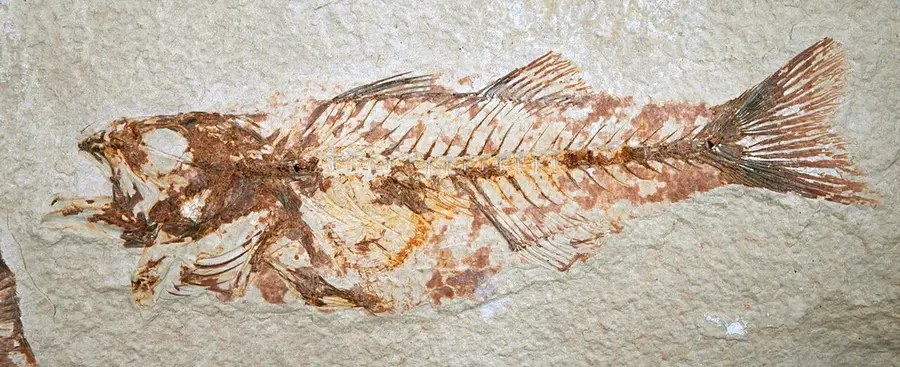
Fossil Lake Basin per title
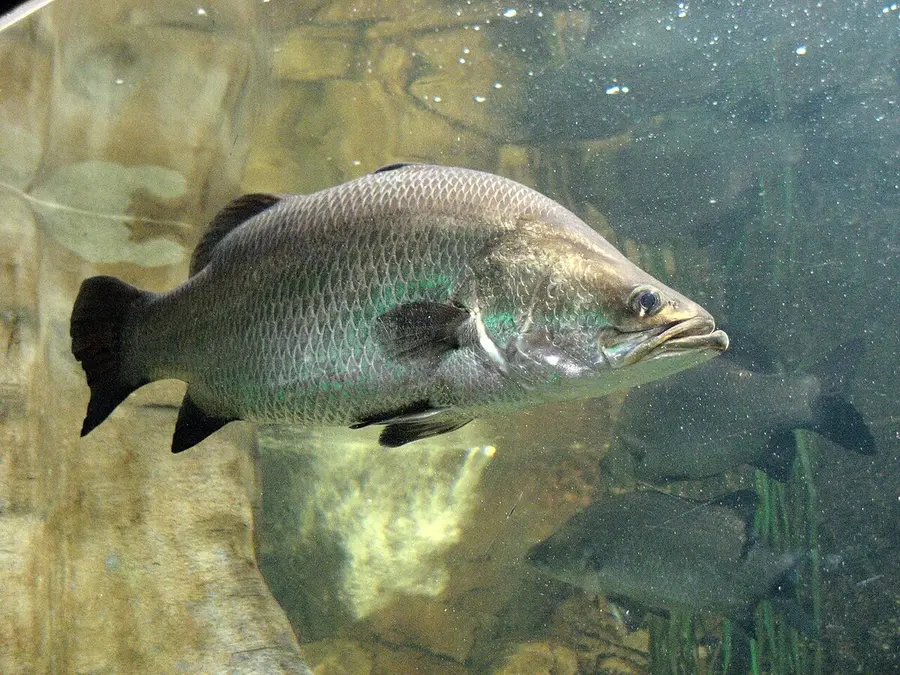
modern analog: Lates calcarifer (Barramundi); catalog modern_analog: "Lates calcarifer (barramundi)"
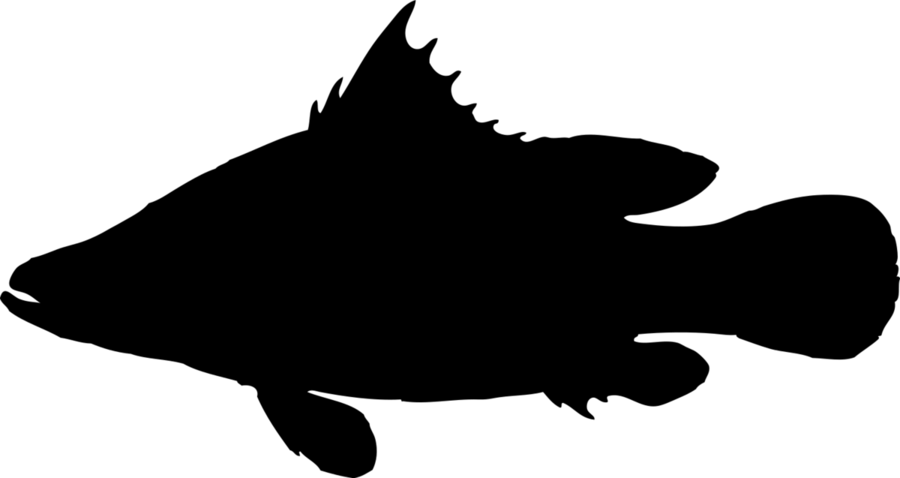
PhyloPic silhouette; depicts Lates niloticus (stand-in for Mioplosus labracoides)
3D models
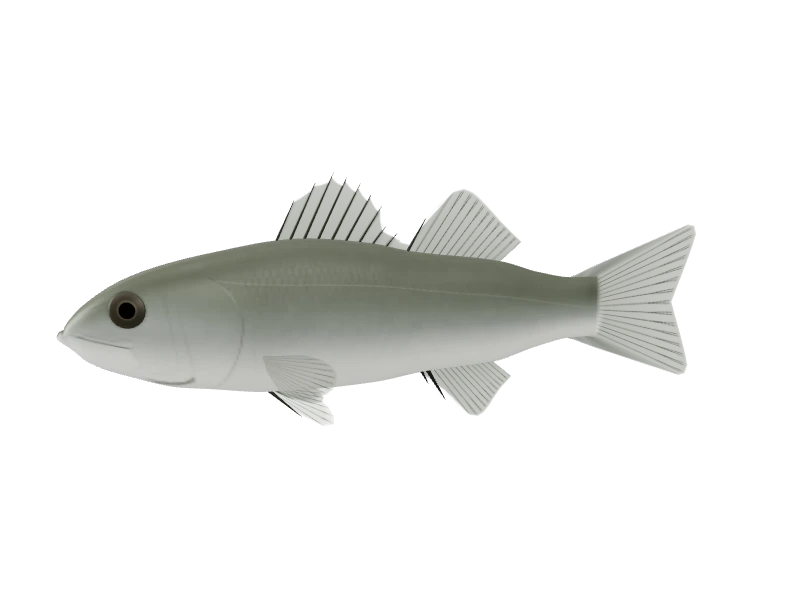
Built from a cited anatomical dossier (Grande 1984, published descriptions and photographed fossils) and chosen unanimously by blind review over a competing model. Shown at 20 cm standard length. The two dorsal fins (a spiny first with nine spines, joined by a low membrane to a second of one spine and twelve rays set opposite the anal fin), the anal fin with two spines, the rounded gill cover without a spine, the forward-pointing teeth on the lower edge of the preopercle, the projecting lower jaw and the broad, slightly forked tail are documented from fossils. Body depth is a judgement, because fossils are flattened (published values range from 0.23 to 0.33 of standard length). No colour is known, so plain countershading is used, without the bars or stripes of living perches and basses.
body-plan analog (percoid predator): Walleye Sander vitreus
body-plan analog: Yellow bass Morone mississippiensis
body-plan analog: Japanese aucha perch Coreoperca kawamebari
- Description
- Perch-like predator with two dorsal fins and a large fan-shaped tail
- Group
- Fish
- Size
- average 20-30 cm, max ~51 cm TL
- Habitat
- shore areas to middle and upper water; juveniles school, adults solitary
- Diet
- voracious piscivore taking fish up to half its own length, usually Knightia
- Abundance
- uncommon (2-4% of samples)
- Modern relative
- Lates calcarifer (barramundi)
- NPS quarry
- 6 specimens, 1998–2020 (Logged as "Mioplosus")
- Notes
- Aspiration specimens are more common for this species than any other FBM fish (G13). A 402 mm individual has a Diplomystus in its stomach (G13). Family: Percidae (G84) / Latidae (S12; NPS) / moronoid (Lucas et al. 2026). M. sauvagenus is a nomen dubium.
Sources
- Grande, L. 1984. Paleontology of the Green River Formation, with a review of the fish fauna (2nd ed.). Geological Survey of Wyoming Bulletin 63, 333 p., p.141 ↗
- Grande, L. 2013. The Lost World of Fossil Lake: Snapshots from Deep Time. Univ. Chicago Press, xi + 425 pp. (catalogue record; publisher says 432 pp.), 243 colour plates. ISBN 9780226922966 / ebook 9780226922980., fig.85 ↗
- National Park Service, Fossil Butte National Monument 2025. Fossil Fish Species. nps.gov/fobu, last updated November 18, 2025; accessed 2026-10-05. ↗
- Finger, T.R. 1998. A comparison of fish community structure among several paleoenvironments of Eocene Fossil Lake, Wyoming: a preliminary report. In Santucci, V.L. & McClelland, L. (eds.) 1998, National Park Service Paleontological Research [vol. 3], NPS/NRGRD/GRDTR-98/01, p. 81ff. ↗
- Sullivan, S.P., Grande, L., Gau, A. & McAllister, C.S. 2012. Taphonomy in North America's most productive freshwater fossil locality: Fossil Basin, Wyoming. Fieldiana Life and Earth Sciences 5: 1–4. ↗