Macginitiea wyomingensis
Also published as: Platanus wyomingensis; Aralia wyomingensis; Aralia macrophylla
This entry was compiled from research notes and has not yet been reviewed by a person. Its facts come from the sources listed below, which are the authority if anything here disagrees with them.
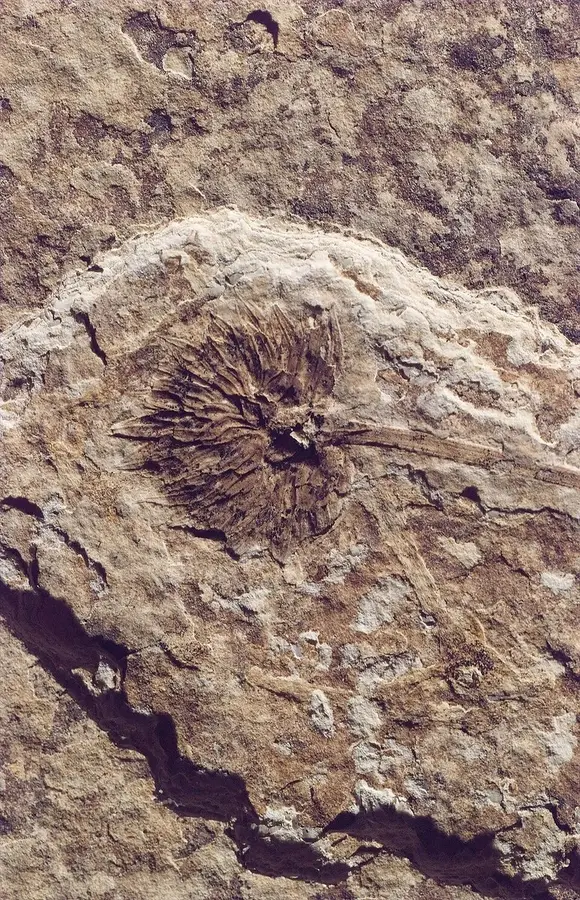
Macginicarpa fruiting head (sycamore-family fruit associated with Macginitiea), FOBU10136
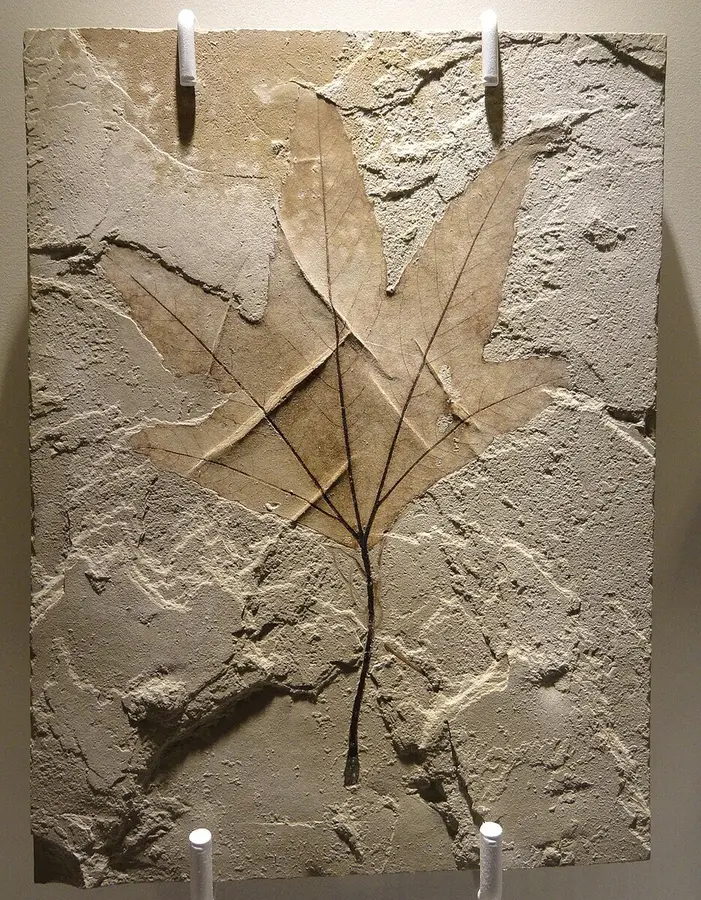
leaf; Parachute Creek Member (Lake Uinta), not Fossil Lake
3D models
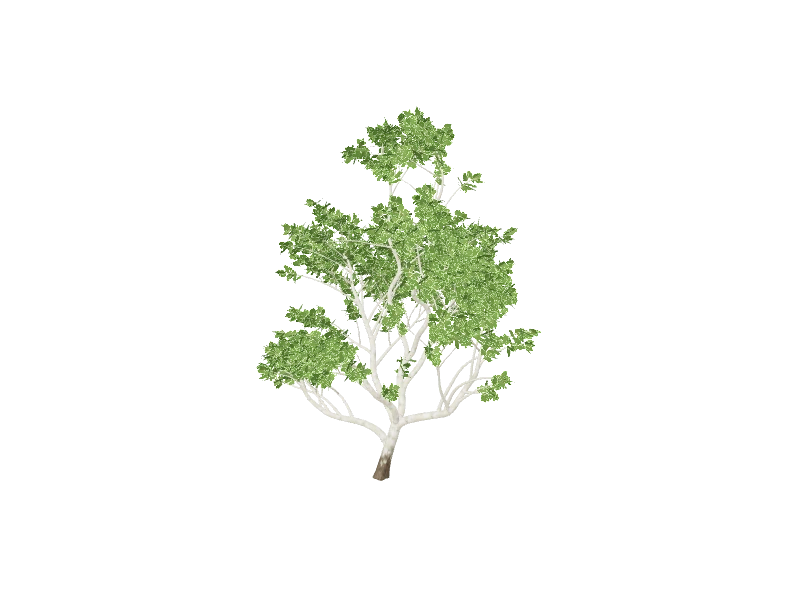
Built from a cited dossier (leaves of this species from Lake Uinta in Utah, among them DMNH EPI.9103 and EPI.9750, a Smithsonian leaf from Colorado, and the living California sycamore Platanus racemosa) and chosen by blind review over a competing model (91.5 vs 87.2). Shown as one leaning tree 18 m tall in summer leaf. The leaf is documented from Green River fossils: wider than long, deeply cut into five narrow, straight-sided lobes with small sharp teeth pointing toward the lobe tips, five main veins meeting at one point at the base, and a slender stalk. At Fossil Lake itself the sycamore family is known from pollen and from undescribed leaves and seed heads, but this species is recorded only in a Fossil Butte National Monument list, so its leaf is modelled on specimens from Lake Uinta, 2 to 4 million years younger. No trunk or bark is known, so the tree's size, crooked pale limbs and peeling mottled bark are reconstructed from living sycamores, and its colours are inferred.
same genus/family: London plane Platanus x acerifolia
- Group
- Eudicots
- Form
- plane tree / sycamore relative, large tree
- Known from
- leaf (large, palmately lobed); Macginicarpa-type fruiting heads co-occur with the leaves at Green River and Bridger Fm sites (museum records via GBIF) and plane-tree heads occur at Fossil Lake (FMNH)
- Habitat
- riparian and floodplain forest along streams
- Abundance
- one of the 8 most abundant species at Parachute Creek (Lake Uinta) localities (MacGinitie 1969 p.30, via Grande 1984)
- Modern relative
- Platanus racemosa (California sycamore); P. occidentalis is a poor match for the leaf (shallow lobes; FNA)
- Occurrence
- Fossil Basin: the species is named only in the FOBU list (Graham 2012 Table 1 p. 19, as Platanus wyomingensis), which also includes Lake Uinta material (e.g. Cardiospermum, FOBU 10725, from the Parachute Creek Mbr); not in Grande's F-1 list (1984 p. 262); the Fossil Lake plane-tree leaves figured in Grande 2013 (FMNH PP 43963, PP 43976) are undescribed and differently shaped; Platanaceae are confirmed at Fossil Lake by pollen (Cushman 1983 Table I) and by FMNH leaves and fruiting heads (PP 43978, 45671, 53546); Lake Uinta (Parachute Creek Mbr); Lake Gosiute: type locality Green River, Wyoming (Newberry 1898 p. 121) and Little Mountain (Wilf 2000 Table A3); Platanus sp. prevalent at Lake Gosiute locality G-1 (Grande 1984); Bridger Fm: Blue Rim (Stein et al. 2021 p. 2518)
- Notes
- Basionym Aralia wyomingensis Knowlton & Cockerell 1919, a replacement name for Aralia macrophylla Newberry 1883, which is preoccupied by A. macrophylla Lindley 1844 (Knowlton 1923 p. 172; Wilf 2000 Table A3 p. 304); the combination is credited to Manchester (place of publication not seen; Manchester 1986 abstract describes the genus with M. angustiloba). The Fossil Lake record of the species is a FOBU list entry only; abundance figure applies to Lake Uinta. Fruiting heads are linked to the leaves by co-occurrence only.
Sources
- Graham, J.P. 2012. Fossil Butte National Monument: geologic resources inventory report. Natural Resource Report NPS/NRSS/GRD/NRR—2012/587. National Park Service, Fort Collins, CO., Table 1 ↗
- Grande, L. 1984. Paleontology of the Green River Formation, with a review of the fish fauna (2nd ed.). Geological Survey of Wyoming Bulletin 63, 333 p., Table V.1 ↗
- Wikipedia. Paleobiota of the Green River Formation. Wikipedia. ↗
- Manchester, S.R. 1986. Vegetative and reproductive morphology of an extinct plane tree (Platanaceae) from the Eocene of western North America. Botanical Gazette 147:200–226. ↗
- Grande, L. 1984. Paleontology of the Green River Formation, with a review of the fish fauna (2nd ed.). Geological Survey of Wyoming Bulletin 63, 333 p., p.262 ↗
- Knowlton, F.H. 1923. Revision of the flora of the Green River formation, with descriptions of new species. USGS Professional Paper 131-F, pp. 133–182., p.172 ↗
- Wilf, P. 2000. Late Paleocene–early Eocene climate changes in southwestern Wyoming: paleobotanical analysis. GSA Bulletin 112(2):292–307., Table A3 ↗
- Newberry, J.S. 1898. The later extinct floras of North America. USGS Monograph 35., p.121 ↗
- Stein, R.A., Sheldon, N.D., Allen, S.E., Smith, M.E., Dzombak, R.M. & Jicha, B.R. 2021. Climate and ecology in the Rocky Mountain interior after the early Eocene Climatic Optimum. Climate of the Past 17:2515–2536., p.2518 ↗
- Cushman, R.A., Jr. 1983. Palynology and Paleoecology of the Fossil Butte Member of the Eocene Green River Formation in Fossil Basin, Lincoln County, Wyoming. MS thesis, Loma Linda University., Table I pp.18-22 ↗
- Field Museum. Field Museum on GBIF. GBIF; accessed 2026-10-05. ↗
- Kaul, R.B. 1997. Platanaceae. In Flora of North America Editorial Committee (eds.), Flora of North America North of Mexico, vol. 3. ↗