Lygodium kaulfussi
Also published as: Lygodium kaulfussii; Lygodium neuropteroides
This entry was compiled from research notes and has not yet been reviewed by a person. Its facts come from the sources listed below, which are the authority if anything here disagrees with them.
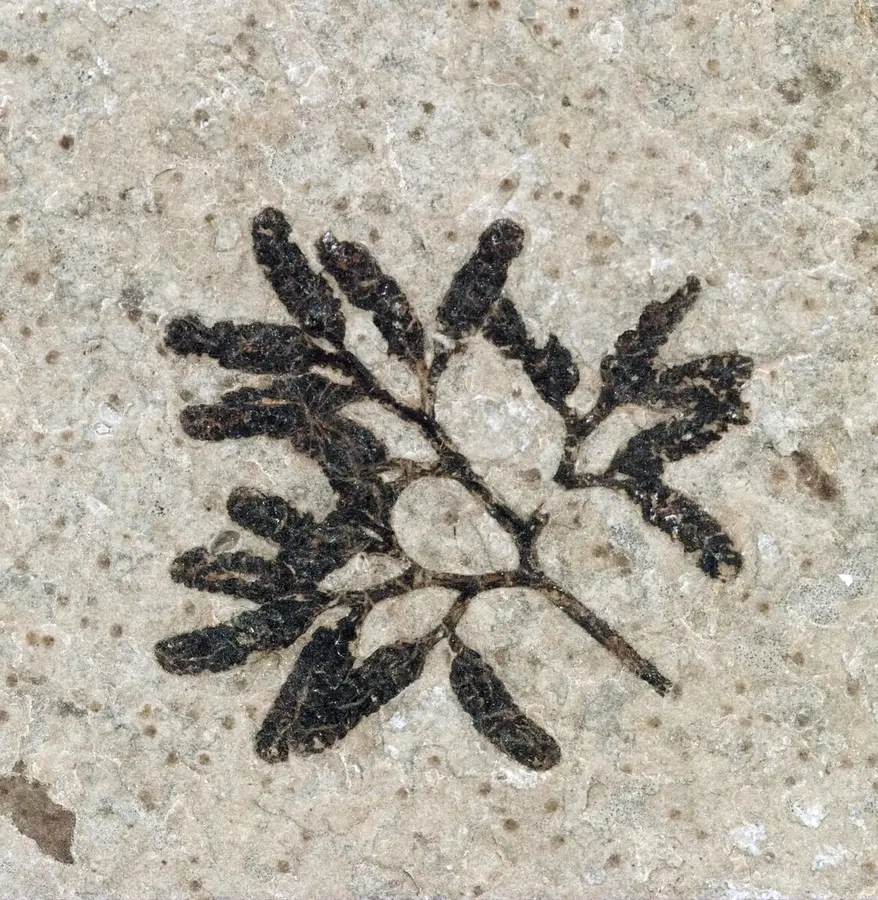
FBM
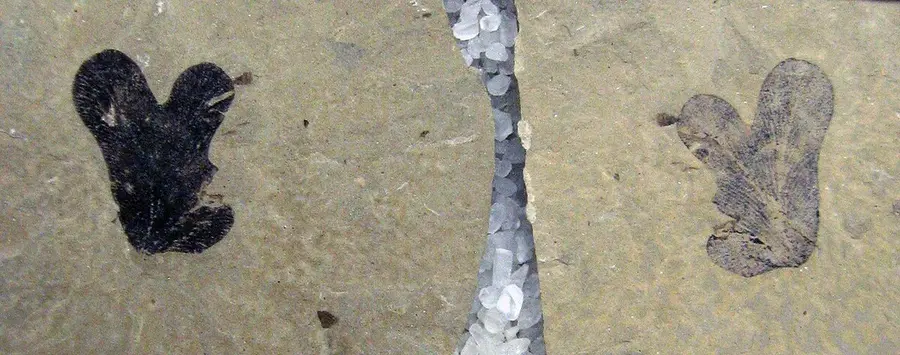
Parachute Creek Member, Colorado (Lake Uinta), not Fossil Lake
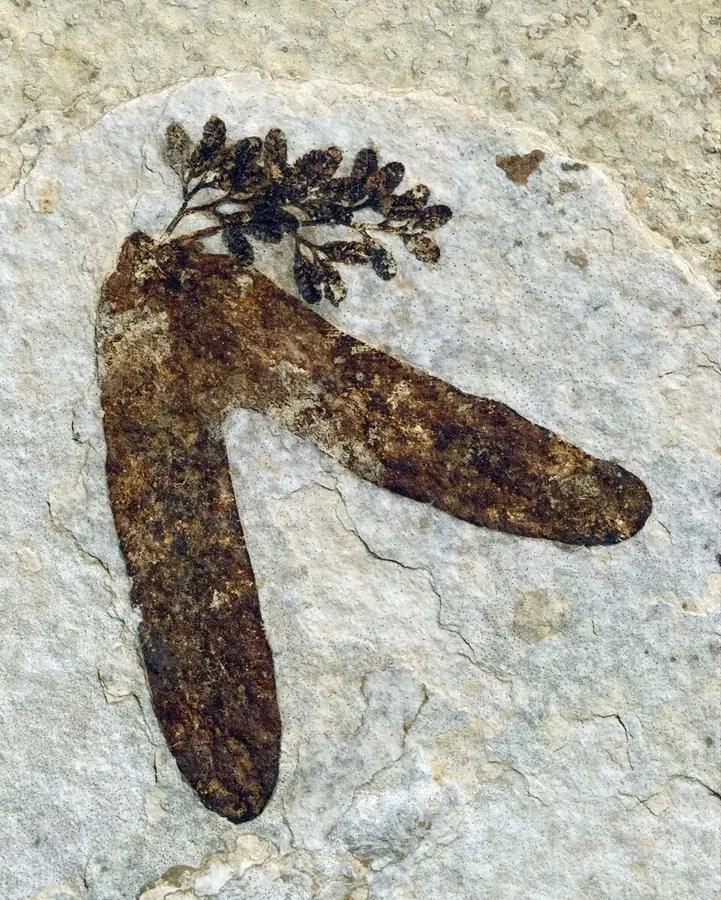
FOBU12018; a two-lobed sterile pinna with a fertile pinna at its base (NPS alt text: 'fossil of 2 long skinny leaves in a v shape with small clump of seeds at the base'; ferns have no seeds; cf. the fertile pinnae in Manchester & Zavada 1987 fig. 6 and FOBU 14035a)
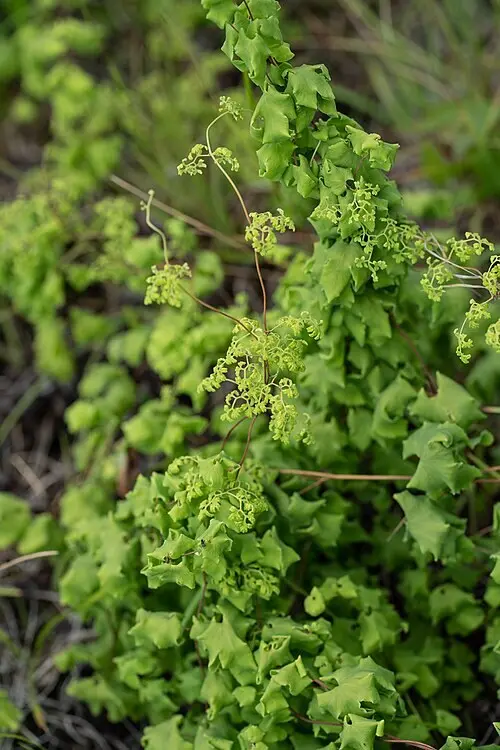
modern analog: Lygodium palmatum; catalog modern_analog: "Lygodium palmatum (American climbing fern)"
3D models
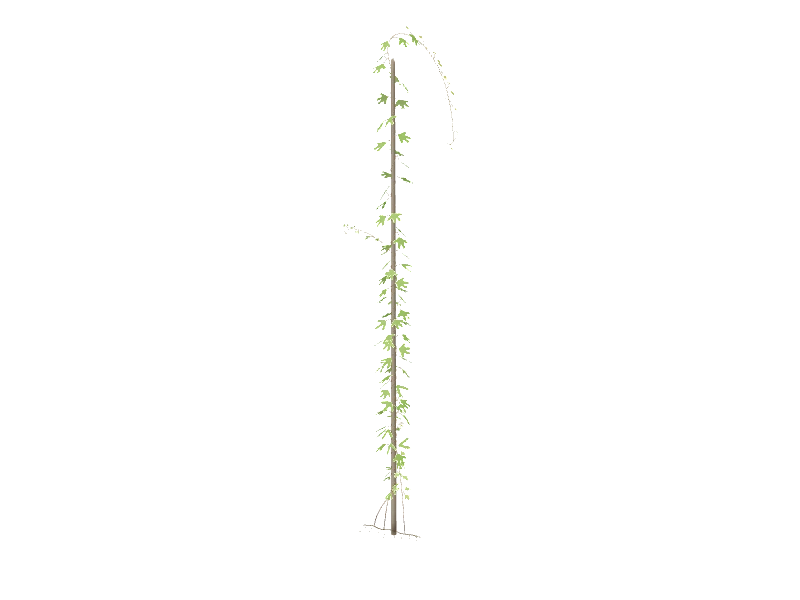
Built from a cited dossier (Fossil Lake specimens FOBU 12018 and FOBU 14035a, fertile material from the Bridger Formation described by Manchester and Zavada in 1987, and the living American climbing fern Lygodium palmatum) and chosen by blind review over a competing model (90.1 vs 80.4). Shown as one plant with three fronds twining up a dead sapling stem 1.6 m tall; the stem is only a support and is not part of the fern. The leaflets are documented from Green River fossils: palm-shaped, about 4 cm long, with two to four long, strap-like, round-tipped lobes and fine forking veins, borne in pairs on short side branches, and separate, finely branched fertile leaflets that carried the spores. What looks like a twining vine is the stalk of a single leaf, as in all climbing ferns. No stem or root of this species is known, so the plant's height, its twining and the number and length of its fronds are reconstructed from the living species, and its colours are inferred.
same family as Platycerium (Polypodiaceae): Common polypody fern
- Group
- Ferns & allies
- Form
- climbing fern (twining fronds)
- Known from
- sterile pinnae; fertile pinnae with sorophores (Fossil Lake FOBU 12018 and FOBU 14035a; Bridger Fm, Manchester & Zavada 1987); spores (smooth-walled, in situ in the Bridger fertile pinnae; dispersed Lygodiumsporites in the FBM, Cushman 1983)
- Habitat
- lake-margin swamp forest; floodplain forest edges (climbing over shrubs)
- Abundance
- figured specimens at FOBU; 'hundreds of specimens' from Green River, Wyoming (Newberry 1898); 'abundant' at Blue Rim, Bridger Fm (Stein et al. 2021); 'numerous' across Green River Fm per Wikipedia list
- Modern relative
- Lygodium palmatum (American climbing fern)
- Occurrence
- Fossil Lake (FOBU12018; FOBU 14035a, NPGallery, 'approximately 1.9 cm across'); Fossil Basin, Fowkes Fm above the Green River Fm (Oriel & Tracey 1970 p. 37); Lake Uinta (Parachute Creek Mbr); Wasatch Fm floodplain floras of the Greater Green River Basin: L. kaulfussi Heer with foliage and sori (USNM 498143, 497986) at Latham, Sourdough and Niland Tongue, 'abundant' at Sourdough (Wilf 2000 Tables A3, A4); Lygodium (genus) at Wasatch Fm floodplain localities (Pigg & DeVore 2010); Bridger Fm with fertile sorophores (Manchester & Zavada 1987)
- Notes
- Spores of the form genus Lygodiumsporites also occur in the FBM (Cushman 1983; see that record). Authority Heer 1861 p. [409] (original spelling 'Kaulfussi'); synonym L. neuropteroides Lesquereux (Gardner & Ettingshausen 1880 p. 48; Newberry 1898; Knowlton 1923 p. 149). Manchester & Zavada (1987) state L. kaulfussi closely resembles living L. palmatum of eastern North America. L. japonicum is not a suitable analog: its pinnae are finely cut and 2-3-pinnate, and its fertile pinnae are weakly differentiated (FNA; FoC).
Sources
- National Park Service, Fossil Butte National Monument 2025. Fossil Plant Species. nps.gov/fobu, last updated September 26, 2025; accessed 2026-10-05. ↗
- Grande, L. 1984. Paleontology of the Green River Formation, with a review of the fish fauna (2nd ed.). Geological Survey of Wyoming Bulletin 63, 333 p., Table V.1 ↗
- Manchester, S.R. & Zavada, M.S. 1987. Lygodium foliage with intact sorophores from the Eocene of Wyoming. Botanical Gazette 148:392–399. ↗
- Wilf, P. 2000. Late Paleocene–early Eocene climate changes in southwestern Wyoming: paleobotanical analysis. GSA Bulletin 112(2):292–307., Tables A3-A4 ↗
- Newberry, J.S. 1898. The later extinct floras of North America. USGS Monograph 35., pp.1-3 ↗
- Stein, R.A., Sheldon, N.D., Allen, S.E., Smith, M.E., Dzombak, R.M. & Jicha, B.R. 2021. Climate and ecology in the Rocky Mountain interior after the early Eocene Climatic Optimum. Climate of the Past 17:2515–2536., p.2518 ↗
- Oriel, S.S. & Tracey, J.I., Jr. 1970. Uppermost Cretaceous and Tertiary stratigraphy of Fossil Basin, southwestern Wyoming. USGS Professional Paper 635, 53 p., p.37 ↗
- NPS. NPGallery FOBU "Donated Fossils" album. NPGallery., FOBU14035a ↗
- Cushman, R.A., Jr. 1983. Palynology and Paleoecology of the Fossil Butte Member of the Eocene Green River Formation in Fossil Basin, Lincoln County, Wyoming. MS thesis, Loma Linda University., Table I pp.18-22 ↗
- Heer, O. 1861. Beiträge zur nähern Kenntniss der sächsisch-thüringischen Braunkohlenflora. Abhandlungen des Naturwissenschaftlichen Vereins für die Provinz Sachsen und Thüringen in Halle 2 (separate: Berlin, G. Bosselmann)., p. [409] ↗
- Gardner, J.S. & Ettingshausen, C. 1880. A monograph of the British Eocene flora, vol. 1, Filices, part 2. Palaeontographical Society, London, pp. 39–58, pls. 6–11., p.48 ↗
- Knowlton, F.H. 1923. Revision of the flora of the Green River formation, with descriptions of new species. USGS Professional Paper 131-F, pp. 133–182., p.149 ↗
- Nauman, C.E. 1993. Lygodiaceae: Lygodium. In Flora of North America Editorial Committee (eds.), Flora of North America North of Mexico, vol. 2. ↗
- Zhang, X. & Hanks, J.G. 2013. Lygodiaceae. In Wu, Z.Y., Raven, P.H. & Hong, D.Y. (eds.), Flora of China, vol. 2–3. ↗