Limnofregata azygosternon
This entry was compiled from research notes and has not yet been reviewed by a person. Its facts come from the sources listed below, which are the authority if anything here disagrees with them.
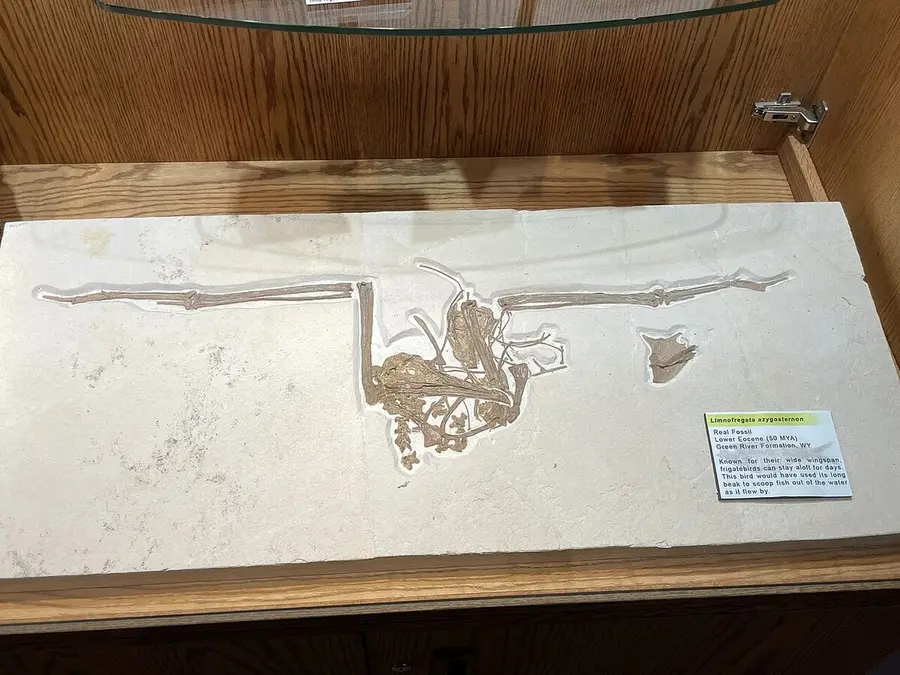
Wyoming Dinosaur Center
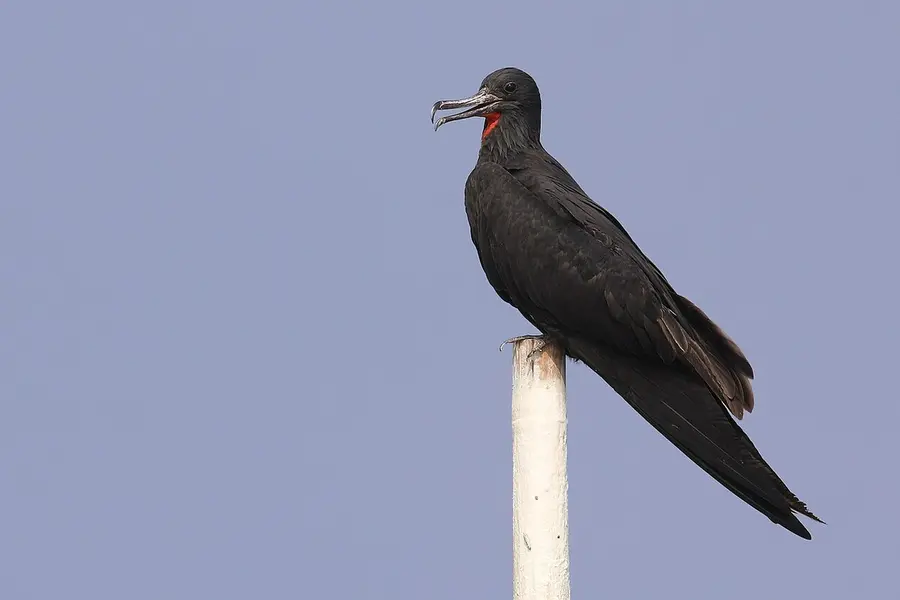
modern analog: Fregata ariel (Lesser frigatebird); catalog modern_analog: "Fregata ariel (lesser frigatebird)"
3D models
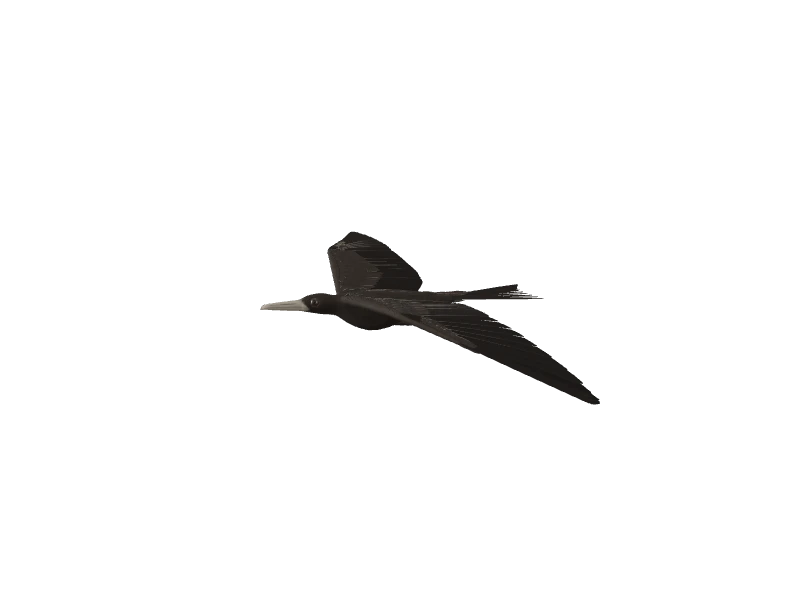
Built from a cited dossier (the Fossil Lake holotype USNM V 22753 described by Olson in 1977, later specimens described by Olson and Matsuoka in 2005, and living frigatebirds and boobies) and chosen by blind review over a competing model (82.2 vs 77.8). Shown as one adult soaring low over the lake with its wings fully spread, about 1.5 m across. The skeleton is documented from fossils, and so are black impressions of its flight feathers: compared with living frigatebirds it had shorter, blunter wings, a shorter bill with only a moderate hook, and longer legs, and it could probably sit on the water. The webbed feet are assumed from its relatives, the shallowly forked tail and its length are inferred because no tail feathers are preserved, and the near-black colour follows the dark feather films but is otherwise inferred.
same family (skull only): Frigatebird skull
- Description
- Lake frigatebird: shorter wings, longer legs (webbed feet assumed) and straighter bill than modern frigatebirds
- Group
- Bird
- Size
- about the size of a small male Lesser Frigatebird; humerus 138-148 mm; skull+bill 132 mm
- Habitat
- open lake; soaring, surface-feeding
- Diet
- fish, probably especially Knightia (inferred; no stomach contents known); possibly scavenged fish die-offs (speculative)
- Abundance
- most abundant large-bodied FBM bird; 7 published specimens (6 from Fossil Lake, 1 from Lake Gosiute) plus unpublished FMNH specimens
- Modern relative
- Fregata ariel (lesser frigatebird)
- Notes
- Holotype USNM 22753 from near the old Haddenham diggings, now inside Fossil Butte NM; collected by M. L. Larsen (O77 pp. 3-4). Grande 1984 credits it to Carl Ulrich, who collected the paratype UWY 6919. Carbonized black flight-feather impressions. Large orbits: possibly crepuscular. The diet is inferred: no stomach contents are known; Olson (1977 p. 32) pictured a gull-like predator and scavenger, and OM05 (p. 13) call Knightia ideal prey. Probably scavenged summer fish die-offs (speculative, OM05). The leg bones and long toes are measured, but the webbing is assumed ('assuming that the foot was totipalmate', OM05 p. 6). Published specimens: holotype and paratypes UWY 6919 and USNM 243766 (O77); GMNH PV 167, FMNH PA 723 and FMNH PA 720 from Fossil Lake and USNM 447002 from Lake Gosiute (OM05). The FMNH catalogue also lists unpublished specimens: PA 755 (as L. azygosternon, although its skull and mandible, about 150-155 and 149 mm on FMNH's scaled photograph, match L. hasegawai (OM05 Table 2; project measurement)), PA 731 and PA 762 (Limnofregata) and PA 790 and PA 805 (L. hasegawai).
Sources
- Olson, S.L. 1977. A Lower Eocene frigatebird from the Green River Formation of Wyoming (Pelecaniformes: Fregatidae). Smithsonian Contributions to Paleobiology 35., pp.3-37 ↗
- Olson, S.L. & Matsuoka, H. 2005. New specimens of the early Eocene frigatebird Limnofregata…. Zootaxa 1046:1–15. ↗
- Nesbitt, S.J. & Clarke, J.A. 2016. The anatomy and taxonomy of the exquisitely preserved Green River Formation (early Eocene) lithornithids (Aves) and the relationships of Lithornithidae. Bulletin AMNH 406:1–91., p.10 ↗
- Grande, L. 1984. Paleontology of the Green River Formation, with a review of the fish fauna (2nd ed.). Geological Survey of Wyoming Bulletin 63, 333 p., p.204 ↗
- Field Museum. Field Museum site-wide collections search. Field Museum (fieldmuseum.org); public but undocumented JSON service; accessed 2026-10-05., PA 731, PA 755, PA 762, PA 790, PA 805 ↗