Knightia eocaena
herring
Also published as: Clupea humilis; Diplomystus humilis; Lithichthys pusillus (in part)
This entry was compiled from research notes and has not yet been reviewed by a person. Its facts come from the sources listed below, which are the authority if anything here disagrees with them.
A little herring that swam in schools
- How big
- Most fossils are about 8 cm (3 in), finger-length; up to 25 cm (10 in)
- What it ate
- Probably algae, tiny shelled animals and insects; rarely small fish
- Where it lived
- In schools all over the open lake, thickest near the shore
- Fossils found
- The most common fossil fish here; 2,319 at the park's research quarry
Knightia was a slim little herring, probably silvery like the herrings alive today. It swam in schools all its life, and it probably strained small bits of food from the water with its gills. Many bigger fish hunted it, and their fossils are often found with a Knightia in their mouth.
Fun fact Knightia is Wyoming's state fossil, and it may be the most common complete fossil of a backboned animal anywhere in the world.
The science
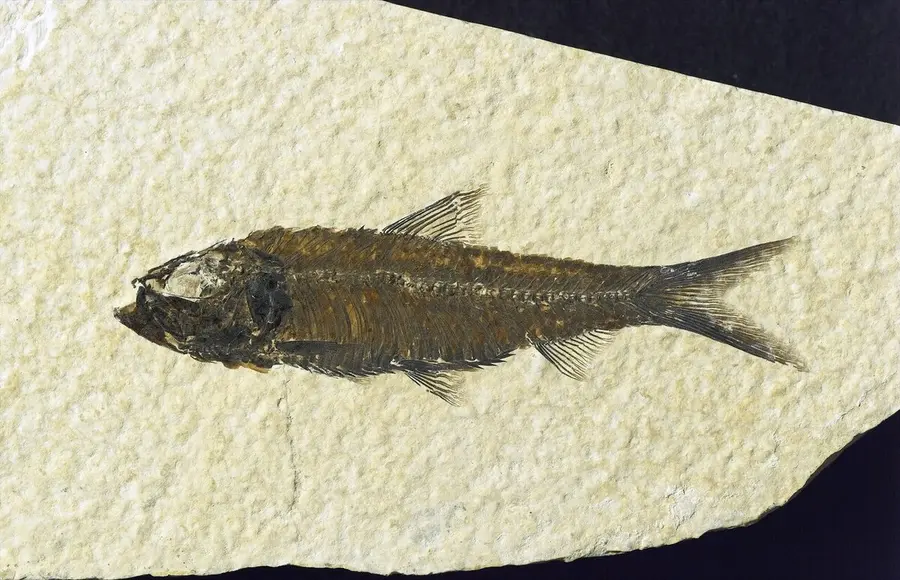
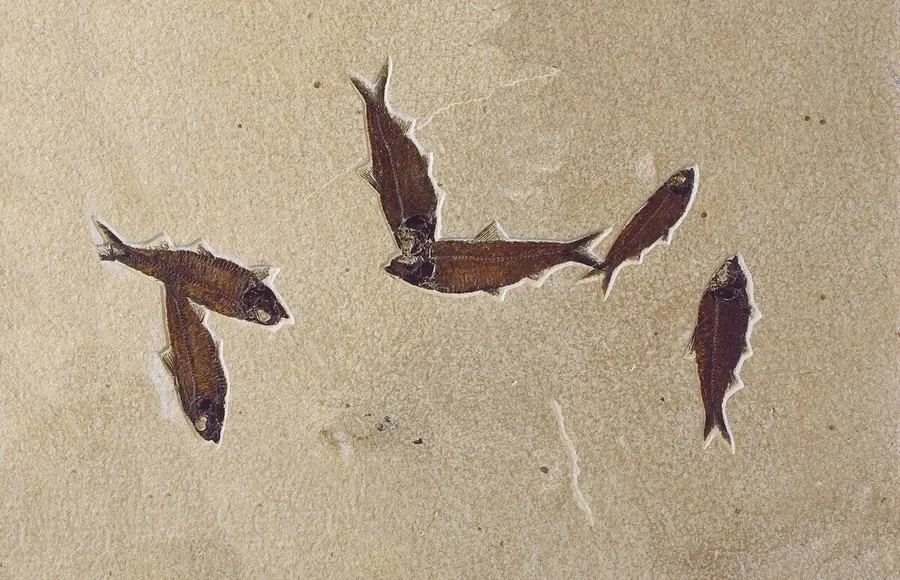
mass mortality
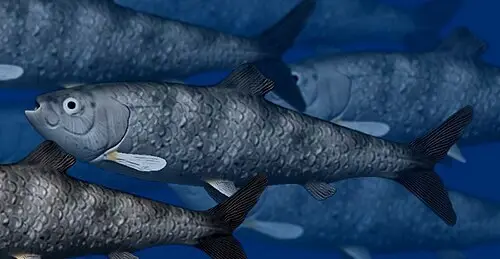
Nobu Tamura digital restoration (Knightia sp.)
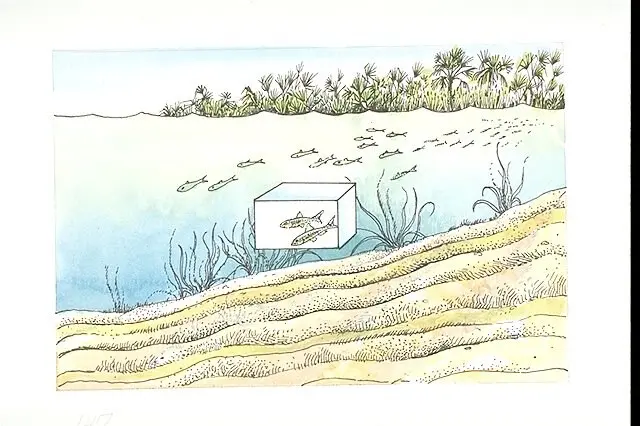
school of Knightia eocaena (fossilization phase 1 panel); NPGallery: "Government owns art and all reproduction rights"; 01/01/1990 - 12/30/1990; Image_Size=9-3/16" x 7-7/16"; Count:15/19; Exhibit 16/Graphic # FB-G-147(16)
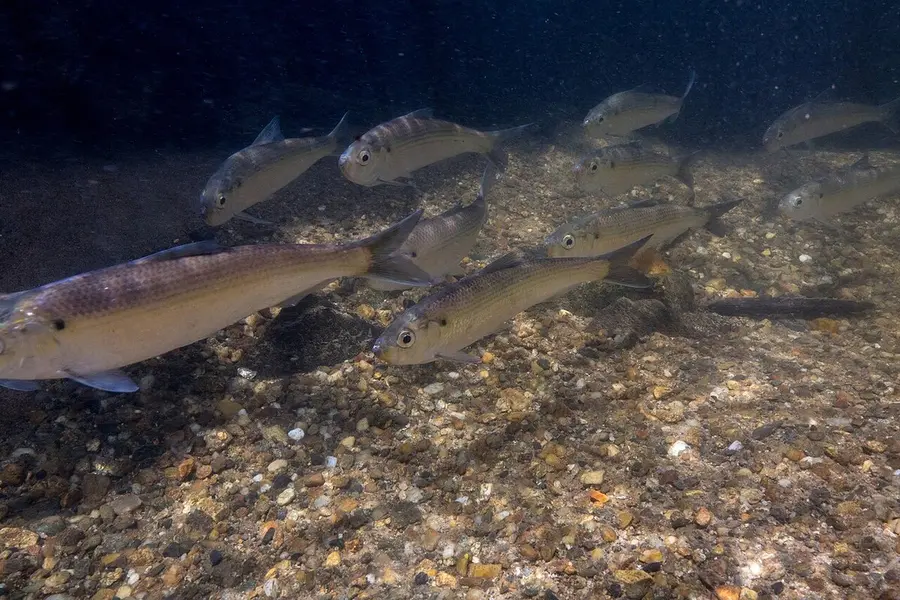
modern analog: Alosa pseudoharengus (Alewife (fish)); catalog modern_analog: "Alosa pseudoharengus (alewife)"
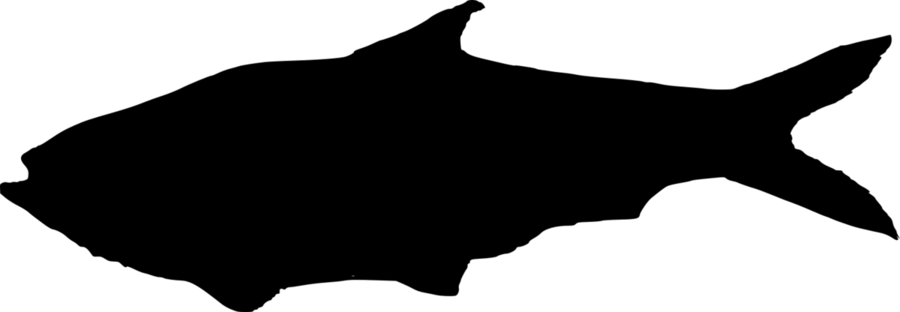
PhyloPic silhouette; depicts Knightia (stand-in for Knightia eocaena)
3D models
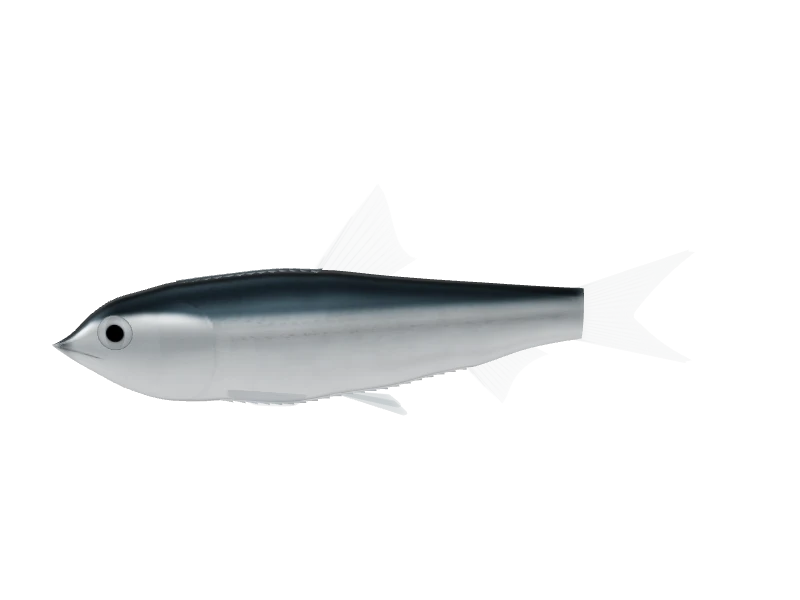
Built from a cited anatomical dossier (Grande 1982, 1984; NPS specimen photographs and research-quarry measurements) and chosen by blind review over a competing model. Shown at the median size of NPS research-quarry fish, 6.7 cm standard length. Body proportions, fin positions, fin-ray counts and the rows of back and belly scutes are documented from fossils. The faint spot bands along the back and side follow a single specimen that Grande (1984) described as showing "possible pigmentation". The countershaded silver colouring and the transparent eyelids are inferred from living herrings.
same species (fossil): Knightia eocaena fossil
same genus (fossil): Knightia sp. (YPM VPPU.010168)
same genus (fossil): Knightia sp. fossil
same family (Clupeidae): Sardine Sardinops melanostictus
same order (Clupeiformes): Pacific herring Clupea pallasii
same order: Red-eye round herring Etrumeus teres
- Description
- Small schooling herring (Clupeidae: Pellonulinae); dorsal scutes; possible pigment: line of dark spots along back plus lighter lateral band
- Group
- Fish
- Size
- average 13-15 cm TL, max ~25 cm; NPS quarry median SL 67 mm (n=1638)
- Habitat
- open-water schools in all zones; densest nearshore
- Diet
- algae, diatoms, ostracods, insects, rarely small fish
- Abundance
- extremely common: most common Fossil Lake fish; 30-61% of counted samples
- Modern relative
- Alosa pseudoharengus (alewife)
- NPS quarry
- 2,319 specimens, 1998–2020 (Logged as "Knightia")
- Notes
- Wyoming state fossil; most commonly found articulated vertebrate fossil in the world (NPS). Forms mass-mortality layers up to several hundred per m2 (G84) / 100 per m2 (NPS). Alternative analogs: Dorosoma petenense, Limnothrissa miodon.
Sources
- Grande, L. 1984. Paleontology of the Green River Formation, with a review of the fish fauna (2nd ed.). Geological Survey of Wyoming Bulletin 63, 333 p., pp.84-89 ↗
- National Park Service, Fossil Butte National Monument 2025. Fossil Fish Species. nps.gov/fobu, last updated November 18, 2025; accessed 2026-10-05. ↗
- Finger, T.R. 1998. A comparison of fish community structure among several paleoenvironments of Eocene Fossil Lake, Wyoming: a preliminary report. In Santucci, V.L. & McClelland, L. (eds.) 1998, National Park Service Paleontological Research [vol. 3], NPS/NRGRD/GRDTR-98/01, p. 81ff. ↗
- National Park Service, Fossil Butte National Monument 2023. Fossil Butte Research Quarry Data: Data 1998–2020, Missing 2018. nps.gov/fobu, specimen and abundance CSV files, page last updated October 26, 2023; accessed 2026-10-05. ↗