Icaronycteris index
This entry was compiled from research notes and has not yet been reviewed by a person. Its facts come from the sources listed below, which are the authority if anything here disagrees with them.
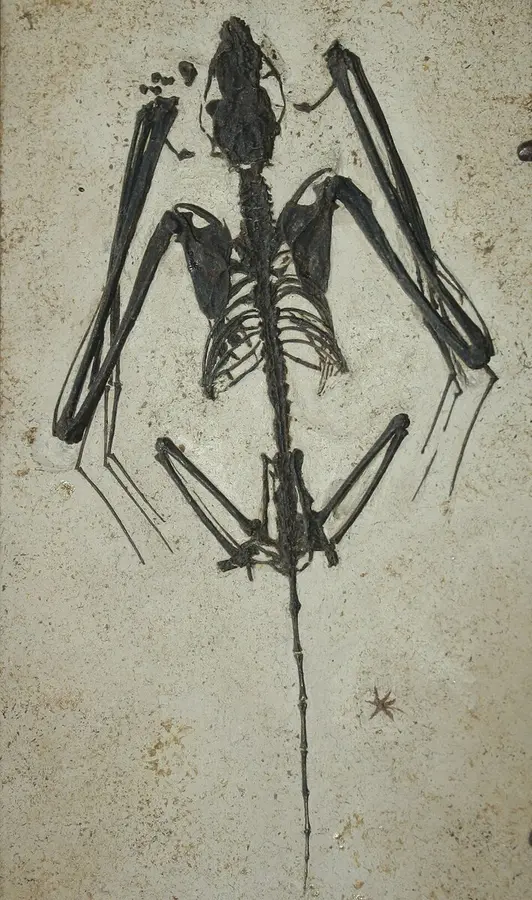
cast of the holotype on display at the AMNH (AMNH 39501, gift of G. L. Jepsen, 1966, per the Commons description of another photo of the same slab); the holotype itself, YPM-PU 18150, is at the Yale Peabody Museum (Rietbergen et al. 2023)
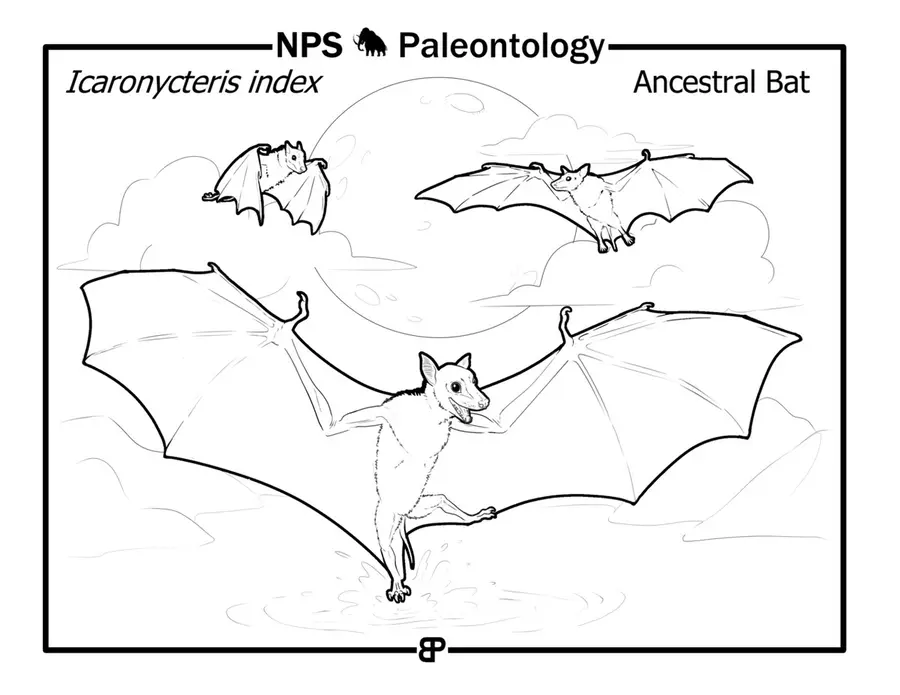
NPS line drawing
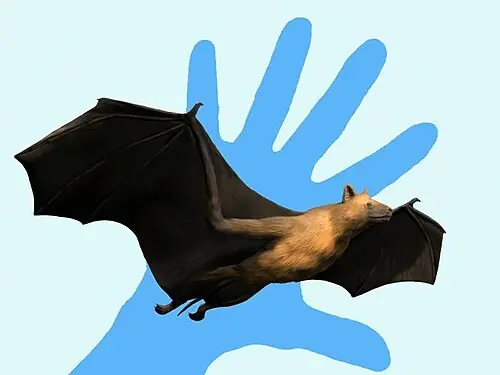
Nobu Tamura
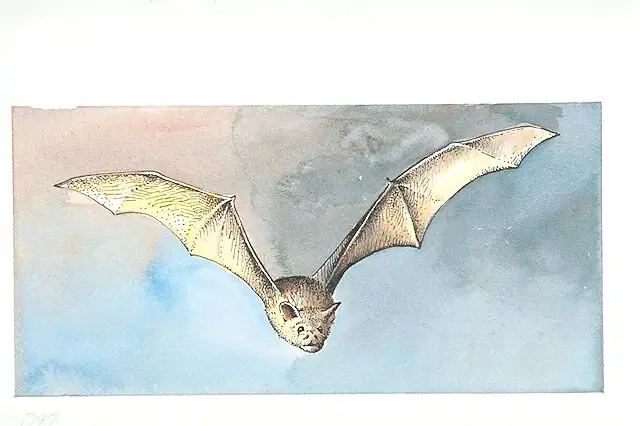
NPGallery: "Government owns art and all reproduction rights"; 01/01/1990 - 12/30/1990; Image_Size=9-3/8" x 6-1/16"; Count:10/19; Exhibit 11/Graphic # FB-G-097(11)
3D models
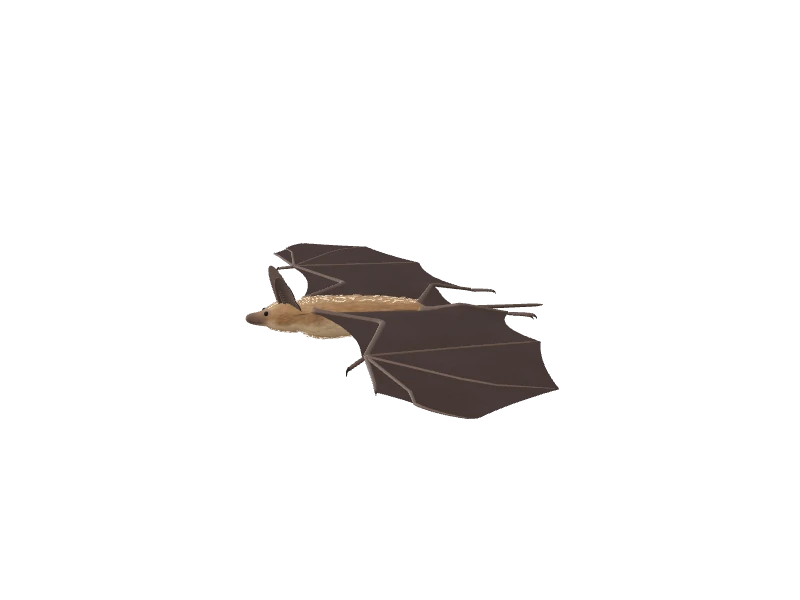
Built from a cited dossier (the complete Fossil Lake holotype YPM-PU 18150 described by Jepsen in 1966, its published bone measurements, later specimens studied by Simmons and Geisler in 1998 and Rietbergen and colleagues in 2023, and living bats for soft tissue) and chosen by blind review over a competing model (94.4 vs 93.1). Shown as one adult gliding between wingbeats, wings fully spread about 30 cm across. The skeleton is documented from fossils: a relatively short forearm and broad wing with a rounded tip, claws on the thumb and index finger only, no calcar spur at the ankle, and a long, free tail almost three-quarters the length of the head and body. No ears, fur or wing membrane are preserved, so the membranes and their attachments, the ears, the furred body and the brown colours are reconstructed from living insect-eating bats and from colour traces found in other Eocene bats.
same species (cast): Icaronycteris index cast
order (Chiroptera): Hammer-headed fruit bat (specimen scan)
- Description
- Early bat (Icaronycteridae) with a long tail; claws on thumb and index finger
- Group
- Mammal
- Size
- head-body ~73 mm, tail 52.4 mm, total ~125 mm (holotype); wingspan ~30 cm; 10-16 g (SG98) or 24-27 g (R23, which credits Amador et al. 2018, probably a citation slip; not checkable as cited)
- Habitat
- forest and lake edge
- Diet
- insects (inferred); one small fish scale lies within the holotype's rib cage and may have been ingested; no fishing adaptations; no stomach contents known (SG98)
- Abundance
- commonest FBM mammal: about 50 I. index skeletons (G13 p.260), though the same book counts '35 or so' bat specimens in all (p. 353); R23 count nearly 30 bat fossils of all species
- Modern relative
- Myotis (mouse-eared bat) as perch-gleaning stand-in
- Notes
- Probably echolocated with short broadband calls used for orientation; perch-hunting gleaner flying low near vegetation (SG98). Specimens come from both the 18-inch layer and the sandwich beds (R23). Lengths are from the holotype (Jepsen 1966 Table 1): overall length 125.0 mm, 13 caudals 52.4 mm. The 50.5 mm 'BL' in the R23 S1 Table is the vertebral column without the skull, not head-body length. NPS reports the fish scale as a stomach content; the primary source (Jepsen 1966 p. 1336) says only that it lies within the rib cage and may have been in the intestinal tract, and that a small fecal mass may include bits of insect chitin.
Sources
- Rietbergen, T.B., van den Hoek Ostende, L.W., Aase, A., Jones, M.F., Medeiros, E.D. & Simmons, N.B. 2023. The oldest known bat skeletons and their implications for Eocene chiropteran diversification. PLoS ONE 18(4):e0283505. ↗
- Simmons, N.B. & Geisler, J.H. 1998. Phylogenetic relationships of Icaronycteris, Archaeonycteris, Hassianycteris, and Palaeochiropteryx to extant bat lineages…. Bulletin AMNH 235:1–182. ↗
- Grande, L. 2013. The Lost World of Fossil Lake: Snapshots from Deep Time. Univ. Chicago Press, xi + 425 pp. (catalogue record; publisher says 432 pp.), 243 colour plates. ISBN 9780226922966 / ebook 9780226922980., p.260 ↗
- National Park Service, Fossil Butte National Monument 2025. Fossil Mammal Species. nps.gov/fobu, last updated September 26, 2025; accessed 2026-10-05. ↗
- Jepsen, G.L. 1966. Early Eocene bat from Wyoming. Science 154(3754):1333–1339., pp.1335-1336, Table 1 ↗
- Grande, L. 2013. The Lost World of Fossil Lake: Snapshots from Deep Time. Univ. Chicago Press, xi + 425 pp. (catalogue record; publisher says 432 pp.), 243 colour plates. ISBN 9780226922966 / ebook 9780226922980., p.353 ↗