Heliobatis radians
stingray
Also published as: Xiphotrygon acutidens; Palaeodasybatis discus
This entry was compiled from research notes and has not yet been reviewed by a person. Its facts come from the sources listed below, which are the authority if anything here disagrees with them.
A round stingray that lived in a lake, not the sea
- How big
- About 35 cm (14 in) long with its tail, a bit longer than a ruler
- What it ate
- Probably snails, crayfish, shrimp and small fish
- Where it lived
- On the lake bottom, mostly in shallower water near shore
- Fossils found
- Hundreds known, many showing a sunburst of fin rays in the disc
Heliobatis was flat and nearly round, with a long, thin, whip-like tail. Like stingrays today, it probably glided over the muddy lake bottom by rippling the edges of its body, and sometimes hid under a thin layer of mud. Halfway down its tail sat one to three barbed stings, which living stingrays swing at anything that threatens them.
Fun fact So far, Fossil Lake is the only place in the world where whole, joined-together skeletons of freshwater stingrays have been found.
The science
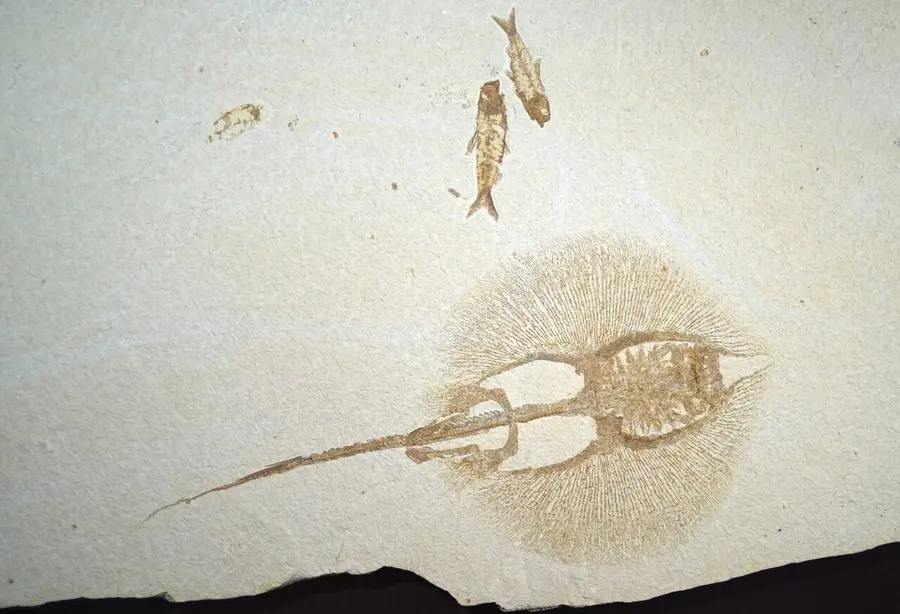
FOBU14172
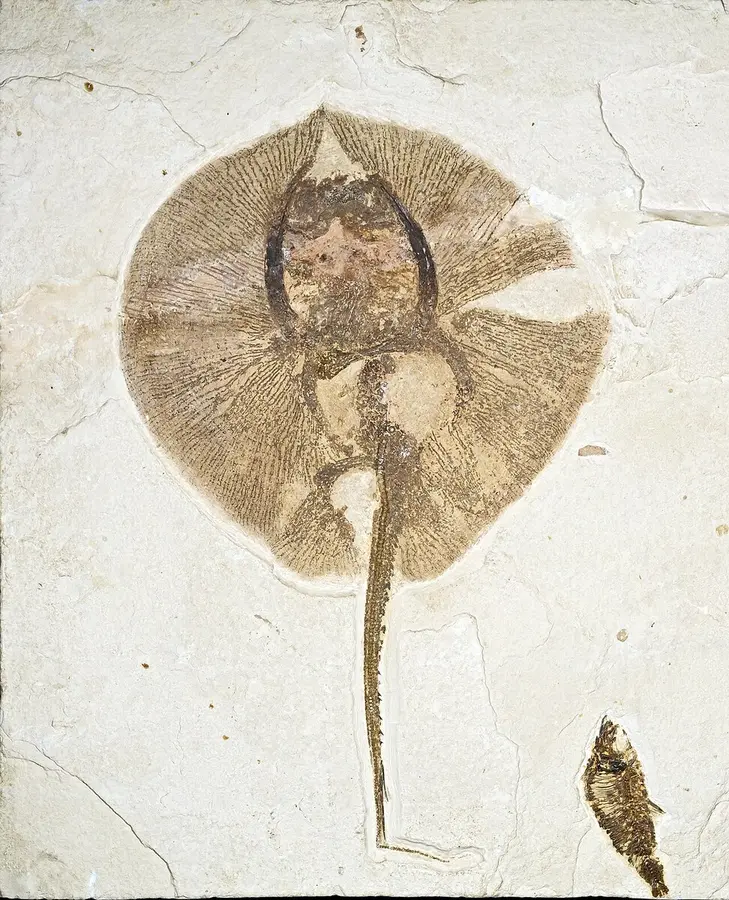
Fossil Lake (Kemmerer) per description
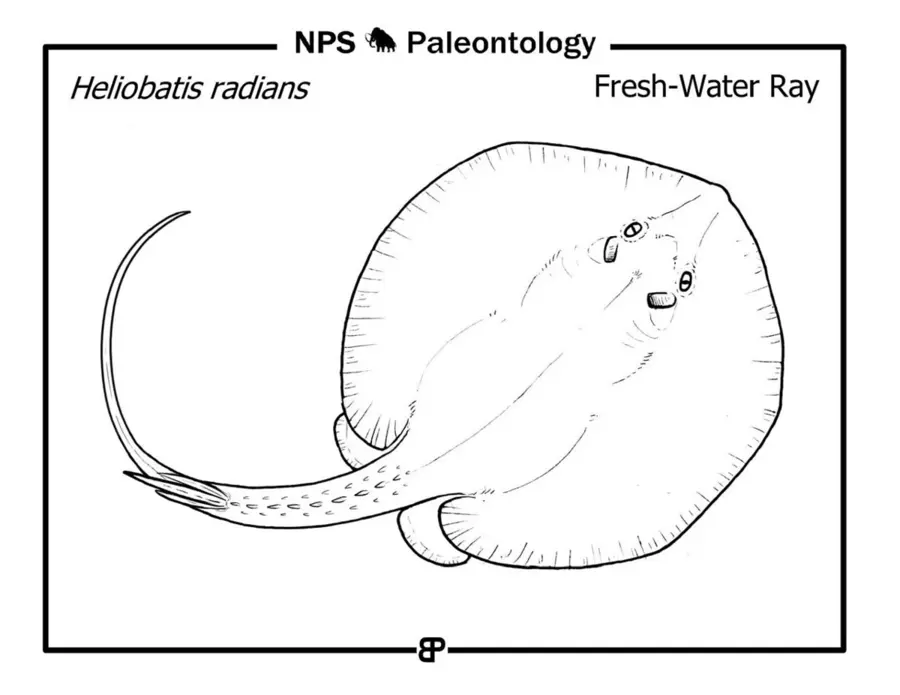
NPS line drawing
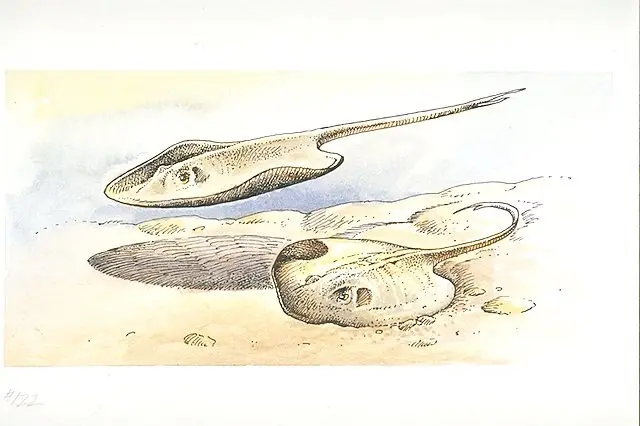
stingrays feeding on lake bottom; species not named in caption; NPGallery: "Government owns art and all reproduction rights"; 01/01/1990 - 12/30/1990; Image_Size=8-5/16" x 5-11/16"; Count:13/19; Exhibit 14/Graphic # FB-G-122(14)
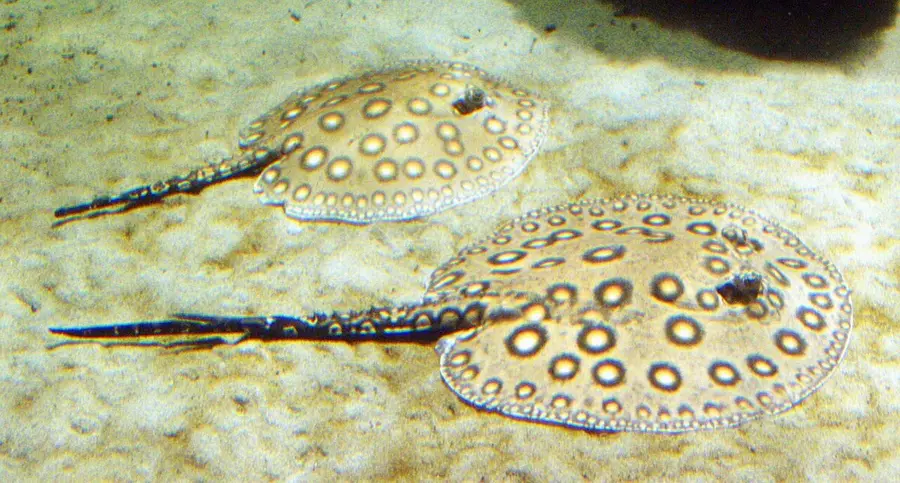
modern analog: Potamotrygon motoro (Ocellate river stingray); catalog modern_analog: "Potamotrygon motoro (South American river stingray)"
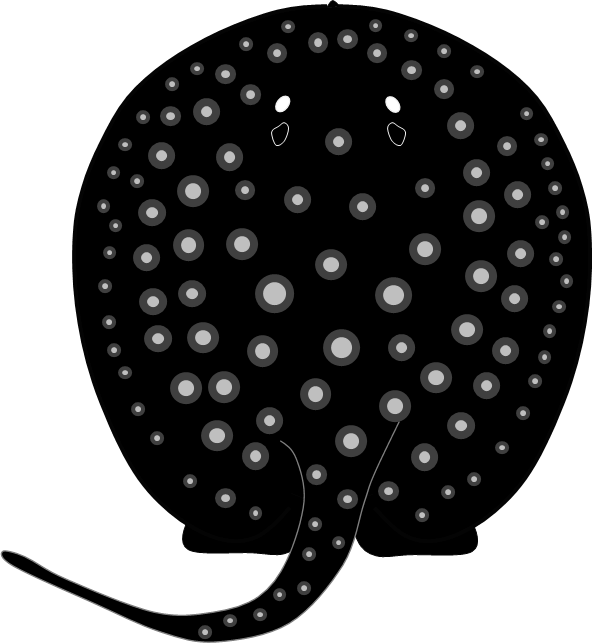
PhyloPic silhouette; depicts Potamotrygon motoro (stand-in for Heliobatis radians)
3D models
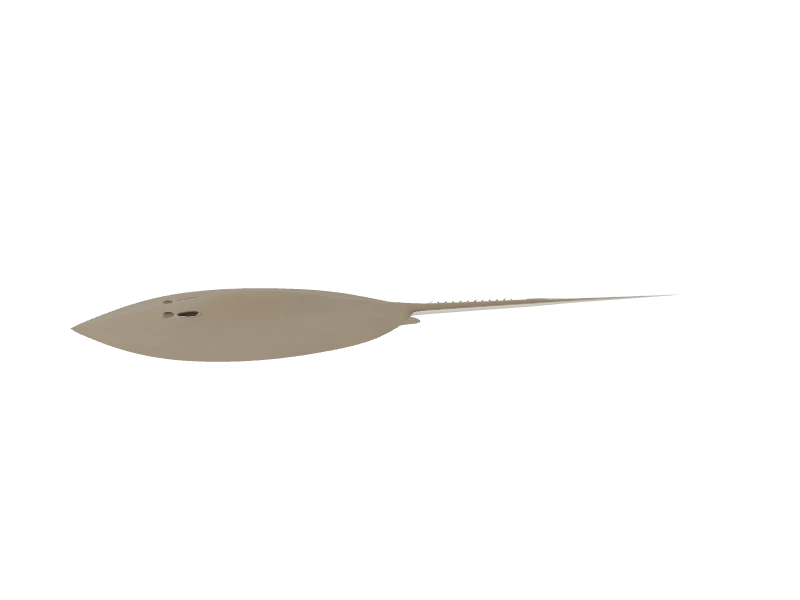
Built from a cited anatomical dossier (Grande 1984, Carvalho et al. 2004 and photographed fossils) and chosen by blind review over a competing model (96.6 vs 95.6). Shown as an adult female (no claspers) with a 17.5 cm disc. The nearly round disc (about 0.95 as wide as long), the slender whip-like tail with stings at mid-tail and a long filament behind them, and the lack of any dorsal or tail fin are documented from fossils; specimens carry one to three stings, and two are shown. Body thickness and the exact positions of the eyes, spiracles, nostrils and gill slits are inferred from living river stingrays, and no colour is preserved, so the plain dull-brown back and pale underside are inferred too.
same order (Myliobatiformes), freshwater: Ocellate river stingray Potamotrygon motoro
- Description
- Freshwater stingray (Myliobatiformes); round disc, up to three barbed tail stings; males with claspers
- Group
- Fish
- Size
- usually 30-40 cm TL; range ~8-90 cm
- Habitat
- benthic; commoner nearshore (F-2) than mid-lake (F-1)
- Diet
- snails, crayfish, shrimp, small fish (crushing teeth)
- Abundance
- rare overall; >100 complete specimens by 1984; ~1 in 2,500 FBM vertebrates is a stingray (both species)
- Modern relative
- Potamotrygon motoro (South American river stingray)
- Notes
- FBM is the only place in the world with articulated freshwater stingray skeletons (NPS). Probably live-bearing like all living stingrays (inferred). Note: the female preserved with young figured by Grande 1984 (fig. II.6a, AMNH 11557) is a paratype of Asterotrygon maloneyi (Carvalho et al. 2004), not Heliobatis.
Sources
- National Park Service, Fossil Butte National Monument 2025. Fossil Fish Species. nps.gov/fobu, last updated November 18, 2025; accessed 2026-10-05. ↗
- Grande, L. 1984. Paleontology of the Green River Formation, with a review of the fish fauna (2nd ed.). Geological Survey of Wyoming Bulletin 63, 333 p., p.27 ↗
- Carvalho, M.R. de, Maisey, J.G. & Grande, L. 2004. Freshwater stingrays of the Green River Formation of Wyoming (early Eocene), with the description of a new genus and species and an analysis of its phylogenetic relationships (Chondrichthyes: Myliobatiformes). Bulletin AMNH 284: 1–136. ↗
- Grande, L. 2013. The Lost World of Fossil Lake: Snapshots from Deep Time. Univ. Chicago Press, xi + 425 pp. (catalogue record; publisher says 432 pp.), 243 colour plates. ISBN 9780226922966 / ebook 9780226922980., p.107 ↗