Gigantosagittata graingeriana
This entry was compiled from research notes and has not yet been reviewed by a person. Its facts come from the sources listed below, which are the authority if anything here disagrees with them.
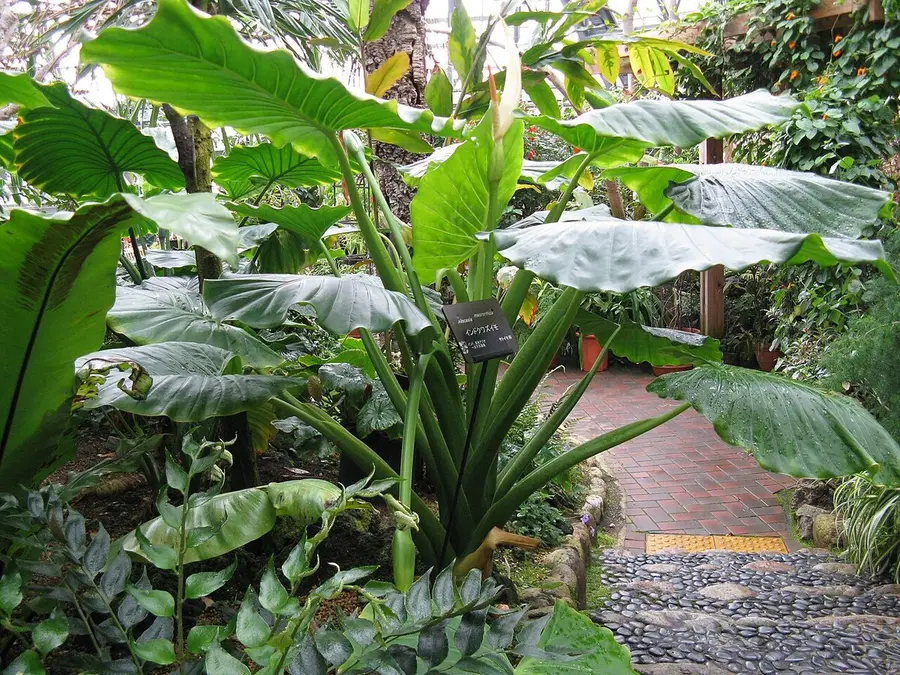
modern analog: Alocasia macrorrhizos; catalog modern_analog: "Alocasia macrorrhizos / Colocasia gigantea / Xanthosoma"
3D models
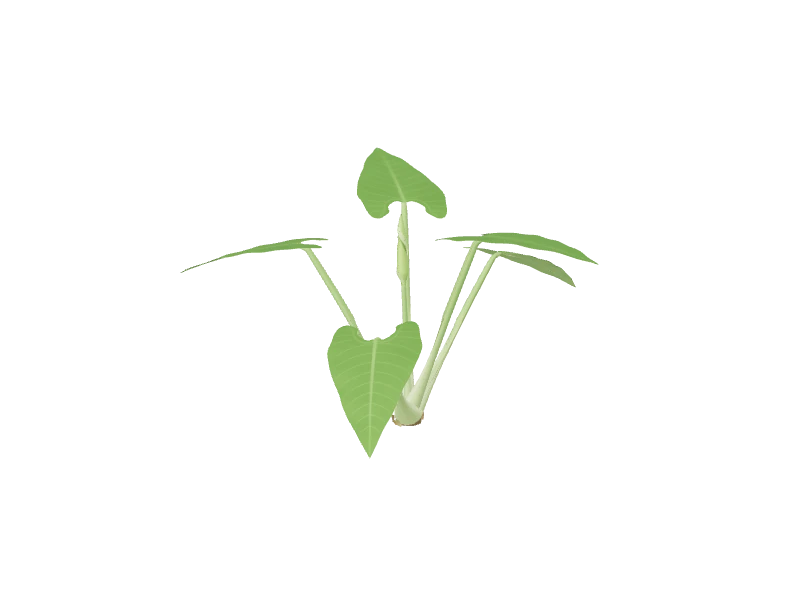
Built from a cited dossier (two Fossil Lake leaves in the Field Museum, PP 54865 and PP 46004, and living elephant-ear aroids) and chosen by blind review over a competing model (96.5 vs 95.5). Shown as one plant 1.2 m tall with five leaves and one unrolling. The leaf is documented from Fossil Lake fossils: an arrowhead blade about 0.6 m long, widest just above the stalk, with two rounded lobes pointing back on either side of an open U-shaped notch, the stalk joining at the top of that notch, and about nine curving side veins on each side with fine parallel veins between them. The species was named in 2026 by Gieser and colleagues, but only the paper's abstract could be read, so the measurements come from museum photographs and may change when the full description is checked. No stem, flower or fruit is known, so the short stem, the rosette of leaves on long stalks and the green colour are reconstructed from living Alocasia, Colocasia and Xanthosoma.
- Group
- Monocots
- Form
- giant aroid ('elephant ear'), herb
- Known from
- leaf (among the largest fossil aroid leaves)
- Habitat
- lake-margin marginal vegetation (wet ground, shoreline)
- Abundance
- part of a 'large collection' at FMNH and FOBU
- Modern relative
- Alocasia macrorrhizos / Colocasia gigantea / Xanthosoma
- Occurrence
- Fossil Lake (Fossil Butte Member)
- Notes
- Abstract: 'provide new evidence for the marginal vegetation of the Fossil Lake system'.