Equisetum sp.
horsetail
This entry was compiled from research notes and has not yet been reviewed by a person. Its facts come from the sources listed below, which are the authority if anything here disagrees with them.
A horsetail with jointed stems and leaves like tiny teeth
- How big
- Stems about as thick as a pencil (6 mm, 1/4 in); maybe 1 m (3 ft) tall
- Where it grew
- In very shallow water at the lake's edge
- Relatives today
- Living horsetails, such as North America's scouring rush of wet shores
- Fossils found
- Only stem pieces; just 2 of 3,471 finds at the park's research dig
Picture a clump of straight stems standing in very shallow water at the lake's edge, probably stiff and dull green like living horsetails. Each stem was jointed about every 5 cm (2 in), and every joint wore a tight collar edged with tiny pointed teeth. Fossils of young fish turn up in the same shoreline rocks, so fish probably swam among the stems.
Fun fact In another Green River lake, a fossil reef holds stem-shaped holes left by horsetails that were still standing upright right where they grew.
The science
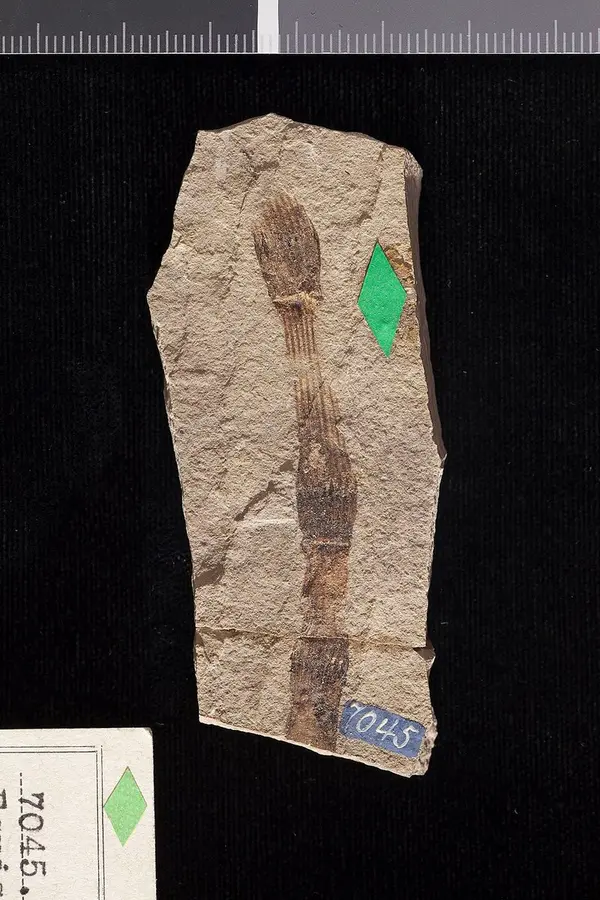
E. wyomingense, USNM P7045; Green River Fm near Green River, WY (not Fossil Lake)
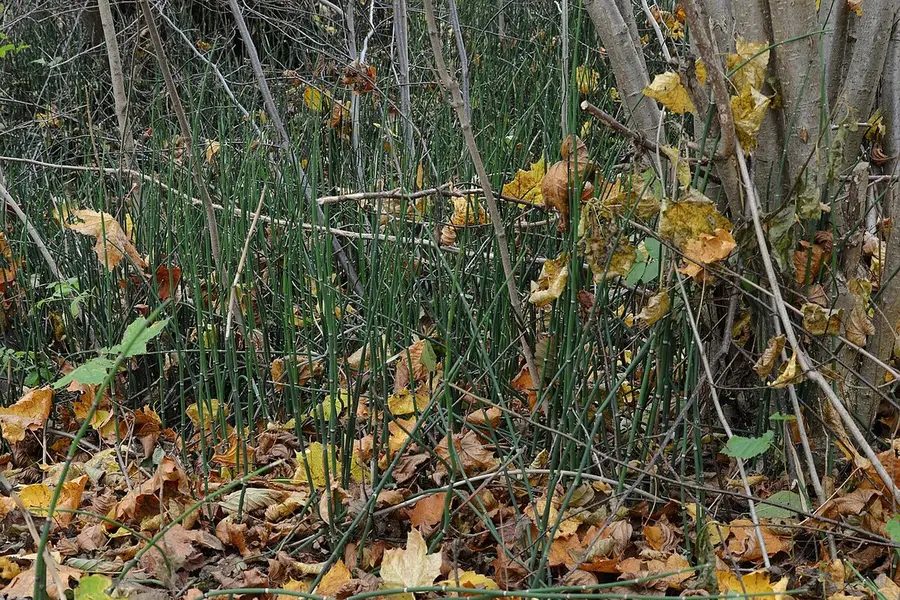
modern analog: Equisetum hyemale; catalog modern_analog: "Equisetum hyemale (scouring rush); E. giganteum for tall stands"
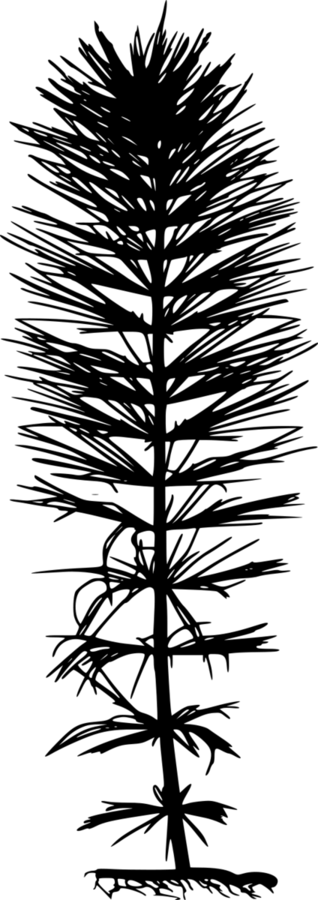
PhyloPic silhouette; depicts Equisetum giganteum (stand-in for Equisetum sp.)
3D models
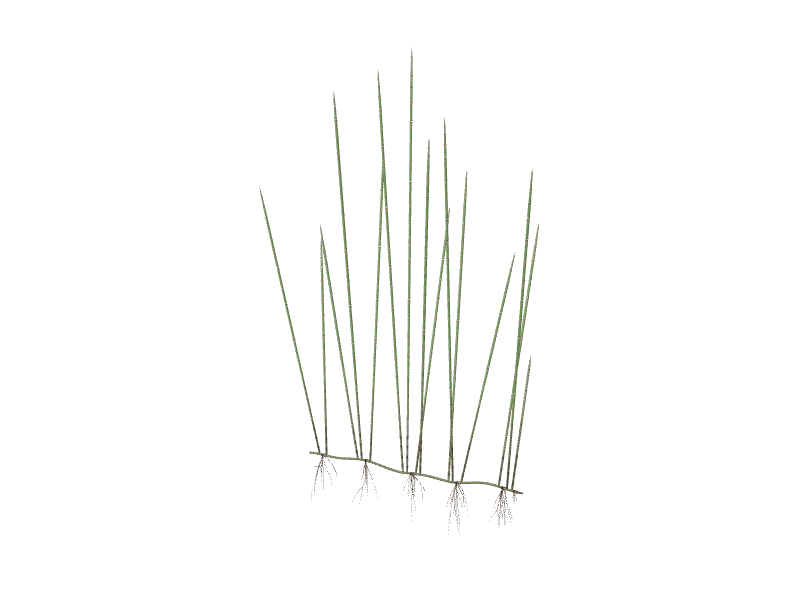
Built from a cited dossier (horsetail stems from the shore carbonates of Fossil Lake's lower unit, Biaggi 1989, in a photograph courtesy of H. Paul Buchheim; other Green River Formation horsetails, including FMNH PP 33656 and Bradley's 1929 fossil horsetail reef; and floras of the living scouring rush Equisetum hyemale) and chosen by blind review over a competing model (96.5 vs 95.2). Shown as one clump of 15 shoots on a rhizome under 0.1 m of water at the lake margin, the tallest 0.9 m above the water. The stems are documented from fossils: straight, jointed and about 6 mm thick, with internodes about 5 cm long and a tight, toothed sheath at each node. The unbranched habit, the height, the number and layout of the shoots, the rhizome and all colours are inferred from E. hyemale, and no cones are shown because none is known from the Green River Formation.
same genus: Field horsetail Equisetum arvense
same genus: Scouring rush Equisetum hyemale
- Group
- Ferns & allies
- Form
- horsetail / scouring rush (herb)
- Known from
- stem; spore (?)
- Habitat
- emergent shoreline: shallow nearshore water and wet margins
- Abundance
- stems in lower-unit littoral carbonates; 2 'Horsetail' among 3471 research-quarry finds 1998-2020
- Modern relative
- Equisetum hyemale (scouring rush); E. giganteum for tall stands
- Occurrence
- Fossil Lake: lower unit marginal lacustrine facies (Biaggi 1989); FOBU research quarry (middle unit); Equisetum also at Greater Green River Basin floodplain localities (Pigg & DeVore 2010)
- Notes
- Not identified to species in these sources; see Equisetum winchesteri for the name on the FOBU list. Cushman (1983) also lists a spore as ?Equisetum sp.
Sources
- Biaggi, R.E. 1989. Paleogeography and Paleoenvironments of the Lower Unit, Fossil Butte Member, Eocene Green River Formation, Southwestern Wyoming. MS thesis, Loma Linda University., pp.53,73 ↗
- National Park Service, Fossil Butte National Monument 2023. Fossil Butte Research Quarry Data: Data 1998–2020, Missing 2018. nps.gov/fobu, specimen and abundance CSV files, page last updated October 26, 2023; accessed 2026-10-05. ↗
- National Park Service, Fossil Butte National Monument. Visitor Center Exhibits. nps.gov/fobu; accessed 2026-10-05. ↗
- Cushman, R.A., Jr. 1983. Palynology and Paleoecology of the Fossil Butte Member of the Eocene Green River Formation in Fossil Basin, Lincoln County, Wyoming. MS thesis, Loma Linda University., pp.18,53 ↗