Diplomystus dentatus
herring cousin
This entry was compiled from research notes and has not yet been reviewed by a person. Its facts come from the sources listed below, which are the authority if anything here disagrees with them.
A herring cousin that swallowed other fish whole
- How big
- Adults often about 30 cm (12 in), a ruler long; up to 65 cm (26 in)
- What it ate
- Young ones probably ate plankton (tiny drifting life); adults ate fish
- Where it lived
- Open lake, probably near the surface; big ones mostly mid-lake
- Fossils found
- Second most common fossil fish here; most are 8–15 cm (3–6 in)
Diplomystus had a tall, flat body and a lower jaw that stuck out and up like a scoop. Young ones probably ate plankton, but adults hunted smaller fish, likely sucking them in head-first from below. No fossil shows its colours, but like most open-water fish it was probably dark on top and silvery underneath.
Fun fact Many Diplomystus fossils have another fish stuck in their mouth, and sometimes that fish is another Diplomystus.
The science
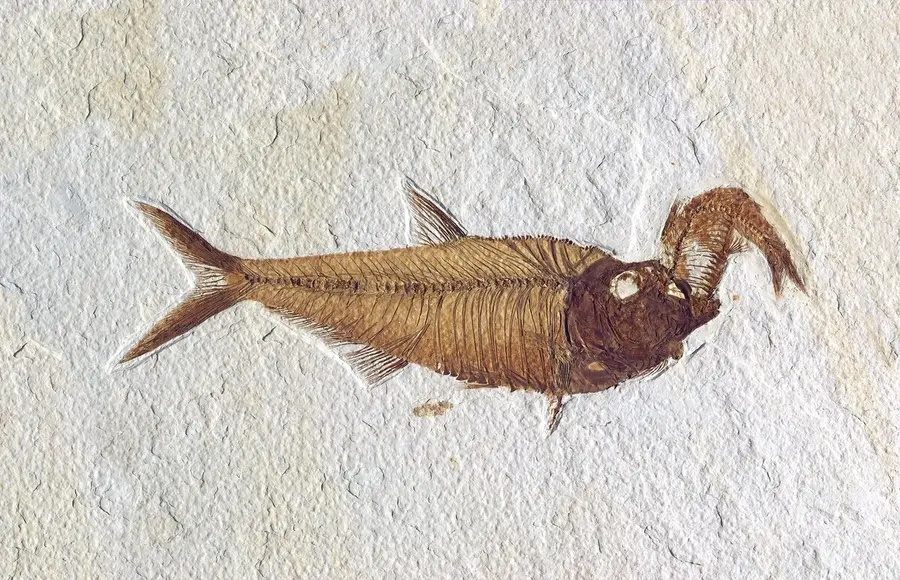
with Knightia eocaena in mouth
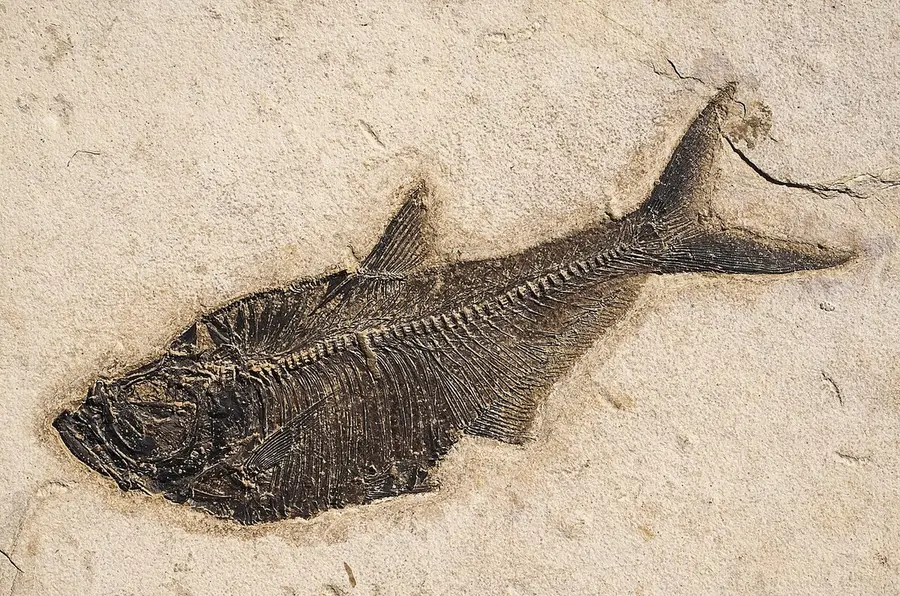
Fossil Lake per description
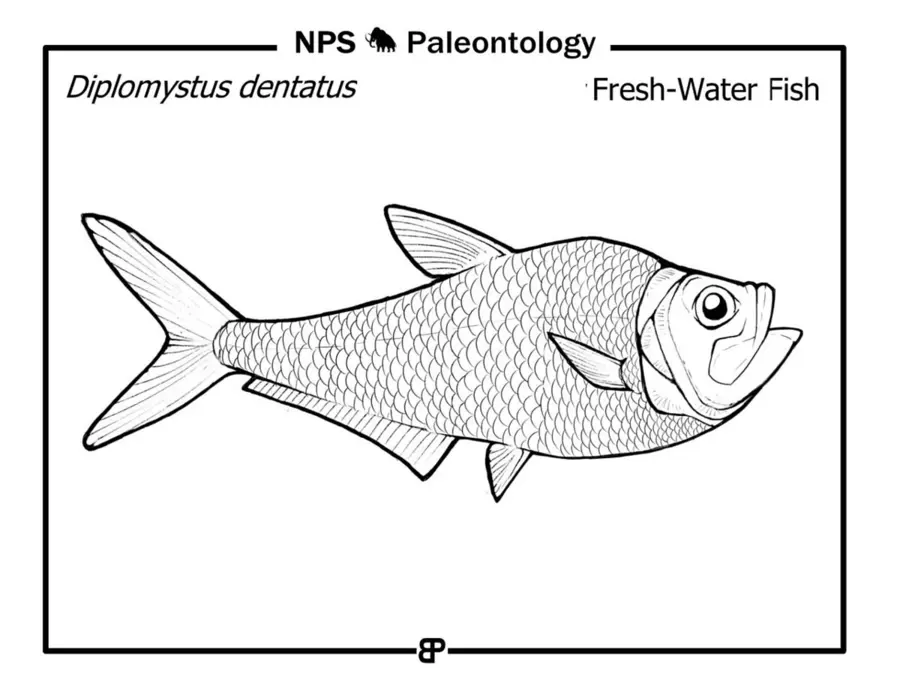
NPS line drawing
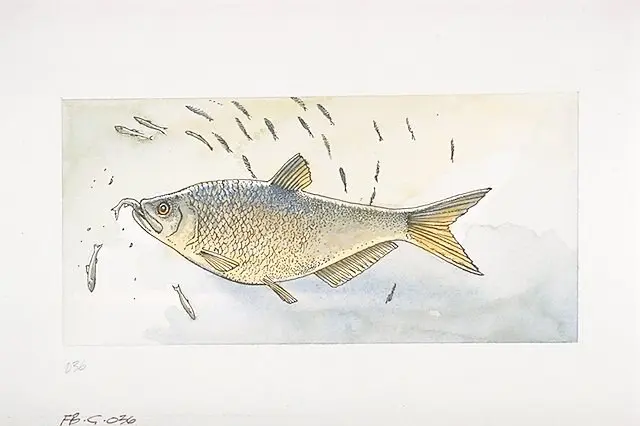
feeding on Knightia eocaena; NPGallery: "Government owns art and all reproduction rights"; 01/01/1990 - 12/30/1990; Image_Size=12" x 5-5/16"; Count:4/19; Exhibit 6/Graphic # FB-G-036(6)

PhyloPic silhouette; depicts Diplomystus dentatus
3D models
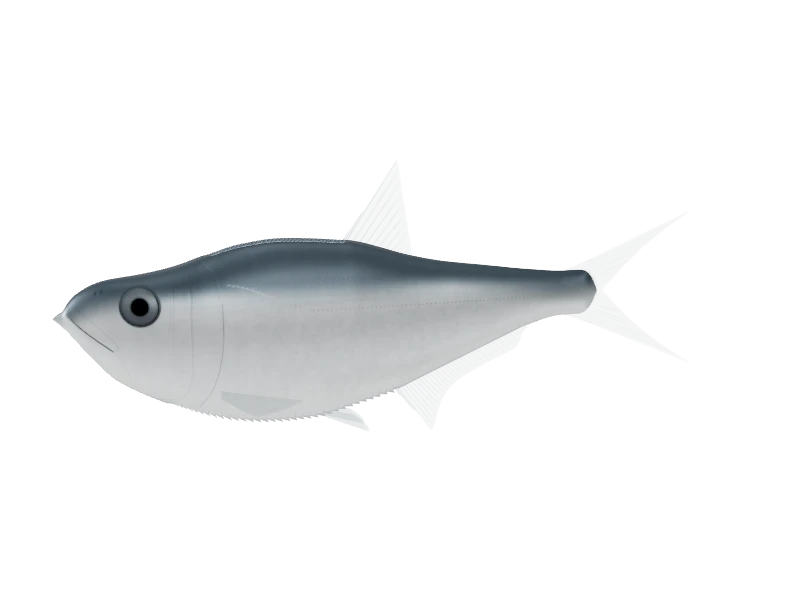
Built from a cited anatomical dossier (Grande 1982, 1984; photographed fossils; NPS research-quarry measurements) and chosen unanimously by blind review over a competing model. Shown at 24 cm standard length, the median of the large adults in the NPS research quarry. The deep body lying mostly below the snout–tail line, the upturned mouth with its projecting lower jaw, the pelvic fins set ahead of the dorsal, the long low anal fin of about 39 rays, the fine ridge of comb-edged dorsal scutes, the belly scutes and the deeply forked tail are all documented from fossils. No colour or pigment pattern has been reported for Diplomystus, so the dark-backed silver colouring is inferred from living relatives.
same species (fossil): Diplomystus dentatus fossil
same genus (fossil): Diplomystus (YPM VPPU.014695)
same order (Clupeiformes): Pacific herring Clupea pallasii
same order: Dotted gizzard shad Konosirus punctatus
same order: Gizzard shad Dorosoma cepedianum
- Description
- Deep-bodied herring-like fish (Ellimmichthyiformes, not a true herring) with a strongly upturned mouth and dorsal scutes
- Group
- Fish
- Size
- to 65 cm TL; most 8-15 cm; embryos ~0.7 in
- Habitat
- surface and open water; very young fish concentrated mid-lake (open-water spawner)
- Diet
- plankton as juvenile; adults eat Knightia and even other Diplomystus
- Abundance
- very common: second most common fish (26-41% of samples)
- Modern relative
- Pellona flavipinnis (upturned-mouth pristigasterid herring)
- NPS quarry
- 257 specimens, 1998–2020 (Logged as "Diplomystus")
- Notes
- Many 'aspiration' fossils with fish stuck in the mouth. Eggs known (largest clupeomorph eggs). Lower-unit bed with ~300 juveniles per m2 (Biaggi 1989). Family placement varies: Ellimmichthyidae (G84), Paraclupeidae (NPS; S12), Armigatidae (PBDB).
Sources
- Grande, L. 1984. Paleontology of the Green River Formation, with a review of the fish fauna (2nd ed.). Geological Survey of Wyoming Bulletin 63, 333 p., p.90, pp.174-175 ↗
- National Park Service, Fossil Butte National Monument 2025. Fossil Fish Species. nps.gov/fobu, last updated November 18, 2025; accessed 2026-10-05. ↗
- Finger, T.R. 1998. A comparison of fish community structure among several paleoenvironments of Eocene Fossil Lake, Wyoming: a preliminary report. In Santucci, V.L. & McClelland, L. (eds.) 1998, National Park Service Paleontological Research [vol. 3], NPS/NRGRD/GRDTR-98/01, p. 81ff. ↗