Crossopholis magnicaudatus
paddlefish
This entry was compiled from research notes and has not yet been reviewed by a person. Its facts come from the sources listed below, which are the authority if anything here disagrees with them.
A paddlefish with a sensing snout and a big tail
- How big
- About 80 cm (31 in) long, like a skateboard; up to about 1.2 m (4 ft)
- What it ate
- Other fish; some fossils still have fish in their stomachs
- Where it lived
- Shallow water near shore; the young probably grew up in rivers
- Fossils found
- Rare; quarry workers long mistook them for poorly preserved gars
Crossopholis swam through shallow water near the shore, a flat, narrow paddle sticking straight out above its big mouth. Fossils show the paddle held tiny sense organs, and living paddlefish use theirs to find prey even in dark or cloudy water. Its name means "fringed scale, large-tailed", after the tiny comb-like scales on its skin and its big tail fin.
Fun fact Scientists once thought it strained tiny floating animals from the water, like its living cousin the American paddlefish, but fish bones in its stomach show it hunted fish instead.
The science
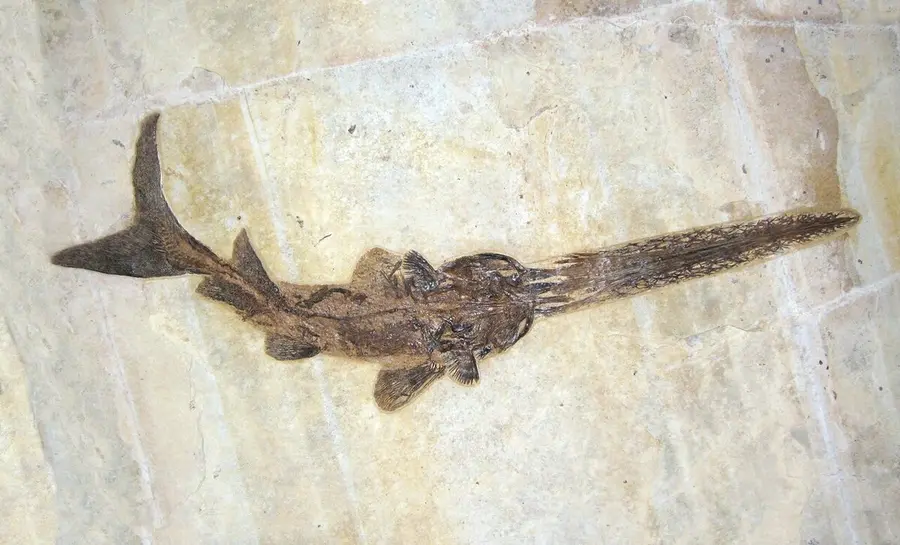
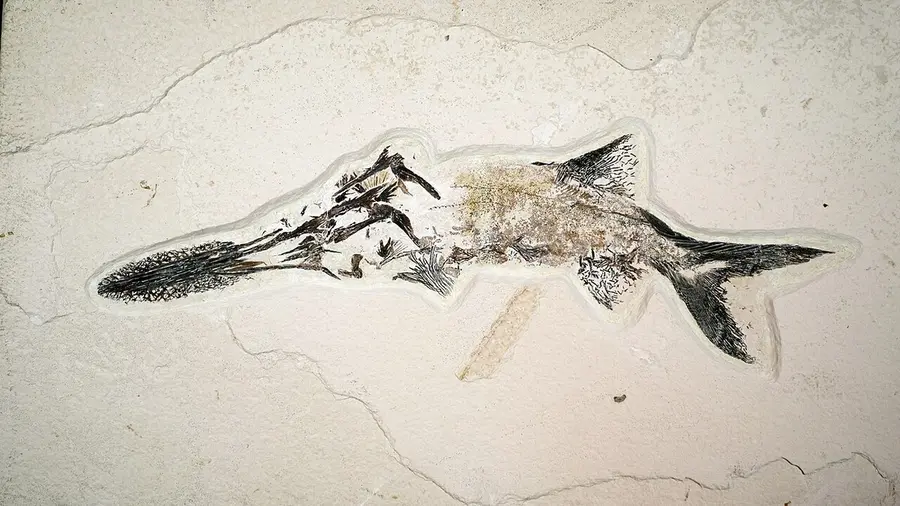
juvenile, FOBU17741
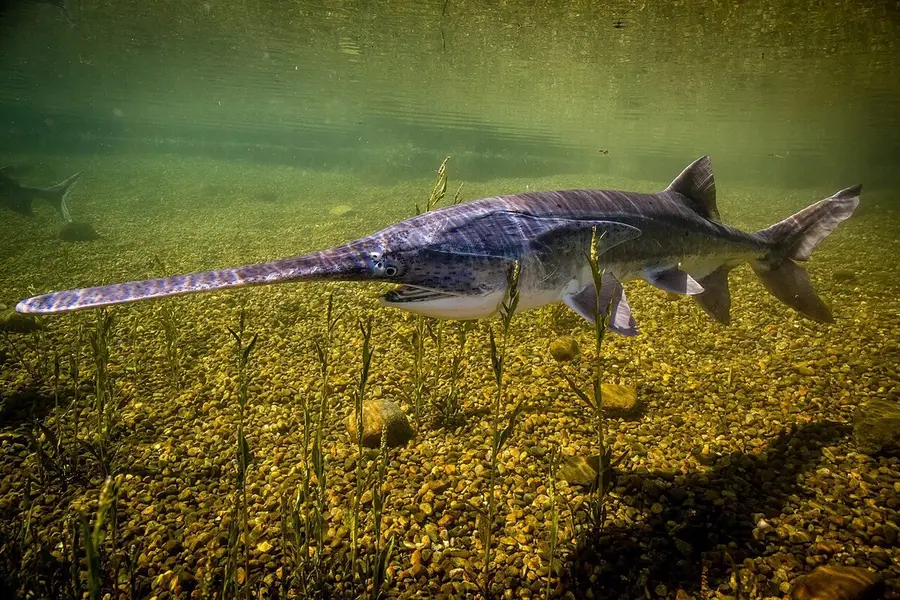
modern analog: Polyodon spathula (American paddlefish); catalog modern_analog: "Polyodon spathula (American paddlefish)"
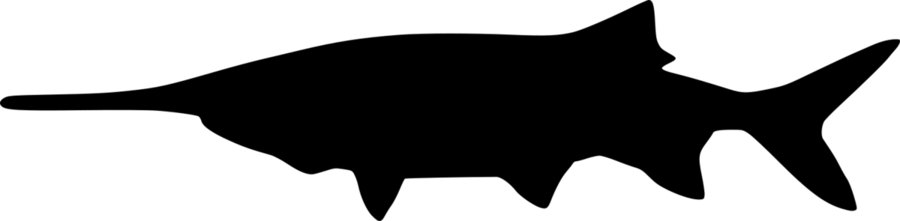
PhyloPic silhouette; depicts Polyodon spathula (stand-in for Crossopholis magnicaudatus)
3D models
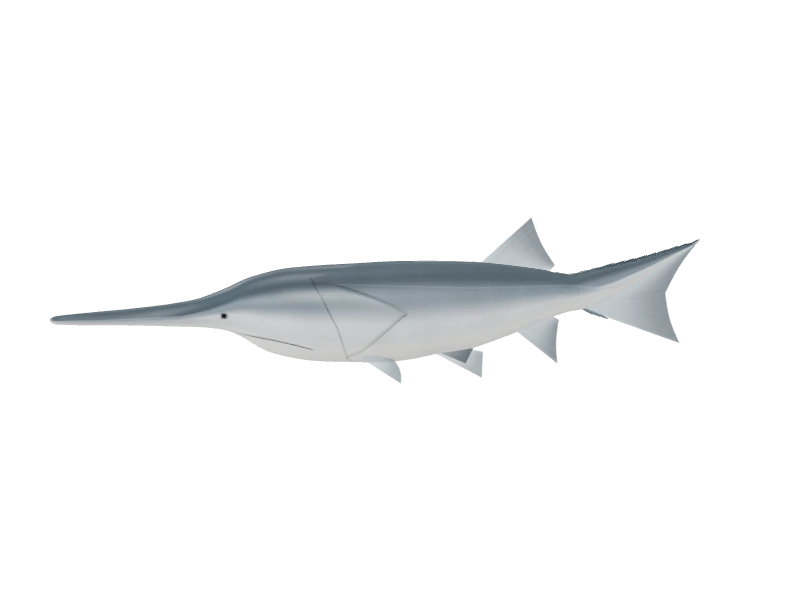
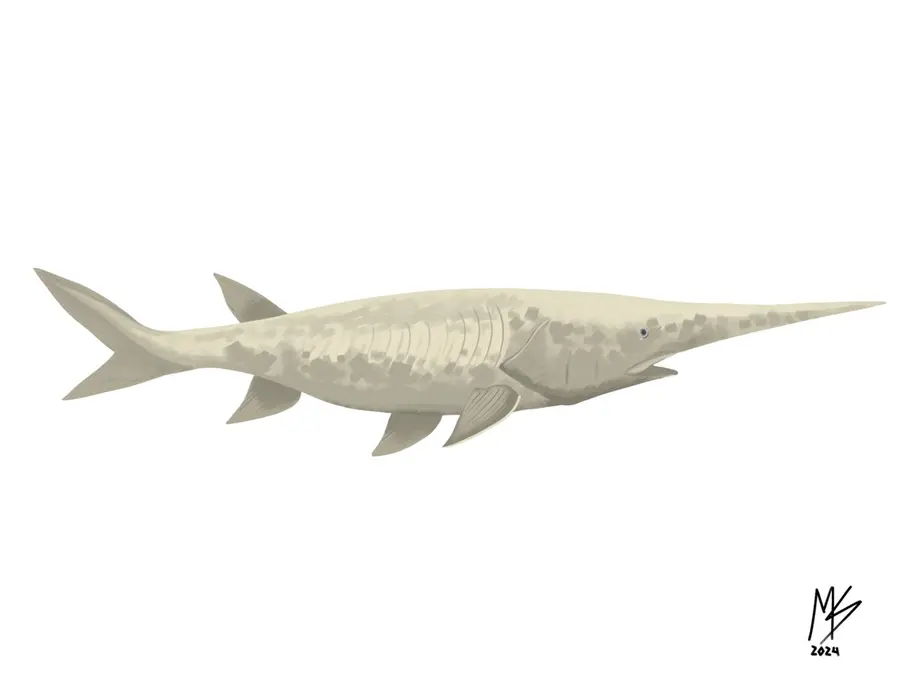
Built from a cited anatomical dossier (Grande & Bemis 1991 as quoted in other sources, Grande 1984, and photographed fossils) and chosen unanimously by blind review over a competing model. Shown at 64 cm standard length. The short, narrow, parallel-sided paddle, the large heterocercal tail with its row of fulcra, the fin positions and the microscopic fringed scales on the trunk (with a naked head and paddle) are based on fossils, though the crushed specimens allow only about ±0.02–0.03 SL precision. Body colour, gill-flap length, eye size and fin posture are inferred from the living paddlefish Polyodon.
same family (Polyodontidae): Paddlefish Polyodon spathula
same family: Paddlefish
- Description
- Paddlefish (Polyodontidae) with a paddle lined with electroreceptors; skin covered with thousands of tiny fringed scales (<0.5 mm)
- Group
- Fish
- Size
- usually 60-90 cm, est. max ~120 cm (G84); NPS: max ~5 ft
- Habitat
- mostly shallow-water deposits; few juveniles (river spawner?)
- Diet
- predator: often preserved with fish in the stomach
- Abundance
- relatively rare; dozens of complete skeletons now known (G13)
- Modern relative
- Polyodon spathula (American paddlefish)
- Notes
- Grande 1984 called it the rarest described Green River fish; by 2013 dozens of complete skeletons, mostly from Thompson Ranch sandwich beds (Locality H) or layers near the K-spar tuff (G13).
Sources
- National Park Service, Fossil Butte National Monument 2025. Fossil Fish Species. nps.gov/fobu, last updated November 18, 2025; accessed 2026-10-05. ↗
- Grande, L. 1984. Paleontology of the Green River Formation, with a review of the fish fauna (2nd ed.). Geological Survey of Wyoming Bulletin 63, 333 p., p.31 ↗
- Grande, L. 2013. The Lost World of Fossil Lake: Snapshots from Deep Time. Univ. Chicago Press, xi + 425 pp. (catalogue record; publisher says 432 pp.), 243 colour plates. ISBN 9780226922966 / ebook 9780226922980., pp.108-109 ↗