Cedrelospermum nervosum
elm relative
Also published as: Zelkova nervosa; Planera nervosa
This entry was compiled from research notes and has not yet been reviewed by a person. Its facts come from the sources listed below, which are the authority if anything here disagrees with them.
A vanished elm cousin with tiny winged fruits
- How big
- Probably about 12 m (40 ft) tall, like a telephone pole
- Where it grew
- Open, freshly cleared ground on lake and stream banks
- Relatives today
- Elm family; cousins include zelkova trees of Japan, Korea and China
- Fossils found
- Leaves, a leafy twig and one tiny winged fruit, 9 mm long
Scientists think this tree was a pioneer, one of the first to grow on bare ground left by floods or covered by volcanic ash. Its narrow leaves, no longer than your finger, grew in two neat rows along thin twigs, so each twig made a flat spray. Tiny winged fruits grew in clusters on short, leafy shoots.
Fun fact Scientists once gave its leaves and fruits several different names, even calling some of the leaves a willow, until twigs with leaves and fruits still attached showed they all came from one tree.
The science
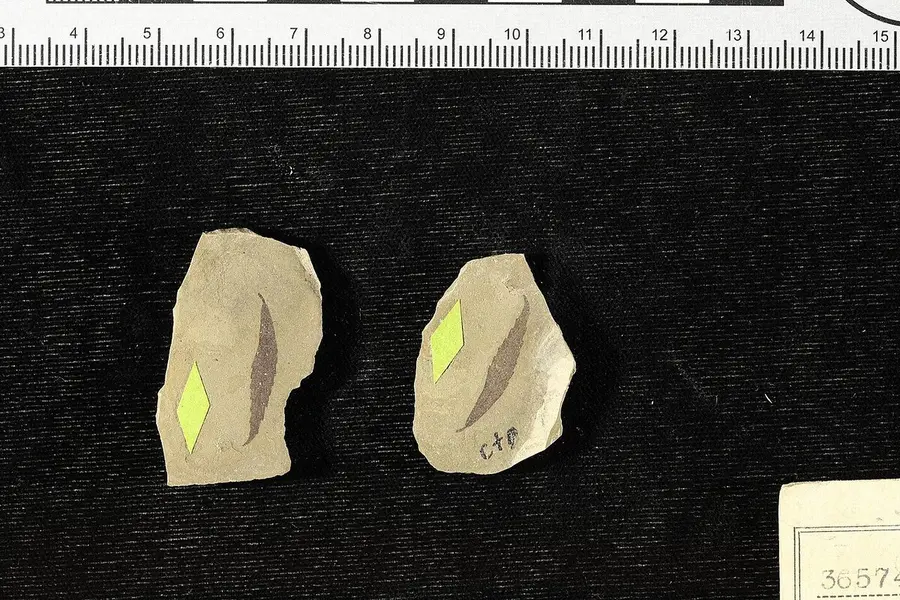
leaf (as Myrica minuta holotype); Greasewood Creek, Rio Blanco County, Colorado (Lake Uinta), not Fossil Lake
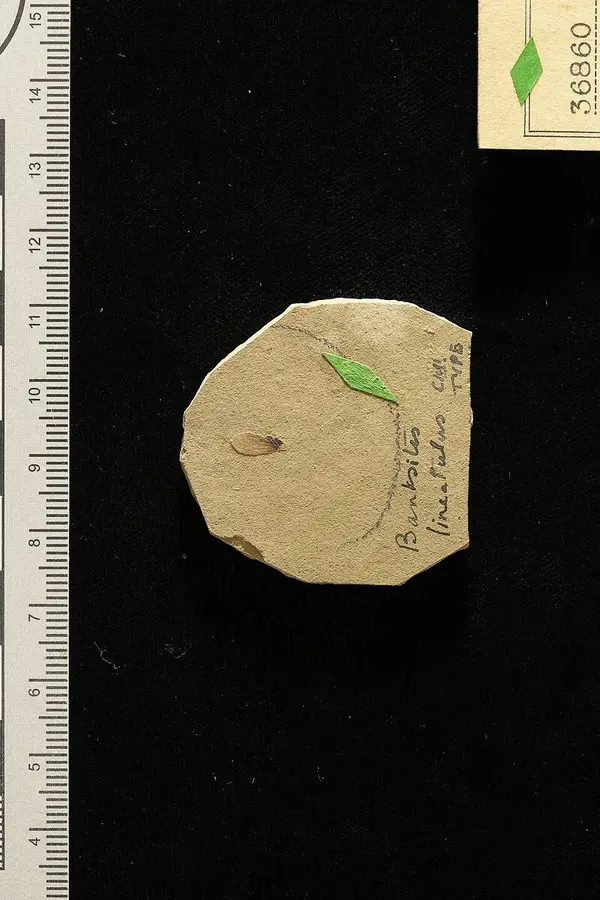
fruit (as Banksites lineatulus holotype); source description mentions: Lake Uinta (check: may be another Green River lake)
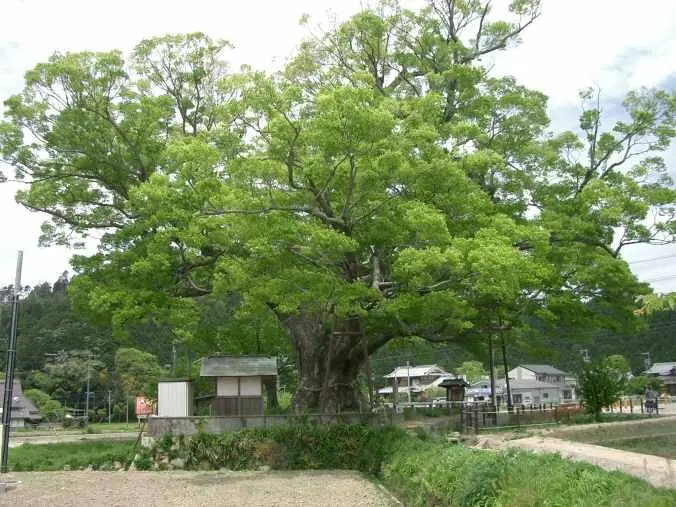
modern analog: Zelkova serrata; catalog modern_analog: "Zelkova serrata / Hemiptelea / Phyllostylon"
3D models
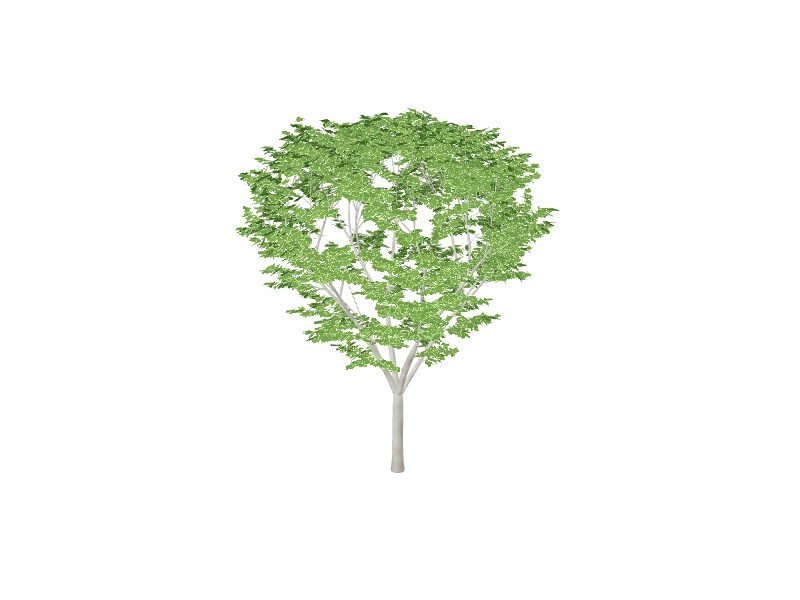
Built from a cited dossier (Green River Formation leaves including four from Fossil Lake and USNM 771572 from Lake Gosiute, the twig with attached leaves and winged fruits figured by Manchester 1989, and living elm-family trees, chiefly Zelkova) and chosen unanimously by blind review over a competing model (91.6 vs 87.5). Shown as one young tree 12 m tall in late-summer leaf. The leaf is documented from fossils: narrowly elliptic, 3–6 cm long on a short stalk, with straight parallel side veins each ending in a small appressed tooth, borne in two rows along flat sprays. The landmark leaf comes from Lake Gosiute, because the Fossil Lake leaves are known only from photographs that can't be reproduced here. No wood or trunk is known, so the height, the vase-shaped crown, the smooth grey bark and the colours are reconstructed from Zelkova.
- Group
- Eudicots
- Form
- elm-family tree with small winged fruits
- Known from
- leaf, leafy twig (USNM 276504) and winged fruit (FMNH PP 46003) at Fossil Lake; twigs with attached flowers and fruits (Lake Uinta)
- Habitat
- open or disturbed lake-margin and floodplain sites ('early successional colonizer of open habitats')
- Abundance
- unknown at Fossil Lake; one of the 8 most abundant species at Parachute Creek (Lake Uinta) localities (MacGinitie 1969 p.30, via Grande 1984)
- Modern relative
- Zelkova serrata / Hemiptelea / Phyllostylon
- Occurrence
- Fossil Lake: F-1 (as Zelkova nervosa); 'Keaki trees' in FOBU collections; Lake Uinta (Parachute Creek Mbr)
- Notes
- Manchester (1989) excluded Green River leaves from Zelkova and referred them to Cedrelospermum; the epithet nervosum and basionym are per Wikipedia list.
Sources
- Grande, L. 1984. Paleontology of the Green River Formation, with a review of the fish fauna (2nd ed.). Geological Survey of Wyoming Bulletin 63, 333 p., p.262 ↗
- Graham, J.P. 2012. Fossil Butte National Monument: geologic resources inventory report. Natural Resource Report NPS/NRSS/GRD/NRR—2012/587. National Park Service, Fort Collins, CO., p.20 ↗
- Field Museum image GEO86891_190d caption (USNM 276504 and FMNH PP 46003)
- Grande, L. 1984. Paleontology of the Green River Formation, with a review of the fish fauna (2nd ed.). Geological Survey of Wyoming Bulletin 63, 333 p., Table V.1 ↗
- Manchester, S.R. 1989. Attached reproductive and vegetative remains of the extinct American-European genus Cedrelospermum (Ulmaceae) from the early Tertiary of Utah and Colorado. Am. J. Bot. 76:256–276. ↗
- Wikipedia. Paleobiota of the Green River Formation. Wikipedia. ↗