Borealosuchus wilsoni
Also published as: Leidyosuchus wilsoni
This entry was compiled from research notes and has not yet been reviewed by a person. Its facts come from the sources listed below, which are the authority if anything here disagrees with them.
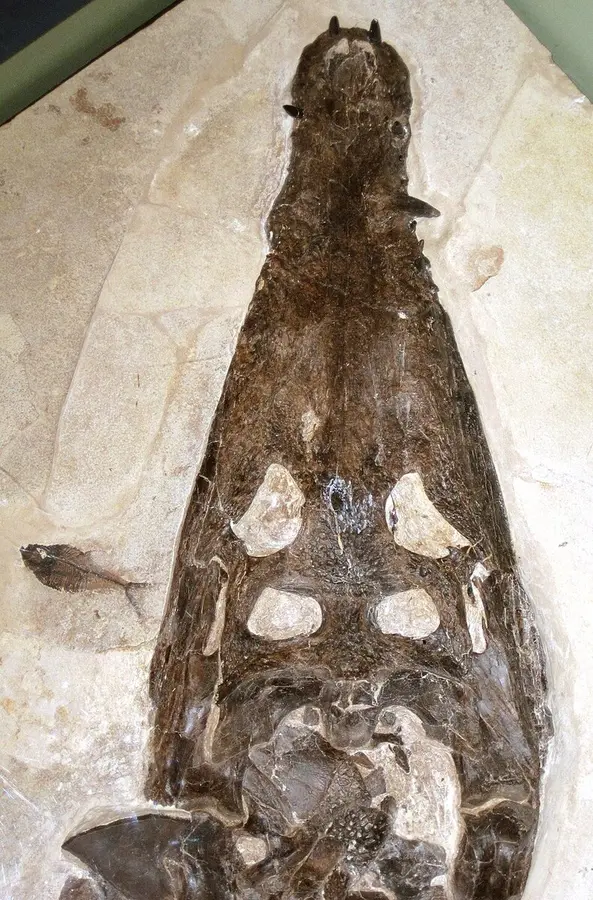
FMNH PR 1674, Fossil Lake
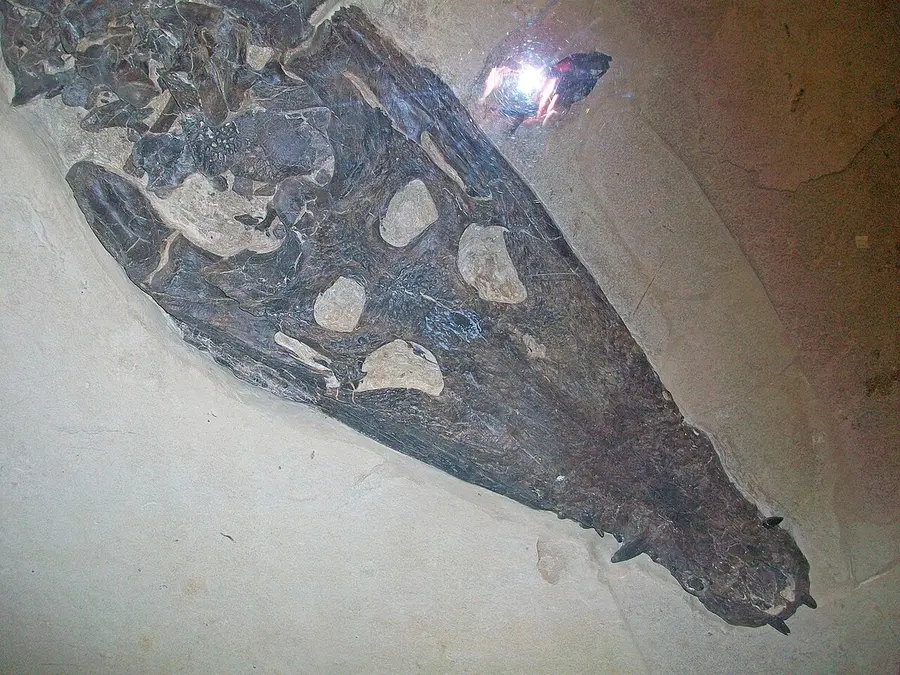
skull with Knightia, Field Museum
3D models
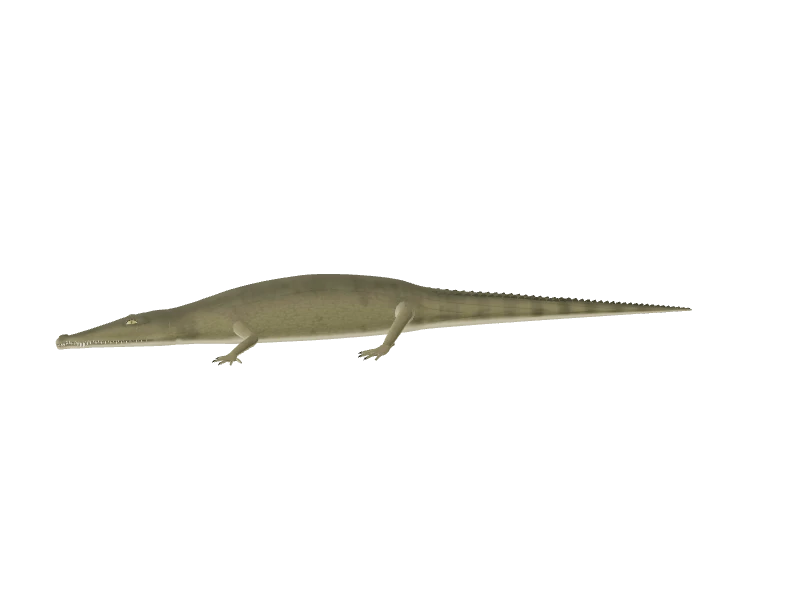
Built from a cited dossier (the complete Fossil Lake skeleton FMNH PR 1674, the Fossil Lake skull UW 20531, other described skulls, and living crocodylians for soft tissue) and chosen by blind review over a competing model (90.9 vs 87.0). Shown as one adult about 3 m long basking on a mud bank with its mouth closed. The skeleton is documented from fossils: a broad, triangular snout with interlocking teeth, both tooth rows visible when the jaws are shut and an enlarged lower tooth fitting into a notch; a flat armour shield four plates wide down the back; and long, slender limbs. Its size is uncertain: the skull suggests about 3 m, while the museum cast of the same skeleton is labelled 13 feet. Every skeleton is crushed flat, so the animal's height and girth, its skin and scales, and its olive colours are reconstructed from living crocodiles and alligators.
same genus: Borealosuchus skull
see notes: Borealosuchus sternbergii (Gilmore 1910), part C
Tsoabichi same family (Alligatoridae): Black caiman (taxidermy)
order (Crocodylia): Siamese crocodile
- Description
- Basal eusuchian at or near the base of Crocodylia (neither true crocodile nor alligator); apex predator
- Group
- Reptile
- Size
- largest FBM individual ~15 ft (4.6 m); tooth growth rings suggest up to 16 ft; FMNH PR 1674 about 3 m (estimated from its skull); Fossil Lake skull UW 20531 43 cm; Eocene Borealosuchus skulls ~40-48 cm (range includes Bridger specimens Hester 2018 separates from B. wilsoni)
- Habitat
- lake and shoreline
- Diet
- generalist predator, partly fish (inferred)
- Abundance
- skeletons uncommon; isolated teeth are the commonest crocodilian fossil
- Modern relative
- Crocodylus (generalized living crocodile, broad-snouted)
- Notes
- An uncatalogued UW headless crocodilian skeleton from F-2 (G84 p.198) is unassigned. Complete articulated skeleton FMNH PR 1674 (found 1984); the Fossil Butte visitor center shows a cast of this same specimen, labelled 13 ft (NPS-EX), but its skull (Hester 2018 fig. 12 p. 50 and p. 51) implies about 3 m in total (project estimate). UW 20531, a complete 43 cm skull from F-1 (G84 p.198), is referred to B. wilsoni by Hester (2018 p. 13). Holotype is from Lake Gosiute (near Wamsutter). Hester (2018) places Borealosuchus inside Crocodylia; Rio & Mannion (2021) recover it as the sister group of Crocodylia, just outside the crown. Crocodilian coprolites up to ~20 cm and teeth occur at nearly every vertebrate-bearing lake outcrop (G84). Crocodiles were top carnivores of the late lake margins (LB98).
Sources
- National Park Service, Fossil Butte National Monument 2025. Fossil Reptile Species. nps.gov/fobu, last updated November 20, 2025; accessed 2026-10-05. ↗
- National Park Service, Fossil Butte National Monument. Visitor Center Exhibits. nps.gov/fobu; accessed 2026-10-05. ↗
- Hester, D.A. 2018. A review of the Paleogene eusuchian crocodyliform Borealosuchus wilsoni (Mook, 1959) from western North America. MS thesis, University of Iowa. ↗
- Grande, L. 1984. Paleontology of the Green River Formation, with a review of the fish fauna (2nd ed.). Geological Survey of Wyoming Bulletin 63, 333 p., p.198 ↗
- Tweet, J.S., Santucci, V.L., Connors, T. & Kenworthy, J.P. 2012. Paleontological resource inventory and monitoring: Northern Colorado Plateau Network. NPS Natural Resource Technical Report NPS/NCPN/NRTR-2012/585 (FOBU chapter pp.363–378). ↗
- Rio, J.P. & Mannion, P.D. 2021. Phylogenetic analysis of a new morphological dataset elucidates the evolutionary history of Crocodylia and resolves the long-standing gharial problem. PeerJ 9:e12094. ↗