Axestemys sp.
This entry was compiled from research notes and has not yet been reviewed by a person. Its facts come from the sources listed below, which are the authority if anything here disagrees with them.
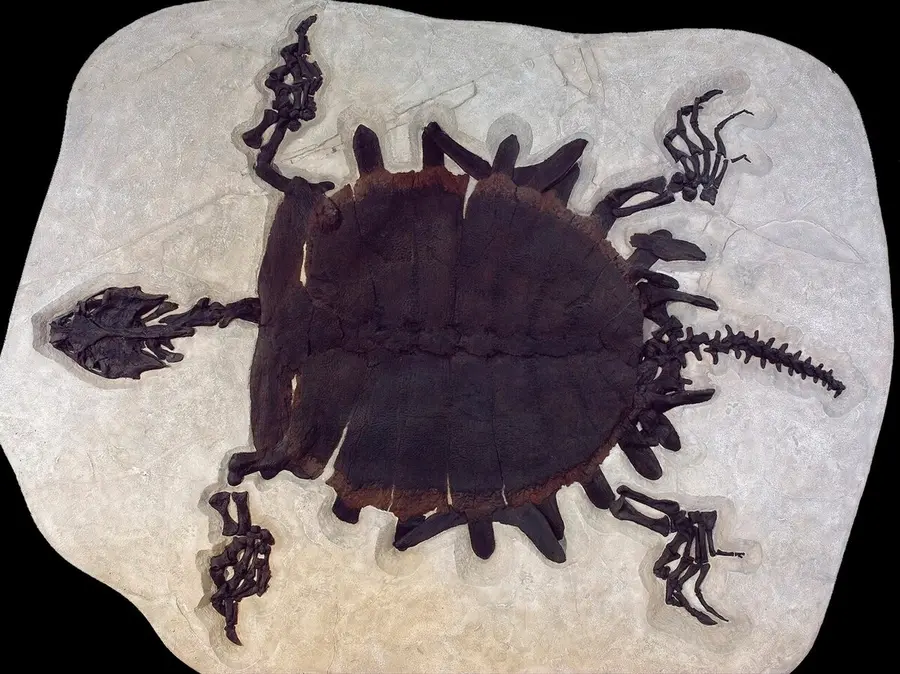
Axestemys byssina, 1.7 m
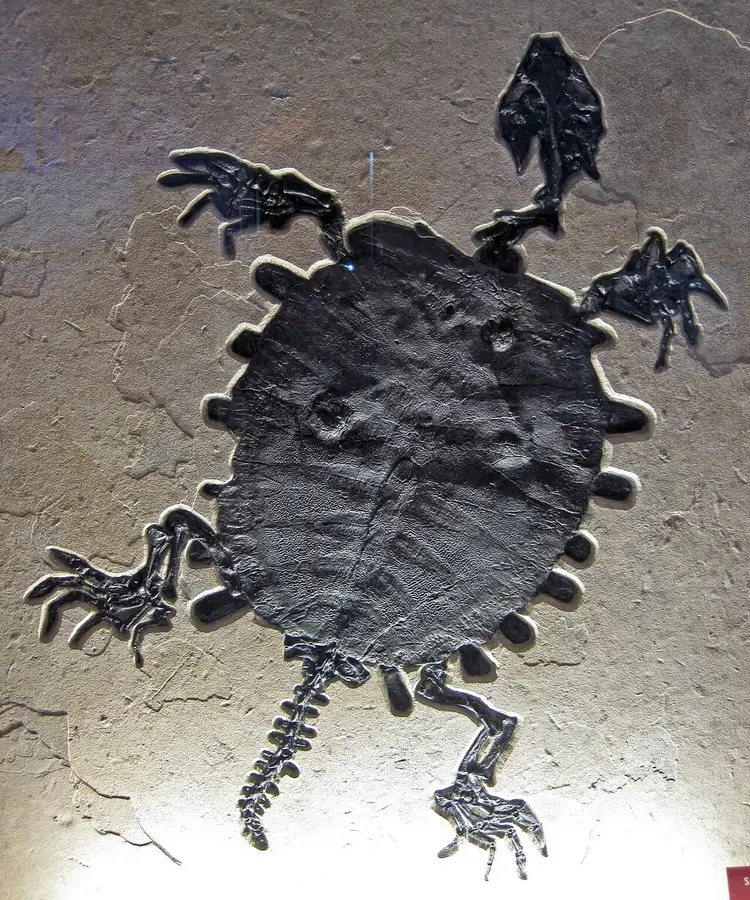
Axestemys byssina; Fossil Butte Member per title
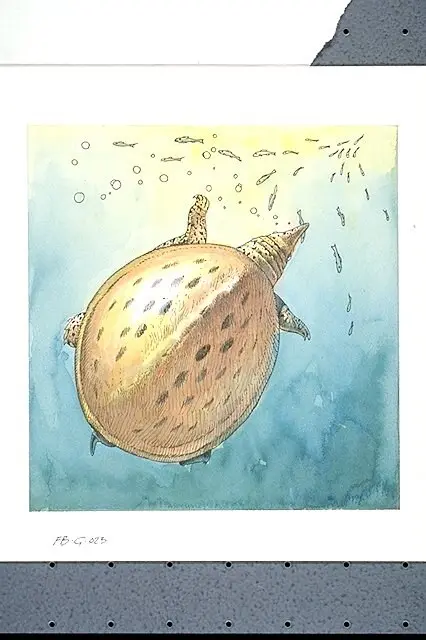
trionychid soft-shelled turtle feeding on Knightia; genus not specified in caption; NPGallery: "Government owns art and all reproduction rights"; 01/01/1990 - 12/30/1990; Image_Size=8-1/8" x 8-5/16"; Count:1/19; Exhibit 5/Graphic # FB-G-023(5)
PhyloPic silhouette; depicts Apalone ferox (stand-in for Axestemys sp.)
3D models
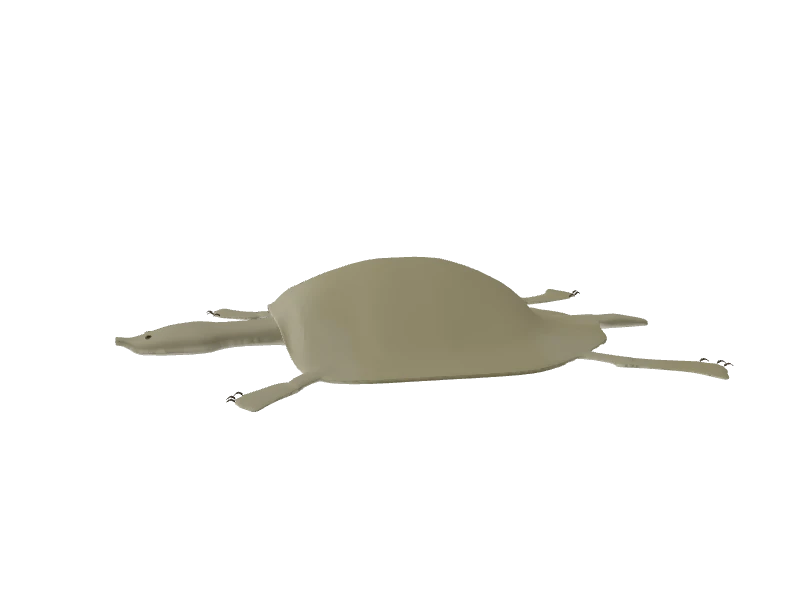
Built from a cited dossier (two complete Fossil Lake skeletons, a 1.7 m cast photographed by the National Park Service and a 1.5 m specimen, Field Museum specimens catalogued as Axestemys byssinus, Vitek's 2012 study of the genus, and living softshells) and chosen by blind review over a competing model (93.5 vs 89.5). Shown as one adult about 1.7 m long resting on a mud bank at the water's edge. The skeleton is documented from fossils: a bony shell disc about 80 cm long with a smooth border, long free rib ends and a broad, heavy skull, which together identify a giant softshell of the genus Axestemys. The species name, cf. A. byssina, comes from museum labels rather than a published description. Softshells carry a leathery skin over and around the bony disc, so the flexible margin, the snorkel snout, the webbed three-clawed feet and the olive-brown colours are reconstructed from living softshells such as Apalone and Rafetus.
same family (Trionychidae): Chinese softshell turtle Pelodiscus sinensis
- Description
- Giant softshell turtle (Trionychidae)
- Group
- Reptile
- Size
- carapace 60 cm or more (genus diagnosis)
- Habitat
- lake
- Diet
- carnivore; apex or near-apex predator
- Abundance
- rare
- Modern relative
- Rafetus swinhoei (Yangtze giant softshell) or Apalone (North American softshells)
- Notes
- Cast of an SSTM specimen shown on the NPS page. Vitek (2012) defines Axestemys phylogenetically (p. 1) and diagnoses it by a carapace 60 cm or longer (p. 5); he lists A. byssina only from the Wasatch and Bridger Formations (pp. 6-7) and reports no softshell from the Green River Formation. The Fossil Lake record rests on NPS, the FMNH catalogue (PR 3039 and PR 4044, catalogued as Axestemys byssinus) and Grande 2013 (p. 200, cited via Wikipedia; not seen). Analog: Vitek (2012 p. 36) places Axestemys, with a grade of other trionychids, as the sister group of Apalonina, i.e. Apalone and Rafetus (Meylan 1987 pp. 91-92); Chitra, with its tiny head, does not match the large, broad skulls of the Fossil Lake specimens.
Sources
- National Park Service, Fossil Butte National Monument 2025. Fossil Reptile Species. nps.gov/fobu, last updated November 20, 2025; accessed 2026-10-05. ↗
- Vitek, N.S. 2012. Giant fossil soft-shelled turtles of North America. Palaeontologia Electronica 15(1):13A., pp.1, 5-7, 36 ↗
- Field Museum. Field Museum site-wide collections search. Field Museum (fieldmuseum.org); public but undocumented JSON service; accessed 2026-10-05., PR 3039, PR 4044 ↗
- Grande, L. 2013. The Lost World of Fossil Lake: Snapshots from Deep Time. Univ. Chicago Press, xi + 425 pp. (catalogue record; publisher says 432 pp.), 243 colour plates. ISBN 9780226922966 / ebook 9780226922980., p.200 ↗
- Meylan, P.A. 1987. The phylogenetic relationships of soft-shelled turtles (family Trionychidae). Bulletin of the American Museum of Natural History 186(1):1–101., pp.91-92 ↗