Atractosteus atrox
giant gar
Also published as: Lepidosteus atrox; Lepisosteus atrox
This entry was compiled from research notes and has not yet been reviewed by a person. Its facts come from the sources listed below, which are the authority if anything here disagrees with them.
A giant armoured gar, the biggest known Fossil Lake fish
- How big
- About 1.7 m (5.5 ft) long, as long as a grown-up is tall; up to 2 m
- What it ate
- Mostly fish, probably snatched with a quick sideways snap
- Where it lived
- Probably shallow, weedy water near the shore
- Fossils found
- Very rare: just 2 gars in one count of 5,232 fossil fish
This giant gar wore a suit of thick, diamond-shaped scales that locked together edge to edge. Its long snout bristled with small teeth and a row of bigger fangs, and scientists think only crocodiles could have hunted a full-grown one. Like gars today, it probably floated almost still in shallow water, rising now and then to gulp air.
Fun fact A fossil poop 13.5 cm (5 in) long was found next to one skeleton, and the scientist who studied it thought only a fish this big could have made it.
The science
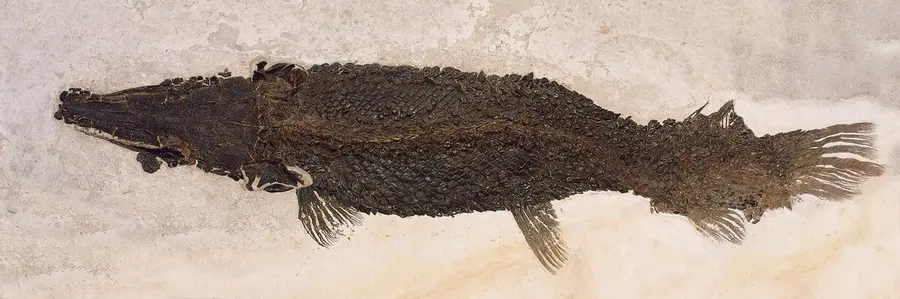
University of Wyoming specimen, 200.4 cm; alt text: A gar fish fossil compressed so it is viewed from its back. Its diamond-shaped scales were preserved.
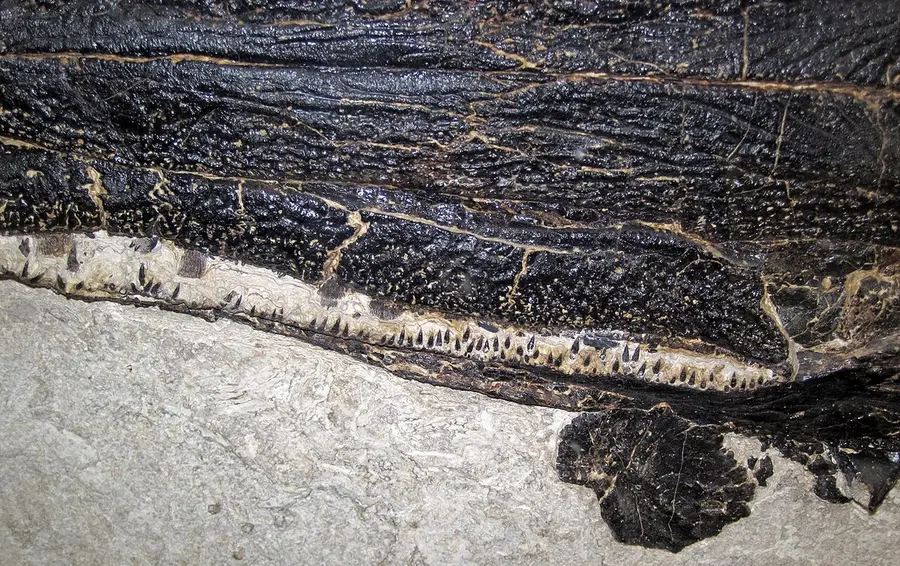
UW 16435, University of Wyoming Geological Museum
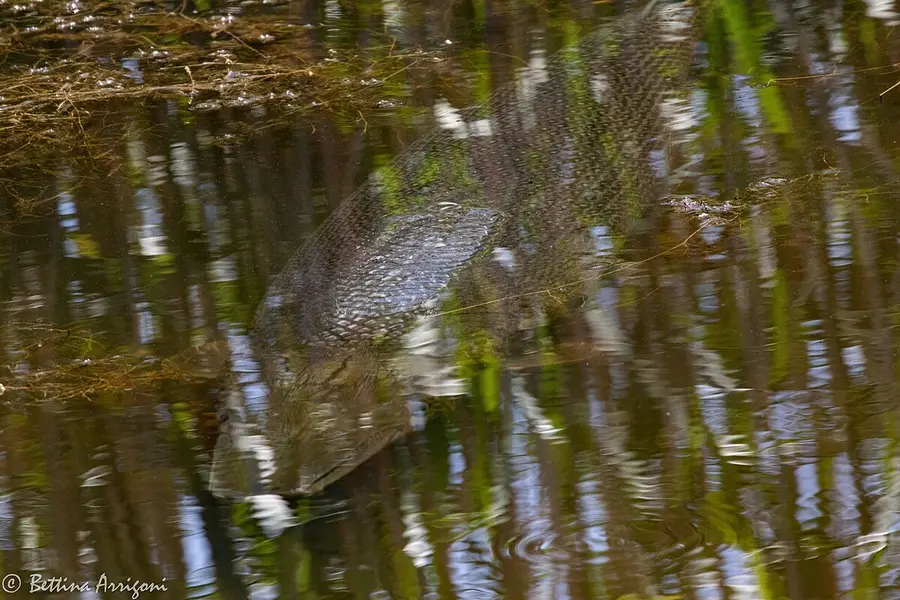
modern analog: Atractosteus spatula (Alligator gar); catalog modern_analog: "Atractosteus spatula (alligator gar)"
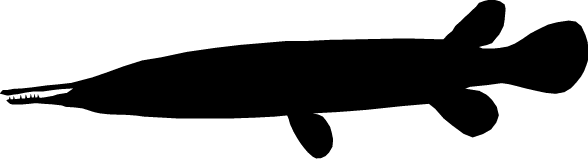
PhyloPic silhouette; depicts Atractosteus spatula (stand-in for Atractosteus atrox)
3D models
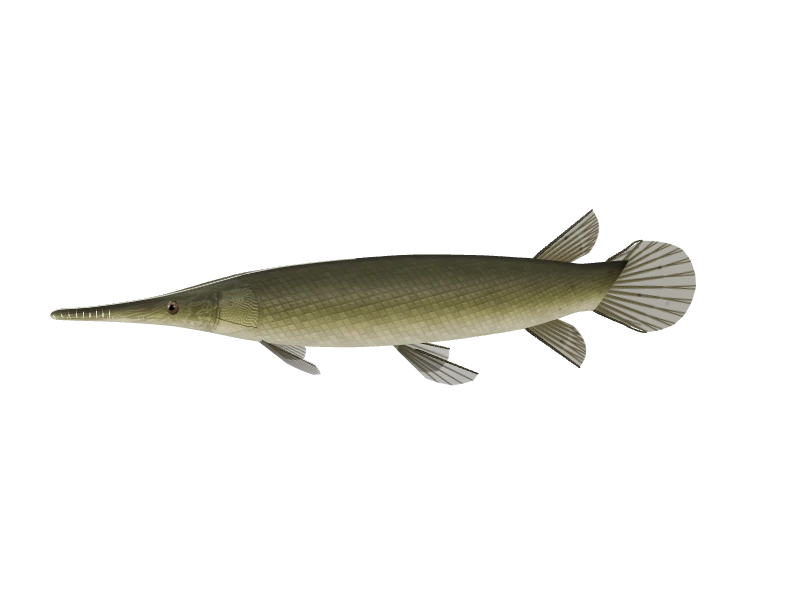
Built from a cited anatomical dossier (Eastman 1900, Grande 1984, specimen photographs, and measurements of the living alligator gar for comparison) and chosen unanimously by blind review over a competing model. Shown at 1.42 m standard length (1.68 m total). The long, tapering snout on a broad, rugose skull with about nine spaced fangs, the heavy diamond-shaped ganoid scales, the dorsal and anal fins set nearly opposite each other far back, the rounded tail and the fulcra along the fin edges are documented from fossils. Fossils measure 0.20–0.22 SL deep but are flattened; the near-round body about 0.16 SL deep is a correction inferred for life. Colour has not been preserved, so the olive-brown back and pale belly are inferred from the alligator gar.
same genus/family: Spotted gar Lepisosteus oculatus
- Description
- Giant gar (Lepisosteidae); largest Green River fish; diamond-shaped ganoid scale armour
- Group
- Fish
- Size
- published specimens ~166-168 cm TL (G84); NPS pictures a 200.4 cm UW specimen ('up to 6 ft')
- Habitat
- nearshore and open water; gars scarce in deep F-1 beds
- Diet
- piscivore
- Abundance
- extremely rare; few specimens
- Modern relative
- Atractosteus spatula (alligator gar)
- Notes
- Only crocodilians could prey on adult gars (G84 p.38).
Sources
- Grande, L. 1984. Paleontology of the Green River Formation, with a review of the fish fauna (2nd ed.). Geological Survey of Wyoming Bulletin 63, 333 p., p.37 ↗
- National Park Service, Fossil Butte National Monument 2025. Fossil Fish Species. nps.gov/fobu, last updated November 18, 2025; accessed 2026-10-05. ↗
- The Paleobiology Database. paleobiodb.org, data service v1.2; occurrences and taxonomic opinions pulled 2026-10-05. ↗