Asterotrygon maloneyi
Also published as: undescribed denticle-tailed ray of Grande 1984
This entry was compiled from research notes and has not yet been reviewed by a person. Its facts come from the sources listed below, which are the authority if anything here disagrees with them.
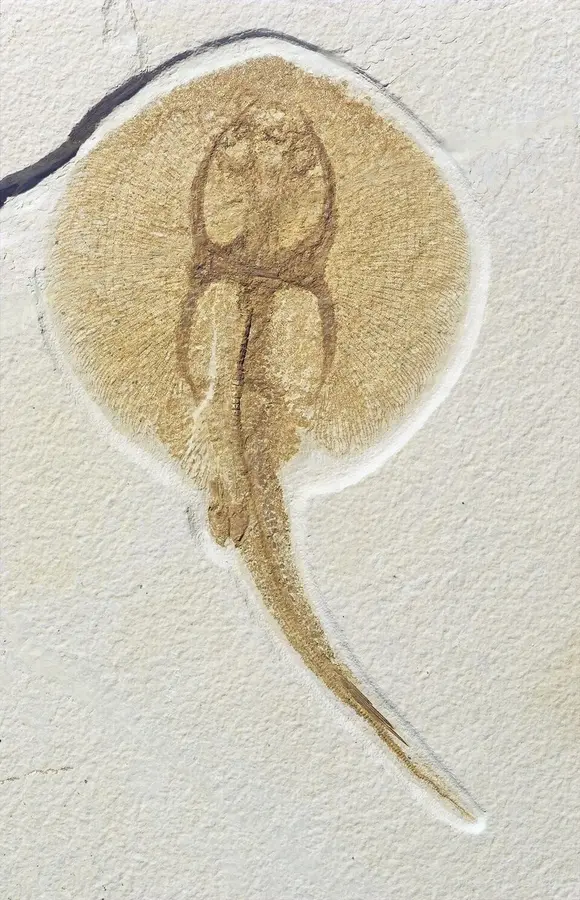
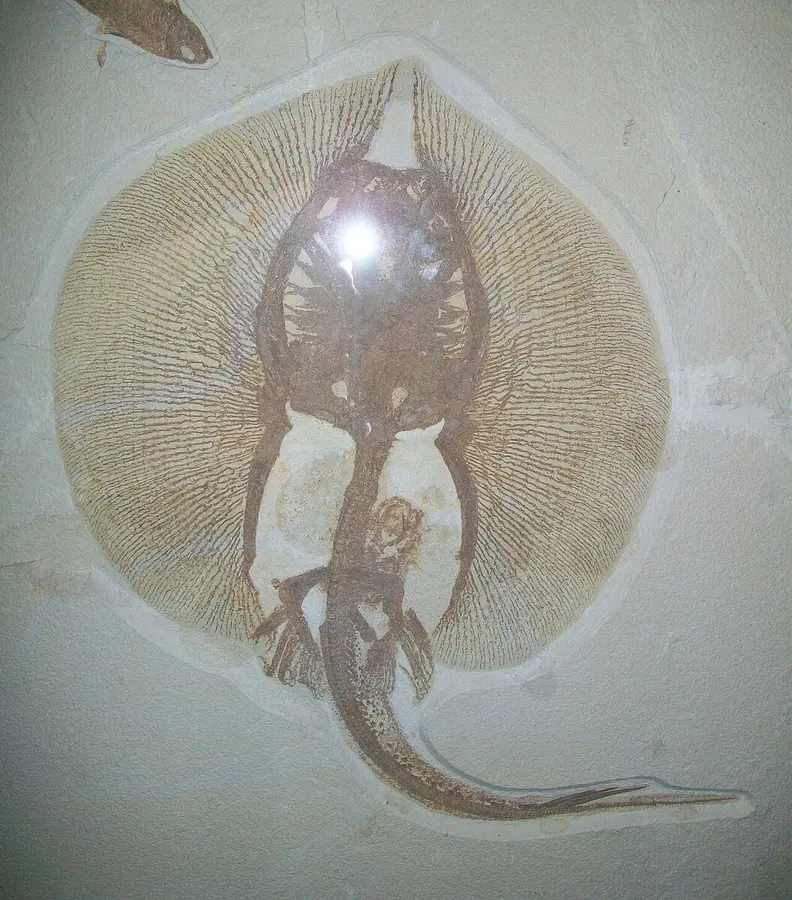
holotype FMNH PF 15166
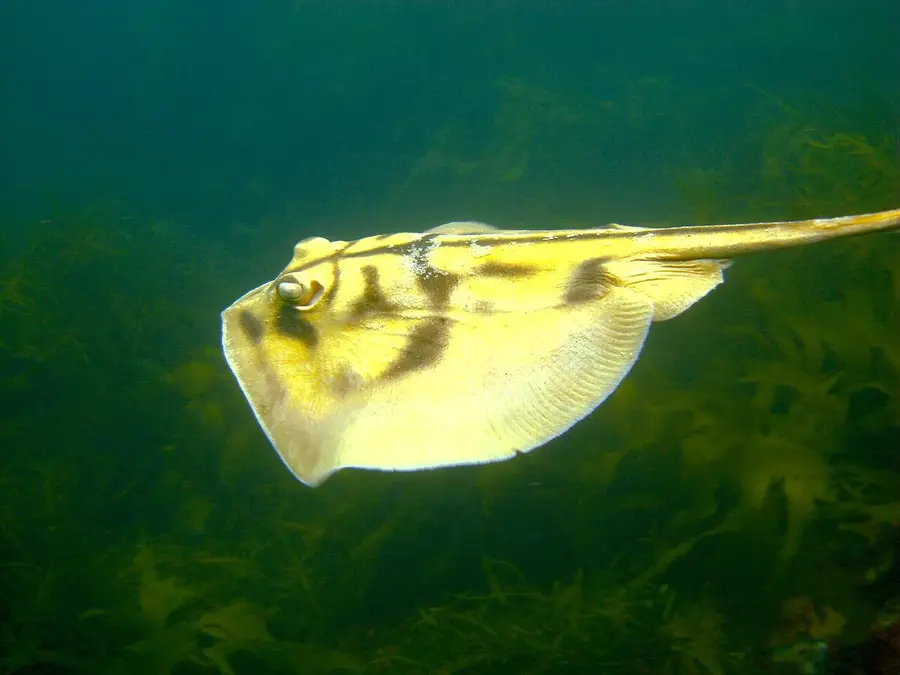
modern analog: Urolophus; catalog modern_analog: "Urolophus (stingaree)"
3D models
same order (Myliobatiformes), freshwater: Ocellate river stingray Potamotrygon motoro
- Description
- Stingray with a denticle-covered dorsal fin in front of the tail stings; dorsal disc and stout tail covered in minute denticles
- Group
- Fish
- Size
- holotype adult female ~625 mm TL; other adults 238-469 mm TL; neonates 80-106 mm
- Habitat
- benthic; mostly nearshore F-2, a few F-1
- Diet
- benthic invertebrates (inferred)
- Abundance
- rare (4 of ~100 rays examined by Grande 1984)
- Modern relative
- Urolophus (stingaree)
- Notes
- Holotype carries a late-term fetus; another female preserved with two aborted fetuses (C04). Phylogenetic allies are urolophids (C04). NPS caption '2.25 cm/8.9 in' is evidently 22.5 cm. The paratype AMNH P 11557 is the female figured by Grande 1984 (fig. II.6a) as an undescribed thick-tailed ray with three very young juveniles (G84 p. 27); Carvalho et al. 2004 interpret two small rays beside her as aborted late-term fetuses.
Sources
- Carvalho, M.R. de, Maisey, J.G. & Grande, L. 2004. Freshwater stingrays of the Green River Formation of Wyoming (early Eocene), with the description of a new genus and species and an analysis of its phylogenetic relationships (Chondrichthyes: Myliobatiformes). Bulletin AMNH 284: 1–136. ↗
- National Park Service, Fossil Butte National Monument 2025. Fossil Fish Species. nps.gov/fobu, last updated November 18, 2025; accessed 2026-10-05. ↗
- Grande, L. 1984. Paleontology of the Green River Formation, with a review of the fish fauna (2nd ed.). Geological Survey of Wyoming Bulletin 63, 333 p., p.27 ↗