Amia pattersoni
bowfin
This entry was compiled from research notes and has not yet been reviewed by a person. Its facts come from the sources listed below, which are the authority if anything here disagrees with them.
A long-jawed bowfin, one of the lake's biggest hunters
- How big
- About 75 cm (30 in) long, almost a skateboard; up to 1.25 m (4 ft)
- What it ate
- Other fish; small ones turn up in fossil bowfins' mouths and stomachs
- Where it lived
- Both near the shore and out in the open lake
- Fossils found
- Very rare: none among 4,687 finds at the park's research quarry
This bowfin had a long body, a long head and long jaws lined with sharp, pointed teeth. Like living bowfins, it probably cruised slowly by rippling the long fin along its back, then burst forward to grab a fish. It probably also rose to the surface now and then to gulp air.
Fun fact Living bowfins can swim backward by reversing the ripples in their long back fin, and this one probably could too.
The science
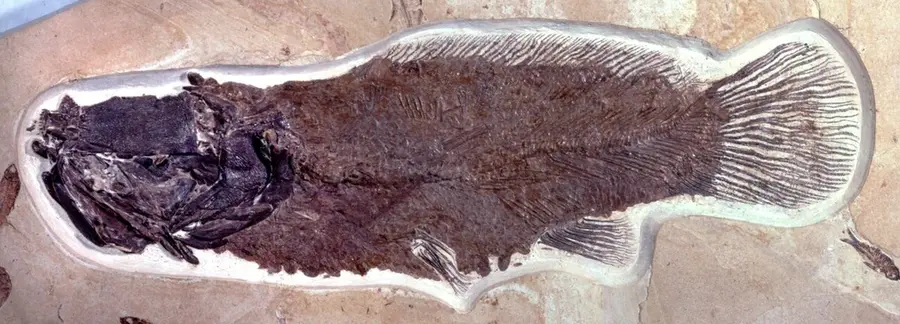
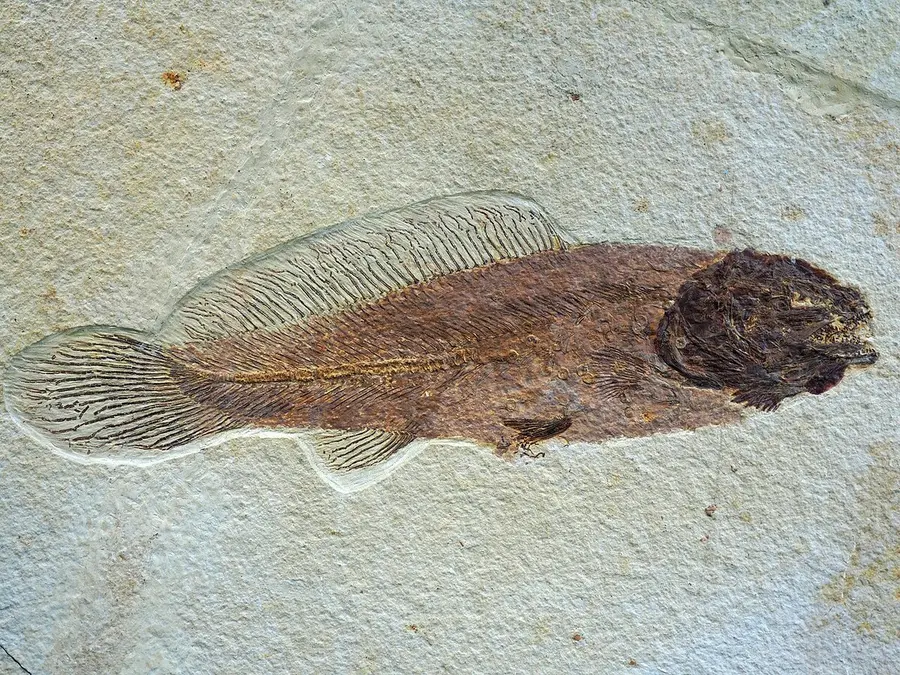
Warfield (Fossil Lake) per filename
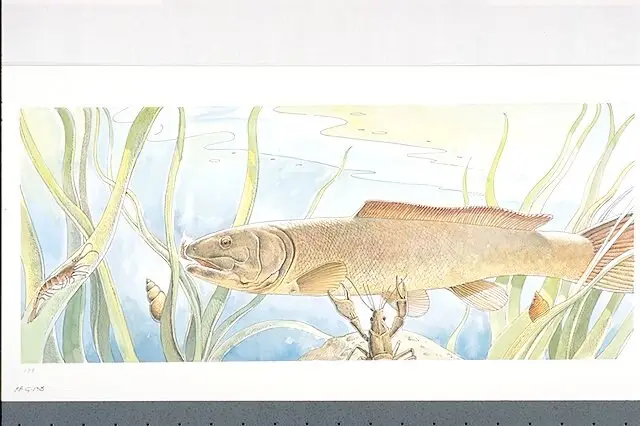
Amia feeding on shrimp (Bechleja), with snails and crayfish; species of Amia not specified; NPGallery: "Government owns art and all reproduction rights"; 01/01/1990 - 12/30/1990; Image_Size=21-1/2" x 10-1/2"; Count:14/19; Exhibit 15/Graphic # FB-G-138(15)
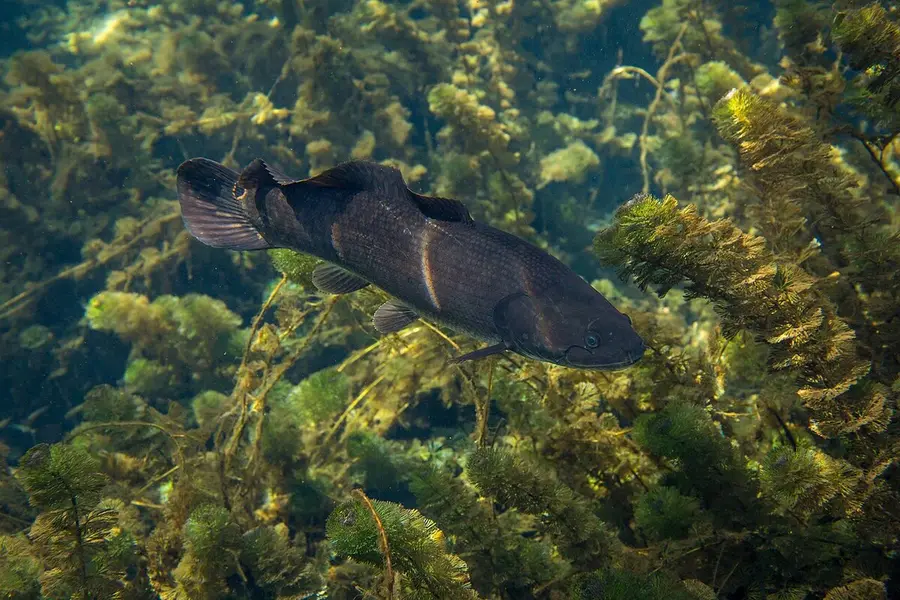
modern analog: Amia calva (Bowfin); catalog modern_analog: "Amia calva (bowfin)"

PhyloPic silhouette; depicts Amia calva (stand-in for Amia pattersoni)
3D models
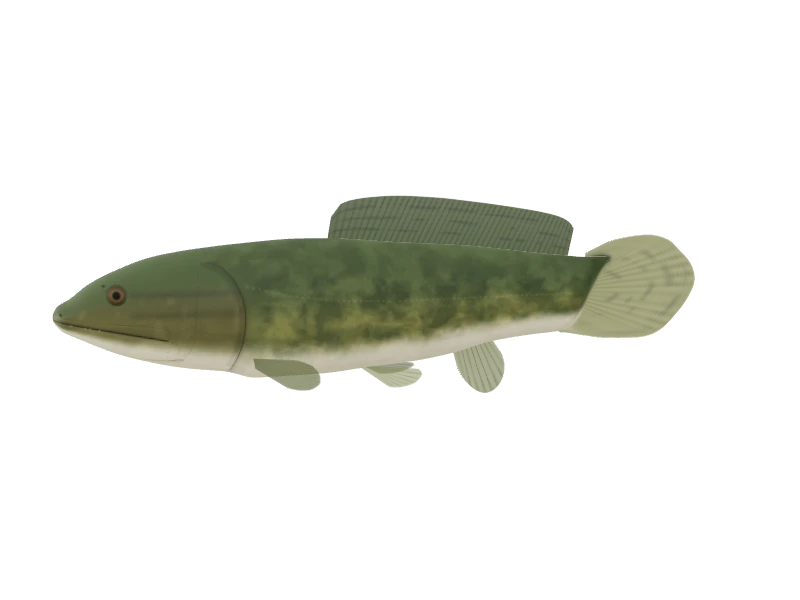
Built from a cited anatomical dossier (Grande 1984, Grande & Bemis 1998 as quoted in other sources, and four photographed fossils) and chosen unanimously by blind review over a competing model. Shown at 60 cm standard length. The long-based dorsal fin running from about 0.48 SL almost to the tail, the long head with long jaws, pointed teeth and a narrow gular plate, and the rounded tail with its oblique, abbreviated heterocercal base are documented from fossils. Body depth is a judgement, because the fossils are flattened. The fish Grande described in 1984 as "Amia uintaensis" is treated here as Amia pattersoni, an identification the dossier rates as fairly but not fully certain. No colour is preserved, so the dark olive back, low-contrast marbled flanks, cream belly and broken fin bars are inferred from the living bowfin; the male's tail eyespot is left off as speculative.
same genus/family: Bowfin Amia calva
same genus/family: Bowfin Amia calva
- Description
- Large bowfin (Amiidae) with long jaw and pointed teeth
- Group
- Fish
- Size
- Fossil Lake Amia reach ~1.25 m (G84); NPS figured specimen 74.3 cm
- Habitat
- nearshore and open water
- Diet
- apex piscivore; Knightia found in Amia stomachs
- Abundance
- extremely rare
- Modern relative
- Amia calva (bowfin)
- Notes
- Grande 1984 reported Fossil Lake bowfins as Amia uintaensis and A. fragosa; how those map onto A. pattersoni / Cyclurus gurleyi is unverified.
Sources
- National Park Service, Fossil Butte National Monument 2025. Fossil Fish Species. nps.gov/fobu, last updated November 18, 2025; accessed 2026-10-05. ↗
- Grande, L. 1984. Paleontology of the Green River Formation, with a review of the fish fauna (2nd ed.). Geological Survey of Wyoming Bulletin 63, 333 p. ↗
- The Paleobiology Database. paleobiodb.org, data service v1.2; occurrences and taxonomic opinions pulled 2026-10-05. ↗