Ailanthus confucii
Also published as: Ailanthus lesquereuxi; Ailanthus longepetiolata Lesquereux 1883 (in part: the fruit, USNM P1587); Ailanthus americana Cockerell 1908
This entry was compiled from research notes and has not yet been reviewed by a person. Its facts come from the sources listed below, which are the authority if anything here disagrees with them.
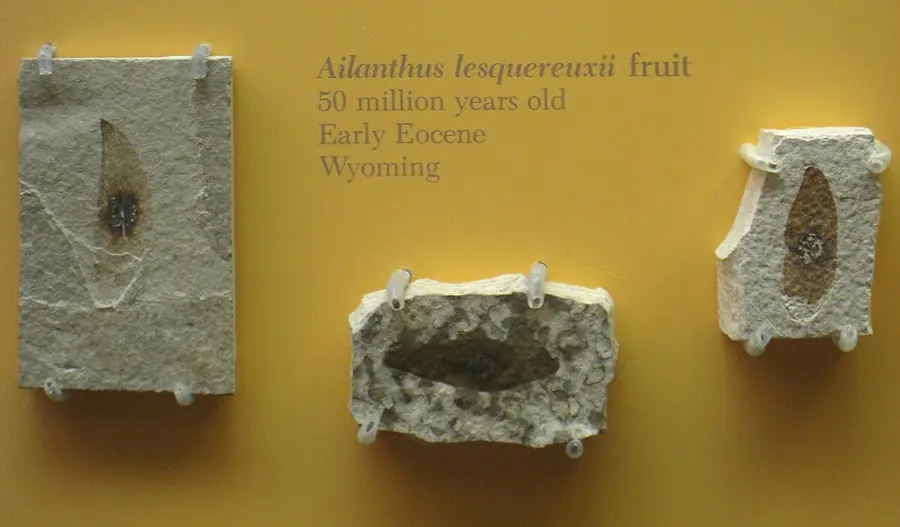
as A. lesquereuxii; locality not stated
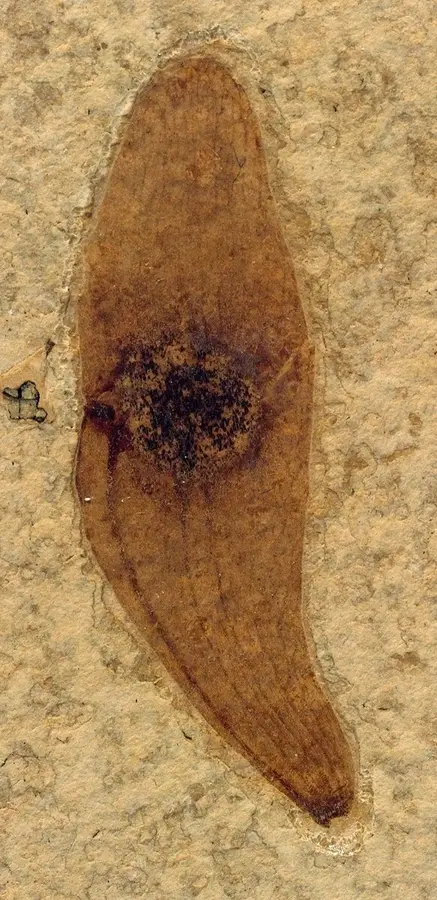
FOBU6708; alt text: a banana-shaped fossil seed with a dark circle in the center
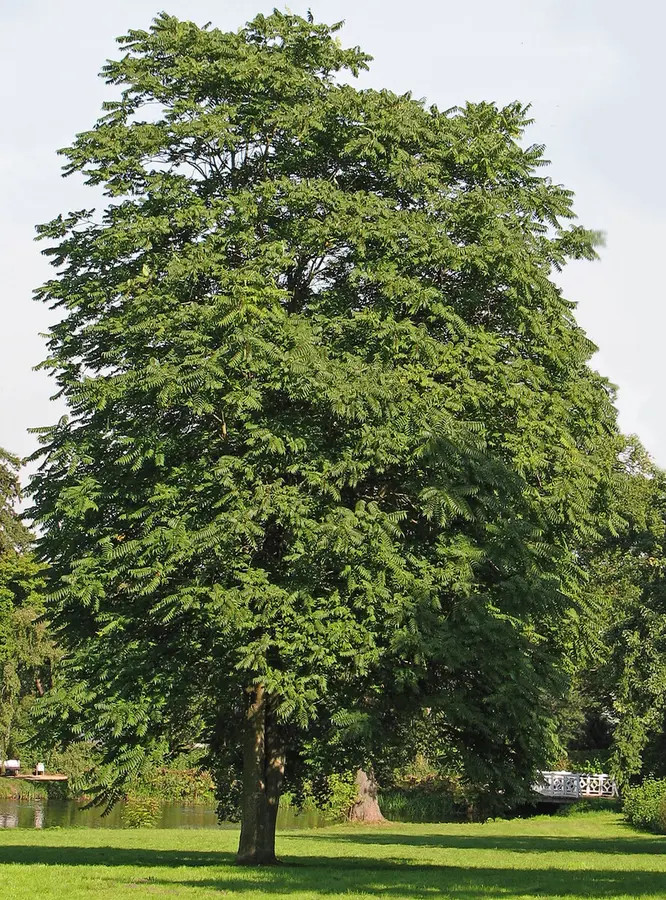
modern analog: Ailanthus altissima; catalog modern_analog: "Ailanthus altissima (tree of heaven)"
3D models
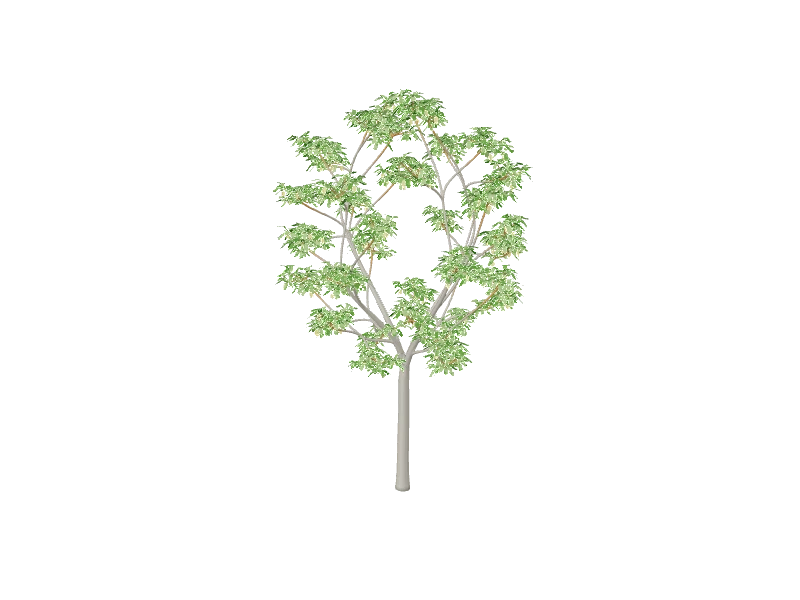
Built from a cited dossier (Fossil Lake winged fruits, including FOBU 6708 and the specimen figured by Grande 1984, fig. V.13, and the living tree of heaven Ailanthus altissima) and chosen by blind review over a competing model (90.9 vs 87.5). Shown as one fruiting tree 15 m tall in late-summer leaf. The winged fruit is documented from Fossil Lake fossils, where it is the commonest plant fossil: a narrow samara about 3.4 cm long with one rounded seed in the middle, a strong vein along one edge leading to a small scar beside the seed, and fine veins running from the seed to both ends. No leaf, twig, wood or flower of Ailanthus has been found in the Green River Formation, so the whole tree (its height, crown of long once-divided leaves, smooth grey bark and hanging fruit clusters) is reconstructed from the living tree of heaven, whose fruit is the closest match, and its colours are inferred.
- Group
- Eudicots
- Form
- tree-of-heaven (winged samaras with central seed)
- Known from
- fruit (samara)
- Habitat
- open, disturbed ground near the lake (inferred: the living A. altissima is a shade- and flood-intolerant pioneer, Miller 1990 pp. 101-102); fruits 'almost exclusively in lake and pond deposits'
- Abundance
- very common at F-1
- Modern relative
- Ailanthus altissima (tree of heaven)
- Occurrence
- Fossil Lake: F-1 ('very common'), FOBU6708, upper-unit blue oil shale, research quarry; Lake Uinta (as A. lesquereuxi); Europe and Asia
- Notes
- Corbett & Manchester (2004) synonymized most fossil Ailanthus fruits under A. confucii; former names per Brown 1934 p. 59 and Wu et al. 2022 Table S1. NPS calls the FBM specimens the oldest known Simaroubaceae in North America, possibly the world, but that is outdated: Ailanthus-type wood (Ailanthoxylon indicum) from the latest Cretaceous to earliest Paleocene of India is older (Wu et al. 2022, citing Wheeler et al. 2017). The Fossil Lake fruits share the place of oldest known Ailanthus fruits with those of Fushun, China (Wu et al. 2022). Authority: Unger 1850 (Manchester & Lott 2024 p. 50); validly published by Unger in 1866 (Hably 2001 p. 208).
Sources
- Grande, L. 1984. Paleontology of the Green River Formation, with a review of the fish fauna (2nd ed.). Geological Survey of Wyoming Bulletin 63, 333 p., p.262; fig. V.13 p.267 ↗
- National Park Service, Fossil Butte National Monument 2025. Fossil Plant Species. nps.gov/fobu, last updated September 26, 2025; accessed 2026-10-05. ↗
- Loewen, M.A. & Buchheim, H.P. 1998. Paleontology and paleoecology of the culminating phase of Eocene Fossil Lake, Fossil Butte National Monument, Wyoming. Same volume (Santucci, V.L., & McClelland, L. (eds.), National Park Service Paleontological Research [v. 3], Technical Report NPS/NRGRD/GRDTR-98/01), p. 73–80. ↗
- Graham, J.P. 2012. Fossil Butte National Monument: geologic resources inventory report. Natural Resource Report NPS/NRSS/GRD/NRR—2012/587. National Park Service, Fort Collins, CO., Table 1 ↗
- Grande, L. 1984. Paleontology of the Green River Formation, with a review of the fish fauna (2nd ed.). Geological Survey of Wyoming Bulletin 63, 333 p., Table V.1 ↗
- Corbett, S.L. & Manchester, S.R. 2004. Phytogeography and fossil history of Ailanthus (Simaroubaceae). Int. J. Plant Sci. 165:671–690. ↗
- National Park Service, Fossil Butte National Monument 2023. Fossil Butte Research Quarry Data: Data 1998–2020, Missing 2018. nps.gov/fobu, specimen and abundance CSV files, page last updated October 26, 2023; accessed 2026-10-05. ↗
- Brown, R.W. 1934. The recognizable species of the Green River flora. USGS Professional Paper 185-C, pp. 45–77., p.59 ↗
- Wu, X., Maslova, N.P., Kodrul, T.M., Wu, Y. & Jin, J. 2022. Fossil samaras of Ailanthus from South China and their phytogeographic implications. iScience 25:104757. ↗
- Manchester, S.R. & Lott, T.A. 2024. Fossil leaves, fruits and seeds of the Late Eocene Teater Road flora near Post, Oregon, USA. PaleoBios 41(2):1–71., p.50 ↗
- Hably, L. 2001. Fruits and leaves of Ailanthus Desf. from the Tertiary of Hungary. Acta Palaeobotanica 41(2):207–219., p.208 ↗
- Miller, J.H. 1990. Ailanthus altissima (Mill.) Swingle. Pp. 101–104 in Burns, R.M. & Honkala, B.H. (tech. coords.), Silvics of North America, vol. 2, Hardwoods. USDA Agriculture Handbook 654., pp.101-102 ↗